On eBird ↗
Black-capped Hemispingus
Live sightings near you, the range map, bar charts of when it is seen, and Macaulay Library photos and recordings.
Black-capped Hemispingus
Kleinothraupis atropileus
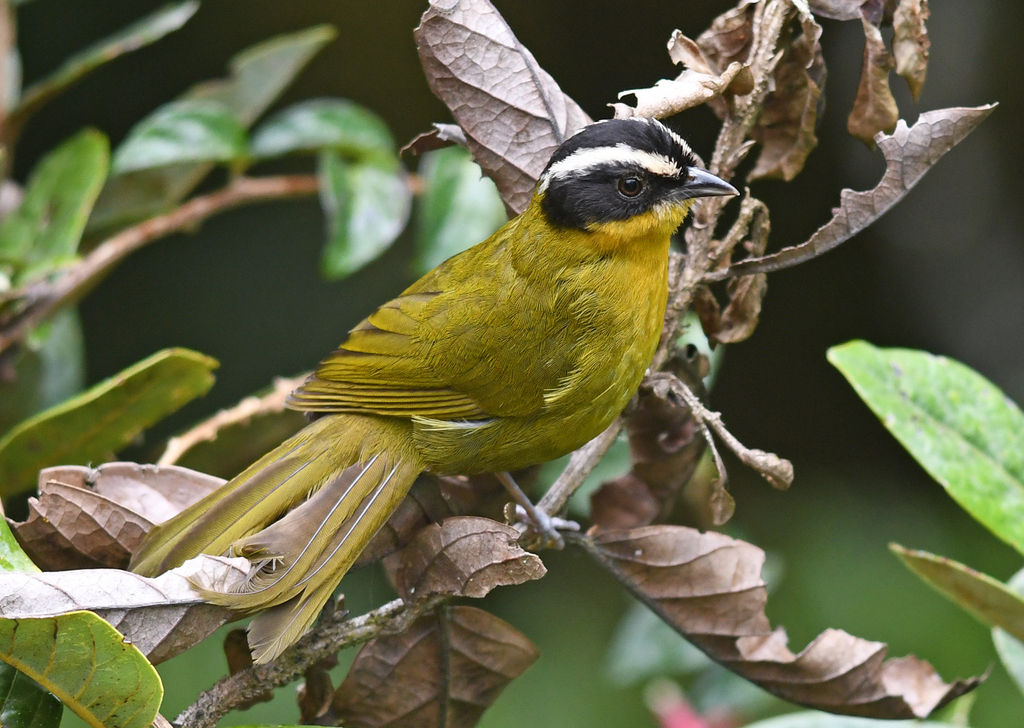
The black-capped hemispingus (Kleinothraupis atropileus) is a species of bird in the family Thraupidae. It is found in the Andes mountains of Colombia, Ecuador, Venezuela and Peru. Its natural habitat is subtropical or tropical moist montane forests.
From the article Black-capped hemispingus on Wikipedia (CC BY-SA), quoted section by section
Description
The black-capped hemispingus is, on average, 15–16 cm (5.9–6.3 in) long and weighs 18–26 g (0.6–0.9 oz). It has olive-brown upperparts, and largely olive to olive-yellow underparts. The throat is ochreous-yellow, grading to a yellow-olive towards the underparts. The sides and top of the head are pure black, with a buff-and-white supercilium that stretches to the back of the neck. Although the black-capped hemispingus is confusable with the closely-related orange-browed hemispingus, these two species do not co-occur anywhere in their ranges. Additionally, they differ in the color of their supercilia (white in the black-capped and orange in the orange-browed) and the extent of their ear-coverts, which are broader in the black-capped hemispingus.
Range & habitat
The black-capped hemispingus is an Andean inhabitant that is found from southern Venezuela south through Colombia and Ecuador to Cuzco in Peru. It inhabits moist montane and dwarf forests with large amounts of Chusquea bamboo at elevations of 1,800–3,600 m (5,900–11,800 ft).
Wikipedia: “Distribution and habitat”
Listen
Looking for field recordings…
Where it lives
Recorded sightings
—
geo-referenced records in GBIF, from museums, herbaria and field observers.
Drag the globe to turn it. Dots are where records exist, not a range map; darker means more records.
In the stacks
Searching the stacks…
Every page naming Kleinothraupis atropileus in the Biodiversity Heritage Library →
This page is assembled live from iNaturalist, GBIF, Wikipedia, the Source Library and the Internet Archive. It is not yet part of the hand-edited codex. iNaturalist taxon 558551.