On eBird ↗
Forest Canary
Live sightings near you, the range map, bar charts of when it is seen, and Macaulay Library photos and recordings.
Forest Canary
Crithagra scotops
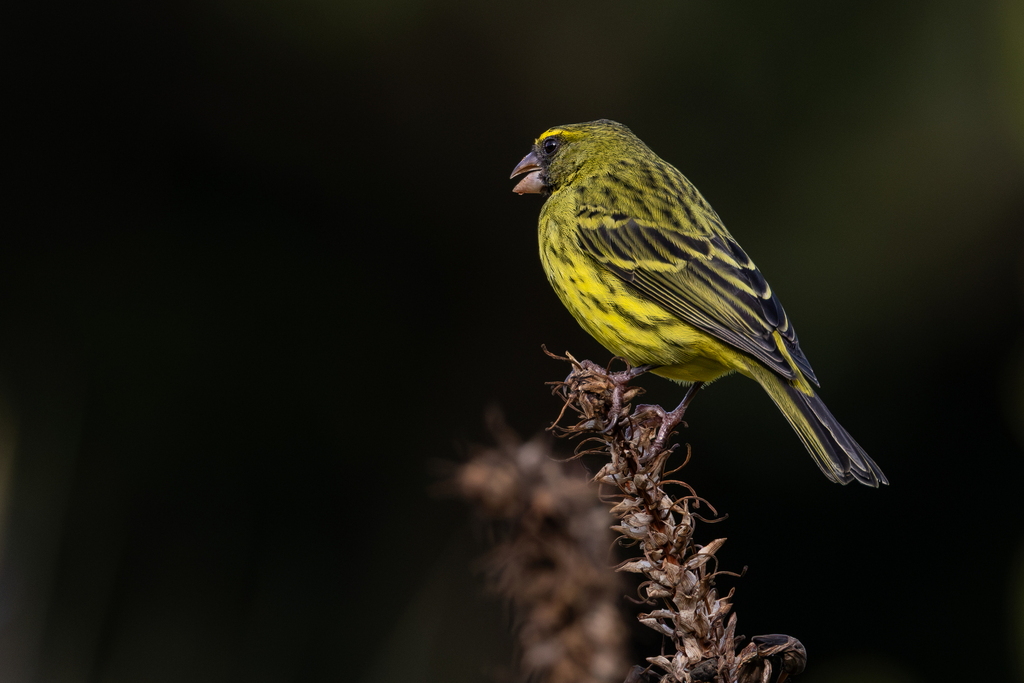
The forest canary (Crithagra scotops) is a species of finch in the family Fringillidae. It is found in South Africa and Swaziland. Its natural habitats are subtropical or tropical moist lowland forest and subtropical or tropical moist montane forest.
From the article Forest canary on Wikipedia (CC BY-SA), quoted section by section
Description
The forest canary is a small bird with a short, thick beak, measuring 11–13 cm in length and weighing 10-14 g. The male and female are identifiable by their differences in color. The feathers on the back and wings of the male are yellow with a slight green tint, while the female has a greenish-gray color with yellow on its underparts. Both the male and female have a black mask that trails from the forehead to the eyes, as well as being marked with multiple black streaks on their upper parts. The juvenile forest canary is similar in appearance to the female, with a dull olive hue.
Wikipedia: “Appearance”
What it does
The forest canary's main diet consists of seeds, fruits, and figs. Seeds like Panicum (Guinea grasses), Alyssum, and Passerina corymbosa (gonna) are commonly found in their diet. Forest canaries enjoy Penaea cneorum and Penaeaceae flowers. These birds enjoy Senecio (creeping groundsel) and Ptaeroxylon obliquum (Sneezewood) leaves. In addition to these, the forest canary will also eat insects. However, insects are usually consumed during the breeding season as a source of more protein. When searching for food, they will forage in small groups or pairs. They tend to forage in low areas, such as the ground or near bushes and flowers. When eating, they will usually take cover to stay hidden.
Wikipedia: “Diet and foraging”
Listen
Looking for field recordings…
Where it lives
Recorded sightings
—
geo-referenced records in GBIF, from museums, herbaria and field observers.
Drag the globe to turn it. Dots are where records exist, not a range map; darker means more records.
In the stacks
Searching the stacks…
Every page naming Crithagra scotops in the Biodiversity Heritage Library →
This page is assembled live from iNaturalist, GBIF, Wikipedia, the Source Library and the Internet Archive. It is not yet part of the hand-edited codex. iNaturalist taxon 558607.