On eBird ↗
Brimstone Canary
Live sightings near you, the range map, bar charts of when it is seen, and Macaulay Library photos and recordings.
Brimstone Canary
Crithagra sulphurata
The brimstone canary or bully canary (Crithagra sulphurata) is a small passerine bird in the finch family. It is a resident breeder in central and southern Africa.
This species is found in open, lightly wooded habitats, such as hillsides with trees or scrub and forest edges. In South Africa it occurs mainly in coastal areas, inhabiting coastal bush, shrubs along streams, gardens, and areas with rank vegetation. It is not truly migratory, but undertakes some seasonal movements.
From the article Brimstone canary on Wikipedia (CC BY-SA), quoted section by section
Description
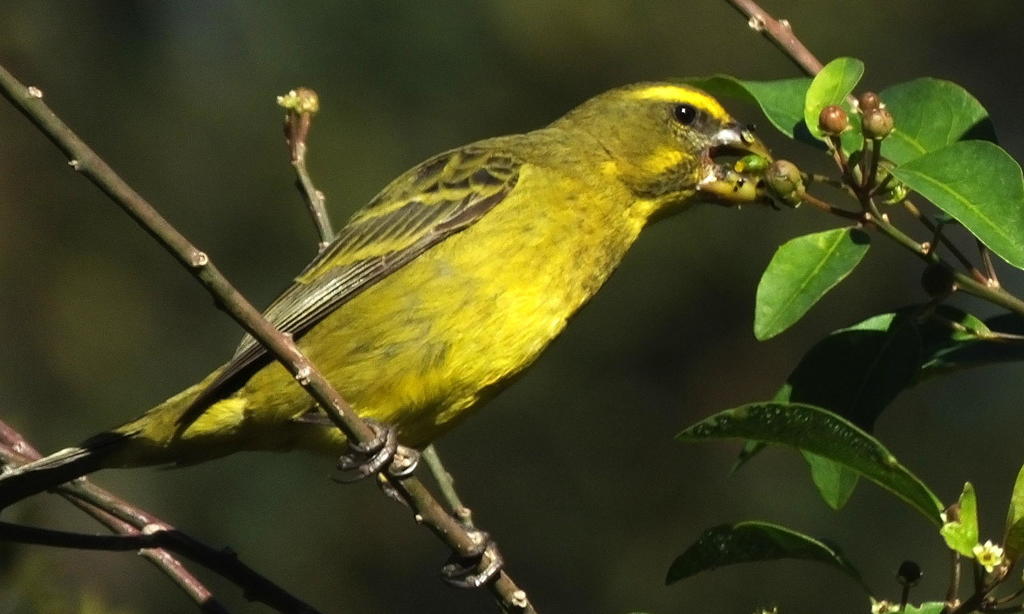
The brimstone canary is 15–16 cm in length with a heavy bill, which is short, conical and very stout at the base. The bill is light brown with a pinkish or yellowish base. The legs and feet are pinkish-brown. It has yellow-green upper parts with dark green streaking, yellow-green ear coverts and malar stripe, and two yellow wing bars. The underparts are yellow, with a greenish wash on the flanks, and breast. The sexes are similar, but the male is brighter, with a bigger bill, better defined face pattern, brighter yellow wing bars and a greenish rump. Young birds are duller, greyer and less yellow below than the adults. The degree to which this bird is green or yellow varies considerably across regions. Southern birds are greener than northern birds, even within subspecies, notably with C. s. sharpii. For an overview of finch phylogeny (including canaries) see the entry on finches. The brimstone canary can be confused with the yellow-fronted canary, but that species is smaller billed with a much more defined head pattern and a bright yellow rump. The yellow canary, with overlapping range, is also a known confusion species. The call notes of the brimstone canary in the south of its range are a trilled, deeply pitched swirriwirrit or chirrup. The song is a jumble of chirps, whistles, warbles and trills, with the same deep pitch as the call. …
What it does
The brimstone canary is less gregarious than other canaries. It tends to be found singly or in pairs, or occasionally in small groups, and is a common visitor to gardens. It feeds on fruit, seeds, flowers and shoots. Hard seed cases are cracked with the stout bill.
Wikipedia: “Feeding”
Listen
Looking for field recordings…
Where it lives
Recorded sightings
—
geo-referenced records in GBIF, from museums, herbaria and field observers.
Drag the globe to turn it. Dots are where records exist, not a range map; darker means more records.
In the stacks
Searching the stacks…
Every page naming Crithagra sulphurata in the Biodiversity Heritage Library →
This page is assembled live from iNaturalist, GBIF, Wikipedia, the Source Library and the Internet Archive. It is not yet part of the hand-edited codex. iNaturalist taxon 558618.