On eBird ↗
Cape Siskin
Live sightings near you, the range map, bar charts of when it is seen, and Macaulay Library photos and recordings.
Cape Siskin
Crithagra totta
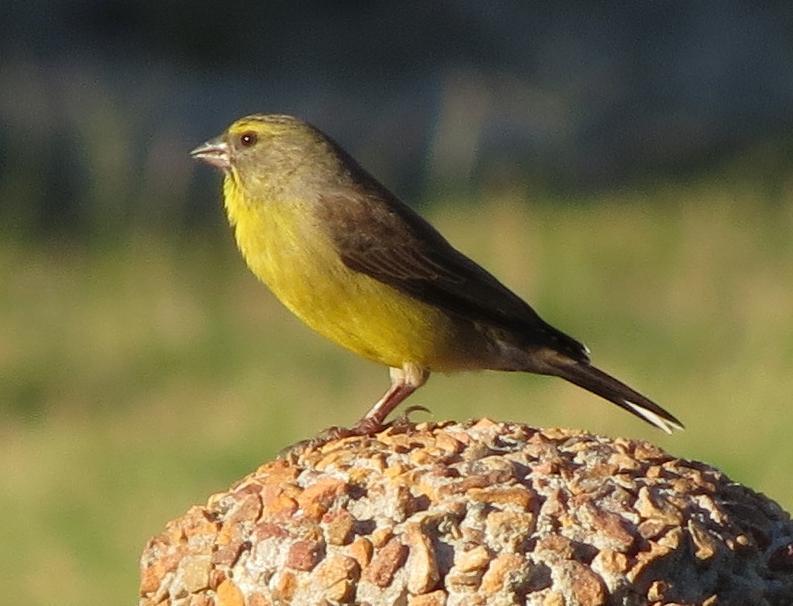
The Cape siskin (Crithagra totta) is a small passerine bird in the finch family. It is an endemic resident breeder in the southern Cape Province of South Africa.
This locally common but shy and unobtrusive siskin is found in the southwestern and southern Cape's rocky slopes, coastal cliffs and fynbos-covered mountains. It also occurs in towns and the suburbs of Cape Town.
From the article Cape siskin on Wikipedia (CC BY-SA), quoted section by section
Description
The Cape siskin averages 13 cm in length. The flight feathers and tail have white spots on the tips which are diagnostic for both sexes, and especially visible in flight. The adult male has a light brown back, wing coverts, rump and upper tail and yellow underparts. The head, nape and sides of neck are yellowish grey and olive. Fine dark brown streaks are most prominent on the head and the sides of the throat. The female is similar but duller; she lacks grey on the head and has more streaking on the face and breast. The juvenile plumage is much like the female's but duller and with darker or browner underparts. There is no range overlap with the slightly larger Drakensberg siskin, which lacks the white spots on the flight feathers and tail and has less uniform upperparts. The Cape siskin's call is a voyp-veeyr, often given in flight. and the song is a weak, pleasant warble similar to the yellow-fronted canary.
What it does
The Cape siskin is seen in pairs or small flock, moving unobtrusively through bushes and scrub as it forages for seeds, buds and insects.
Wikipedia: “Feeding”
Listen
Looking for field recordings…
Where it lives
Recorded sightings
—
geo-referenced records in GBIF, from museums, herbaria and field observers.
Drag the globe to turn it. Dots are where records exist, not a range map; darker means more records.
In the stacks
Searching the stacks…
Every page naming Crithagra totta in the Biodiversity Heritage Library →
This page is assembled live from iNaturalist, GBIF, Wikipedia, the Source Library and the Internet Archive. It is not yet part of the hand-edited codex. iNaturalist taxon 558631.