On eBird ↗
Sooty-capped Hermit
Live sightings near you, the range map, bar charts of when it is seen, and Macaulay Library photos and recordings.
Sooty-capped Hermit
Phaethornis augusti
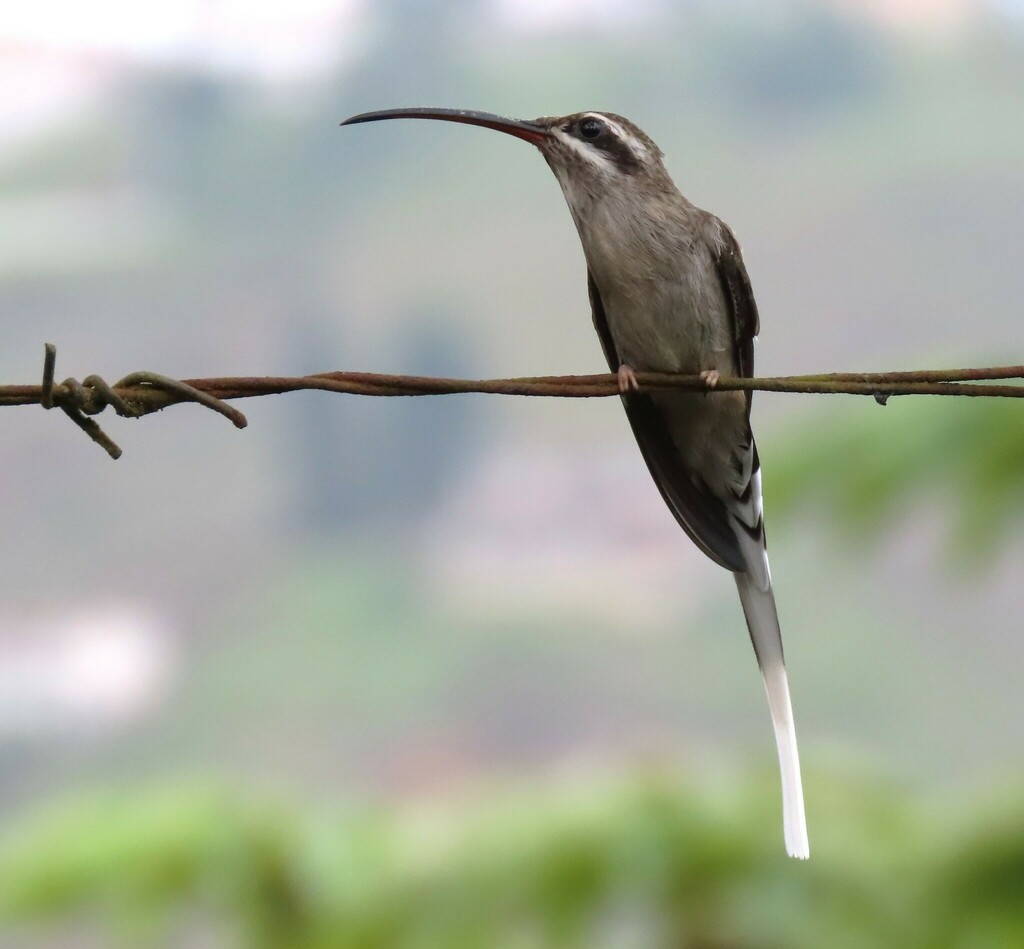
The sooty-capped hermit (Phaethornis augusti) is a hummingbird from Venezuela, Colombia, Guyana and Brazil. It builds one of the most remarkable nests which hangs by a single stout cable of spiders' silk from some overhead support. These curious nests have been found beneath bridges, in highway culverts, and hanging from the roof inside dark buildings. As far as is known, most other hermits build rather similar nests.
From the article Sooty-capped hermit on Wikipedia (CC BY-SA), quoted section by section
Description
The sooty-capped hermit is about 14 to 15 cm (5.5 to 5.9 in) long. Males weigh 4.5 to 6 g (0.16 to 0.21 oz) and females 4 to 5 g (0.14 to 0.18 oz). They are mostly grayish brown above with a rufous rump and uppertail coverts. The next-to-inner tail feathers are longer than the others and all have white tips. Their underparts are gray. The face has a black "mask" with a white supercilium and gular stripe. The subspecies differ slightly in the intensity of the breast and uppertail covert colors and the size of the gular stripe. What was once thought to be a separate species P. fumosus was determined to be a melanistic morph of the nominate sooty-capped hermit.
Range & habitat
Major taxonomic systems place the nominate subspecies of sooty-capped hermit in Venezuela's Coastal Range and eastern Andes and south on the eastern slope of Colombia's Eastern Andes; P. a. curiosus in the isolated Sierra Nevada de Santa Marta of northeastern Colombia; and P. a incanescens on the tepuis of southern Venezuela, western Guyana, and Brazil's Roraima state. The South American Classification Committee (SACC) of the American Ornithological Society places the species in those four countries and also French Guiana and Suriname.
Wikipedia: “Distribution and habitat”
What it does
The sooty-capped hermit is a "trap-line" feeder like other hermit hummingbirds, visiting a circuit of flowering plants for nectar. It also consumes small arthropods, and has been observed catching them in buildings.
Wikipedia: “Feeding”
Listen
Looking for field recordings…
Where it lives
Recorded sightings
—
geo-referenced records in GBIF, from museums, herbaria and field observers.
Drag the globe to turn it. Dots are where records exist, not a range map; darker means more records.
In the stacks
Searching the stacks…
Every page naming Phaethornis augusti in the Biodiversity Heritage Library →
This page is assembled live from iNaturalist, GBIF, Wikipedia, the Source Library and the Internet Archive. It is not yet part of the hand-edited codex. iNaturalist taxon 5594.