- Animals
- ›Chordates
- ›Vertebrates
- ›Mammals
- ›Therians
- ›Placental Mammals
- ›Primates, Rodents, and Allies
- ›Primates
- ›Monkeys, Apes, and Tarsiers
- ›Monkeys and Apes
- ›Apes and Old World Monkeys
- ›Old World Monkeys
- ›Cercopithecines
- ›Guenons, Vervet Monkeys, and Talapoins
- ›Cercopithecus
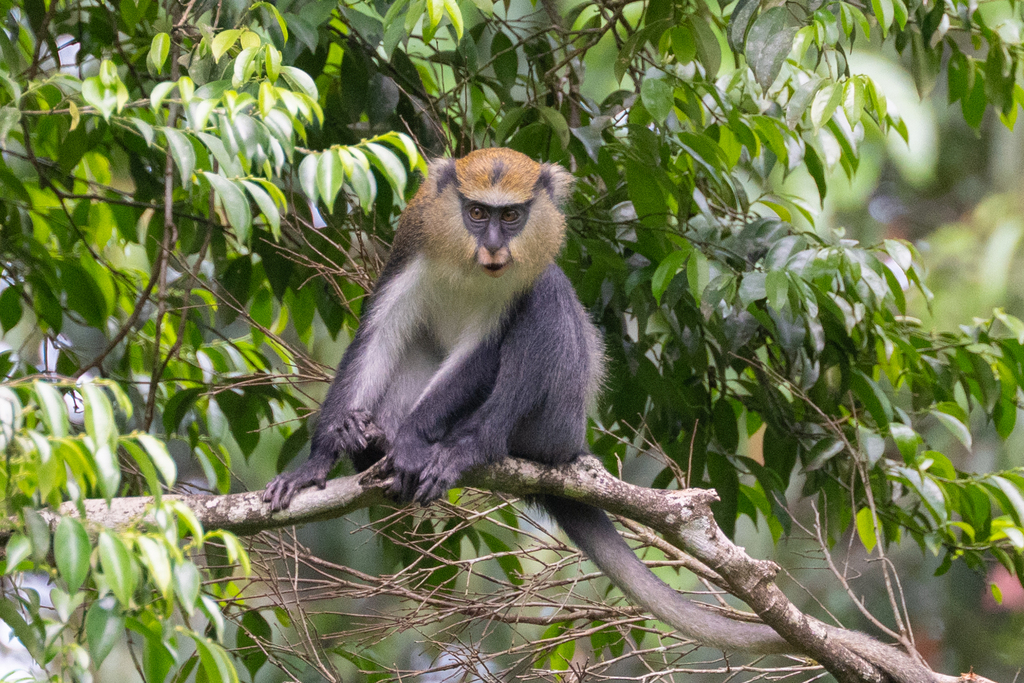
Campbell's Monkey
Cercopithecus campbelli
Campbell's mona monkey (Cercopithecus campbelli), also known as Campbell's guenon and Campbell's monkey, is a species of primate in the family Cercopithecidae found in the Ivory Coast, Gambia, Ghana, Guinea, Guinea-Bissau, Liberia, Senegal, and Sierra Leone. It was named for Henry Dundas Campbell, in 1838.
Lowe's mona monkey was previously considered a subspecies of Campbell's mona monkey. The International Union for Conservation of Nature has rated this species as being a near-threatened species because it has a wide range and is able to adapt to degraded habitats.
From the article Campbell's mona monkey on Wikipedia (CC BY-SA), quoted section by section
Range & habitat
Campbell's mona monkey is native to Senegal, Gambia, Guinea-Bissau, Guinea, Sierra Leone and Liberia as far east as the Cavally River on the border with Ivory Coast, and also the island of Caravela, off Guinea Bissau. Its habitat is lowland forest, both primary and secondary, gallery forest, mangrove swamps, agricultural land and scrubland.
Wikipedia: “Distribution and habitat”
What it does
Campbell's mona monkey is a sociable and territorial species, living in small groups of about eight individuals. Around dawn and dusk, the dominant male climbs to a perch on an emergent tree and issues a series of booms. The sound carries for at least a kilometre, and other males join in. This monkey often associates with monkeys of other species and engages in inter-species territorial calling which obey certain ritual rules. This species has one of the more advanced forms of animal communication, with a rudimentary syntax. Campbell's mona monkey is a slow, deliberate forager. The greater part of its diet is wild and cultivated fruit, but it also eats seeds, invertebrates, grubs, small amphibians and lizards.
== References ==
Wikipedia: “Ecology”
Listen
Looking for field recordings…
Where it lives
Recorded sightings
—
geo-referenced records in GBIF, from museums, herbaria and field observers.
Drag the globe to turn it. Dots are where records exist, not a range map; darker means more records.
In the stacks
Searching the stacks…
Every page naming Cercopithecus campbelli in the Biodiversity Heritage Library →
This page is assembled live from iNaturalist, GBIF, Wikipedia, the Source Library and the Internet Archive. It is not yet part of the hand-edited codex. iNaturalist taxon 566529.