- Animals
- ›Chordates
- ›Vertebrates
- ›Mammals
- ›Therians
- ›Placental Mammals
- ›Primates, Rodents, and Allies
- ›Primates
- ›Monkeys, Apes, and Tarsiers
- ›Monkeys and Apes
- ›Apes and Old World Monkeys
- ›Old World Monkeys
- ›Cercopithecines
- ›Guenons, Vervet Monkeys, and Talapoins
- ›Cercopithecus
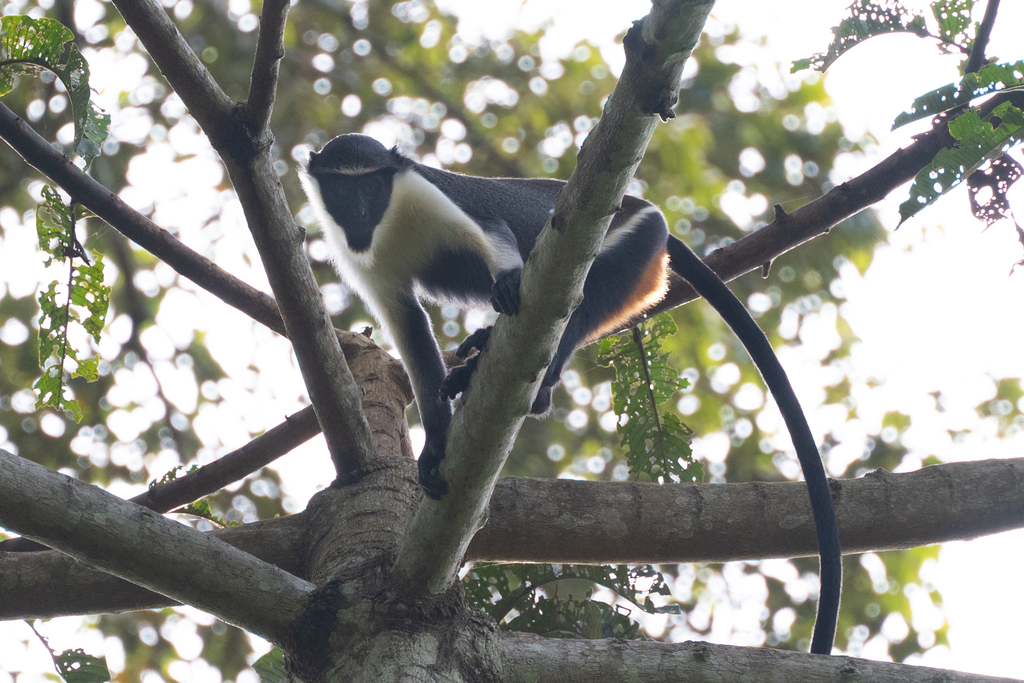
Diana Monkey
Cercopithecus diana
The Diana monkey (Cercopithecus diana) is an Old World monkey found in the high canopy forests in Sierra Leone, Liberia, and western Côte d'Ivoire Named for its white brow, which is said to resemble the bow of the Roman goddess Diana, this black-grey guenon has a white throat, crescent-shaped browband, ruff, and beard.
From the article Diana monkey on Wikipedia (CC BY-SA), quoted section by section
Description
The Diana monkey ranges from 40 to 55 cm (16 to 22 in) in length, excluding its tail, which is of a uniform 3–4 cm diameter, and 50–75 cm (20–30 in) long. Adults weigh from 4–7 kg (8.8–15.4 lb). They are generally black or dark grey, but have a white throat, crescent-shaped browband, ruff, and beard; the browband gave the species its common name, since it was held to resemble the crescent on the brow of the goddess Diana. The monkeys' underarms are also white, and they have a white stripe down their thighs, while the backs of their thighs and their lower backs are a chestnut colour. Apart from the browband, ruff, and beard, and some fringes on their limbs, their fur is rough and tough.
Range & habitat
The Diana monkey is found in primary forests and does not thrive in secondary forests. The species is regarded as endangered by the IUCN, as well as by the United States Fish and Wildlife Service, the chief dangers to them being habitat destruction (they are now virtually confined to coastal areas) and hunting for bushmeat.
Wikipedia: “Habitat”
What it does
Healthy Diana monkeys may live for up to 20 years. This species is active during the day and feeds at all levels of the canopy, rarely venturing down to the ground for fear of predation. Diana monkeys retreat to the upper levels of the trees at night, though they do not make nests, preferring to sleep on branches. They feed mainly on fruit, blossoms, and leaves, as well as occasional insects and other invertebrates. The monkeys, in turn, are preyed upon by various animals, including the crowned hawk-eagle, African leopard, common chimpanzee, and humans. The Diana monkey is a noisy presence in the forest. Its marked coloration allows a wide range of visual social signals. Females produce specific alarm calls, alert calls, and greeting/contact calls, depending on the occasion; in moments of predatory threat, they use distinct calls based on the specific predator around, with some research suggesting that the vocabulary of the females' vocalisations is larger and more variable than that of the males. Other forest residents, such as the yellow-casqued hornbill (in addition to other birds) and other primates, are able to discriminate between these and use them to take appropriate action, should a mutual threat be present in the immediate area. …
Wikipedia: “Biology and behavior”
Listen
Looking for field recordings…
Where it lives
Recorded sightings
—
geo-referenced records in GBIF, from museums, herbaria and field observers.
Drag the globe to turn it. Dots are where records exist, not a range map; darker means more records.
In the old herbals & bestiaries

In the stacks
Searching the stacks…
Every page naming Cercopithecus diana in the Biodiversity Heritage Library →
This page is assembled live from iNaturalist, GBIF, Wikipedia, the Source Library and the Internet Archive. It is not yet part of the hand-edited codex. iNaturalist taxon 566530.