- Animals
- ›Chordates
- ›Vertebrates
- ›Mammals
- ›Therians
- ›Placental Mammals
- ›Primates, Rodents, and Allies
- ›Primates
- ›Lemurs, Lorises, and Allies
- ›Lemurs
- ›Lemurs
- ›Sportive Lemurs
- ›Lepilemur
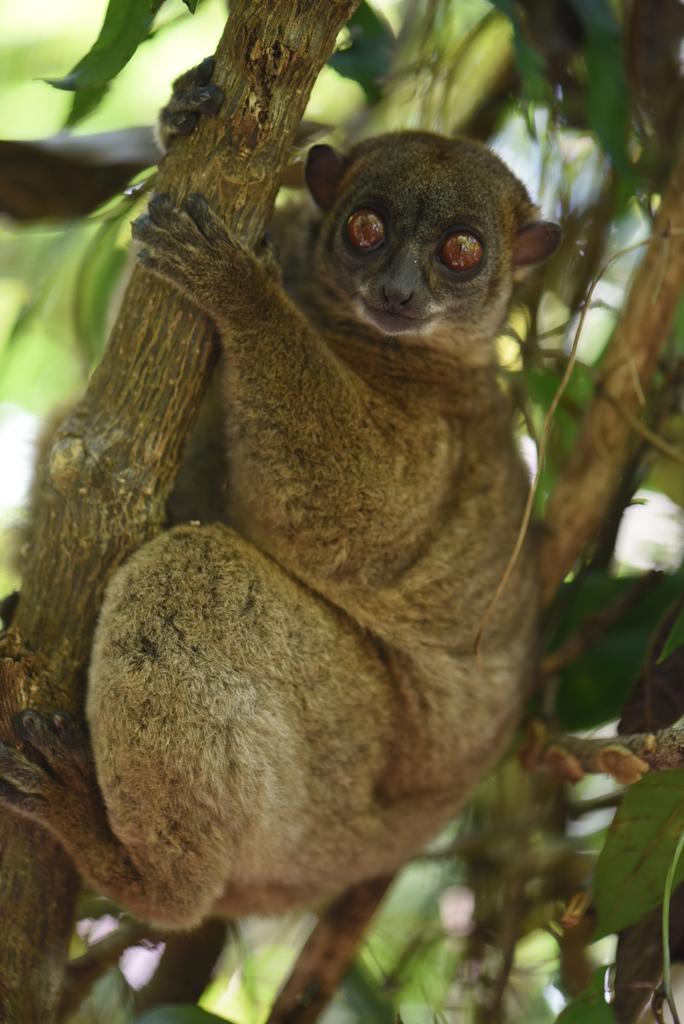
Nosy Be Sportive Lemur
Lepilemur tymerlachsoni
Hawks' sportive lemur (Lepilemur tymerlachsoni), also known as the Nosy Be sportive lemur or Nosy Be weasel lemur, is a sportive lemur endemic to Madagascar. Like all members of its genus, it is solitary, nocturnal and largely folivorous. It is threatened by habitat loss and unsustainable hunting.
From the article Hawks' sportive lemur on Wikipedia (CC BY-SA), quoted section by section
Description
Hawks' sportive lemur is light brownish-gray with the upper half of the back a lighter reddish-brown. The underside is a light grayish-white. The outer side of the thighs and edges of the extremities also have a light reddish-brown color. A dark brown to black stripe is present from the head to the lower half of the back. The face is gray. The tail is a uniform light reddish-gray to brown. It is a moderately large sportive lemur, with a total length of about 50 to 68 cm (20 to 27 in), of which 22 to 27 cm (8.7 to 10.6 in) is the tail.
Range & habitat
Hawks' sportive lemur is endemic to Nosy Be island, Madagascar, where it is only known from Lokobe National Park and adjacent degraded forest. It is estimated to occupy an area of less than 72 km2 and occurs from 12-35 metres above sea level. Within Lokobe National Park, it has been recorded to achieve an average density of 63.2 individuals/km2. The main forest type within its range is lowland rain forest, although the region experiences a distinct dry season. Selection of daytime sleeping spots change according to habitat type, with individuals favoring tree holes in dense primary forest and dense vegetation tangles in more open deciduous forest.
Wikipedia: “Distribution and habitat”
Listen
Looking for field recordings…
Where it lives
Recorded sightings
—
geo-referenced records in GBIF, from museums, herbaria and field observers.
Drag the globe to turn it. Dots are where records exist, not a range map; darker means more records.
In the stacks
Searching the stacks…
Every page naming Lepilemur tymerlachsoni in the Biodiversity Heritage Library →
This page is assembled live from iNaturalist, GBIF, Wikipedia, the Source Library and the Internet Archive. It is not yet part of the hand-edited codex. iNaturalist taxon 566534.