- Animals
- ›Chordates
- ›Vertebrates
- ›Birds
- ›Hawks, Eagles, Kites, and Allies
- ›Hawks, Eagles, and Kites
- ›Typical Eagles and Hawk-Eagles
- ›Hieraaetus
Haast's Eagle
Hieraaetus moorei
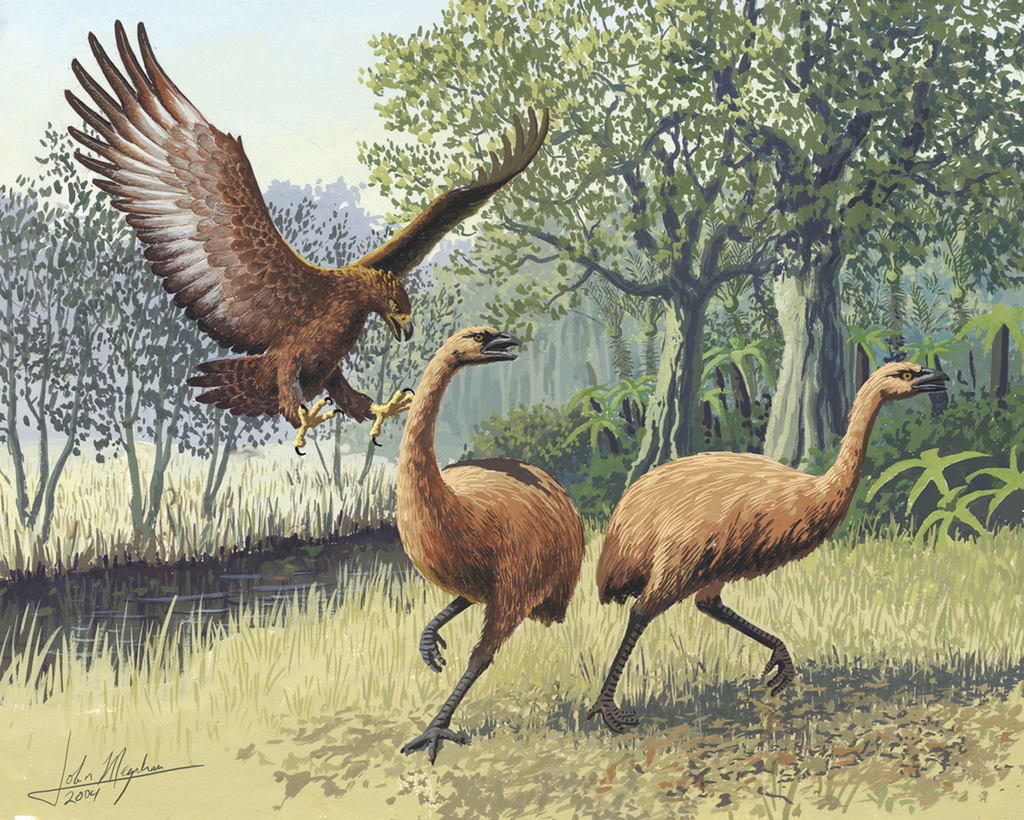
Haast's eagle (Hieraaetus moorei), sometimes known as Fuller's eagle, is an extinct species of eagle that lived in the South Island of New Zealand, commonly accepted to be the pouākai of Māori mythology. It is the largest eagle known to have existed, with an estimated weight of 10–18 kilograms (22–40 pounds), compared to the next-largest and extant harpy eagle (Harpia harpyja) and Steller's sea eagle (Haliaeetus pelagicus) at up to 9 kg (20 lb). Its massive size is explained as an evolutionary response to the size of its primary prey—the flightless moa—the largest of which could weigh 200 kg (440 lb). Haast's eagle became extinct around 1445, following the arrival of the Māori, who hunted moa to extinction, introduced the Polynesian rat (Rattus exulans), and destroyed large tracts of forest by fire.
From the article Haast's eagle on Wikipedia (CC BY-SA), quoted section by section
Description
Haast's eagle was one of the largest known true raptors. In length and weight, it was even larger than the largest living vulture (the Andean condor). Another giant bird (not actually an eagle save for in name) more recently and scantily described from the fossil record, Woodward's eagle, which resided in North America, rivaled Haast's eagle in at least the aspect of total length. Female eagles were larger than males. Most estimates place the female Haast's eagles in the range of 10–18 kg (22–40 lb) and males around 9–12 kg (20–26 lb). A comparison with living eagles of the Australasian region resulted in estimated masses in Haast's eagles of 11.5 kg (25 lb) for males and 14 kg (31 lb) for females. One source estimates that the largest females could have weighed more than 16.5 kg (36 lb). The largest extant eagles, none of which are verified to exceed 9 kg (20 lb) in a wild state, are about forty percent smaller in body size than Haast's eagles.
It had a relatively short wingspan for its size. It is estimated that the grown female typically spanned up to 2.6 m (8 ft 6 in), possibly up to 3 m (10 ft) in a few cases. This wingspan is broadly similar to the larger range of female size in some extant eagles: the wedge-tailed eagle (A. audax), golden eagle (A. …
What it does
Haast's eagle predominantly preyed on large, flightless bird species, including the moa. Moa would be up to fifteen times the weight of the eagle. Its large beak also could be used to rip into the internal organs of its prey, leading to death by blood loss. Due to the absence of other large predators or kleptoparasites, a Haast's eagle could easily have monopolised a single large kill over a number of days. Its prey, the moa, could weigh up to 200 kg (440 lb). A 2021 analysis showed that, while predatory, the bill of Haast's eagle was functionally closer to that of the Andean condor (Vultur gryphus) than to that of other eagles. This is also supported by historic Māori cave art which depicts Haast's eagle being pale-headed. It also suggests that it deployed feeding tactics more similar to those of vultures after making a kill, plunging its head into the body cavity to devour the vital organs of its prey. This may have been an adaptation to the bird's hunting animals much larger than itself.
Wikipedia: “Behaviour and ecology”
In human culture
Haast named the eagle Harpagornis moorei after George Henry Moore, the owner of the Glenmark Estate, where the bones of the bird were found. The genus name was from the Greek harpax, meaning "grappling hook", and ornis, meaning "bird". In an article in 2025, the biologist Richard Holdaway said he had coined the now-conventional common name Haast's eagle in the early 1990s but on later reflection proposes a more suitable name be Fuller's eagle, after its actual discoverer.
Wikipedia: “Etymology”
Listen
Looking for field recordings…
Where it lives
Recorded sightings
—
geo-referenced records in GBIF, from museums, herbaria and field observers.
Drag the globe to turn it. Dots are where records exist, not a range map; darker means more records.
In the stacks
Searching the stacks…
Every page naming Hieraaetus moorei in the Biodiversity Heritage Library →
This page is assembled live from iNaturalist, GBIF, Wikipedia, the Source Library and the Internet Archive. It is not yet part of the hand-edited codex. iNaturalist taxon 567086.