On eBird ↗
Nazca Booby
Live sightings near you, the range map, bar charts of when it is seen, and Macaulay Library photos and recordings.
Nazca Booby
Sula granti
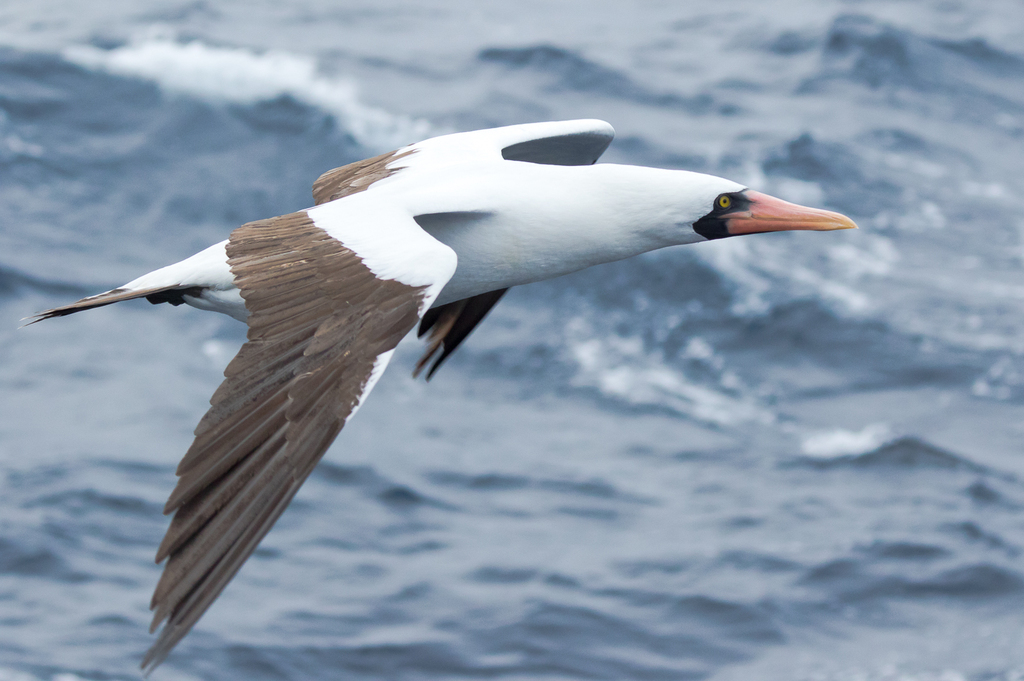
The Nazca booby (Sula granti) is a large seabird of the booby family, Sulidae, native to the eastern Pacific. First described by Walter Rothschild in 1902, it was long considered a subspecies of the masked booby until recognised as distinct genetically and behaviorally in 2002. It has a typical sulid body shape, with a long pointed orange-yellow bill, long neck, aerodynamic body, long slender wings and pointed tail. The adult is bright white with black and white wings, a black tail and a dark face mask.
From the article Nazca booby on Wikipedia (CC BY-SA), quoted section by section
Description
The species has a yellow iris, orange and pinkish beak, black facial skin in the form of a mask, and grey feet. Adults present white plumage with black tips of the wings and tail. The female is bigger and heavier than the male, has a slightly differently colored beak, and squawks while the male whistles. Chicks are snow white and fluffy, plumage changing to grey along with beak and feet upon fledging.
Range & habitat
The species occurs in the eastern Pacific from the islands in Baja California to the Galápagos Islands and the Isla de la Plata in Ecuador and Malpelo in Colombia. Individuals have been recorded as vagrants in the western Pacific, including near Waigeo in Indonesia, and off north-western Australia.
Wikipedia: “Distribution and habitat”
What it does
The Nazca booby preys on small fish caught by diving at high speed from flight into the ocean. The main food species is South American pilchard, but also take flying fish, anchovies and squid, especially during the El Niño events, when sardine numbers are low. Because of their sexual dimorphism, females tend to feed on bigger prey and dive deeper.
Wikipedia: “Feeding”
Listen
Looking for field recordings…
Where it lives
Recorded sightings
—
geo-referenced records in GBIF, from museums, herbaria and field observers.
Drag the globe to turn it. Dots are where records exist, not a range map; darker means more records.
In the stacks
Searching the stacks…
Every page naming Sula granti in the Biodiversity Heritage Library →
This page is assembled live from iNaturalist, GBIF, Wikipedia, the Source Library and the Internet Archive. It is not yet part of the hand-edited codex. iNaturalist taxon 56768.