- Animals
- ›Chordates
- ›Vertebrates
- ›Mammals
- ›Therians
- ›Placental Mammals
- ›Ungulates, Carnivorans, and Allies
- ›Carnivorans
- ›Felids
- ›Big Cats
- ›Panthera
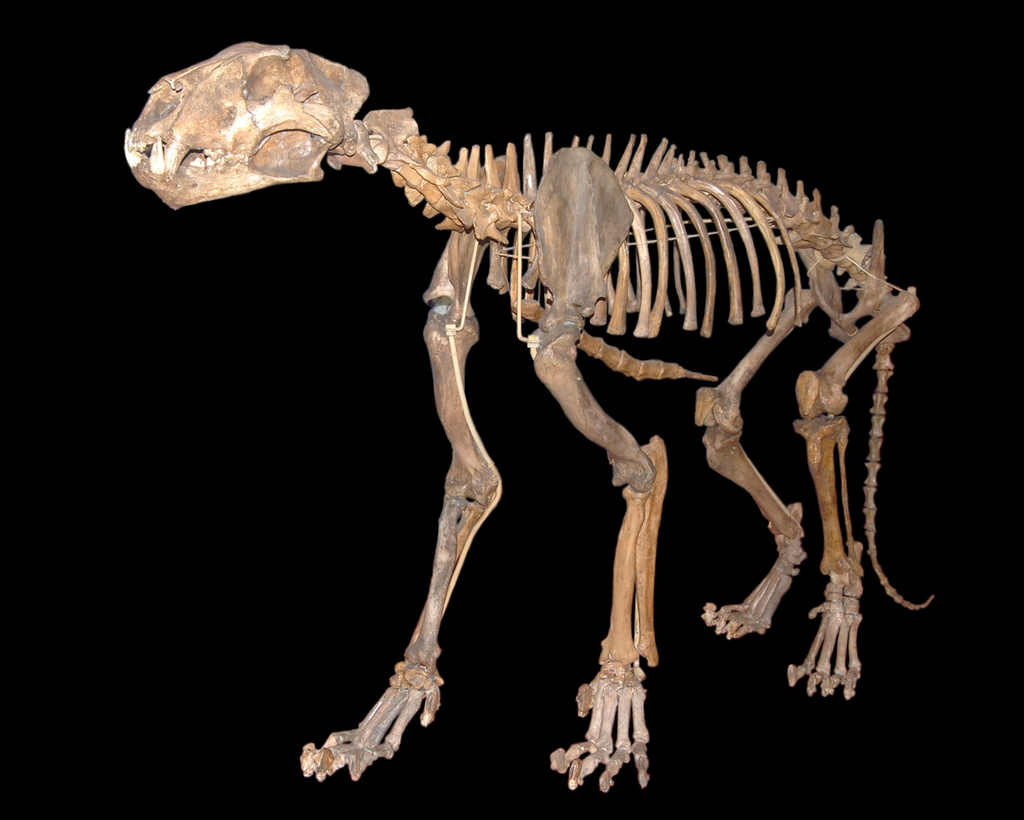
Steppe Lion
Panthera spelaea
Panthera spelaea, commonly known as the cave lion or in some scientific literature, the steppe lion, is an extinct species of Panthera that inhabited Eurasia and northwestern North America during the Pleistocene. Ancient DNA analyses indicate that, although closely related to the modern lion (Panthera leo), it was a genetically distinct species. Estimates place the divergence between the two lineages at approximately 500,000 to 1 million years ago.
The earliest fossils of the P. spelaea lineage (either regarded as the separate species Panthera fossilis or the subspecies P. spelaea fossilis) in Eurasia date to around 700,000 years ago (with possible late Early Pleistocene records). It is closely related and probably ancestral to the American lion (Panthera atrox). The species ranged from Western Europe to eastern Beringia in North America, and was a prominent member of the mammoth steppe fauna, and an important apex predator across its range along with other large carnivores like cave hyenas, which cave lions came into conflict with.
From the article Panthera spelaea on Wikipedia (CC BY-SA), quoted section by section
Description
Carvings and cave paintings of cave lions, which were discovered in the Lascaux and Chauvet Caves in France, dating to the Upper Paleolithic. A drawing in the Chauvet cave depicts two cave lions walking together. The one in the foreground is slightly smaller than the one in the background, which has been drawn with a scrotum and without a mane. Such cave paintings suggest that male cave lions completely lacked manes, or at most had very small manes.
Early members of the cave lion lineage assigned to Panthera (spelaea) fossilis during the Middle Pleistocene were considerably larger than individuals of P. spelaea from the Last Glacial Period and modern lions, with some of these individuals having an estimated length of 2.5–2.9 m (8.2–9.5 ft), shoulder height of 1.4–1.5 m (4.6–4.9 ft) and body mass of 400–500 kg (880–1,100 lb), respectively, making them among the largest cats to have ever lived. The Late Pleistocene Panthera spelaea spelaea was noticeably smaller though still large relative to living cats, with an estimated length of 2–2.1 m (6.6–6.9 ft) and shoulder height of 1.1–1.2 m (3.6–3.9 ft), respectively, The species showed a progressive size reduction over the course of the Last Glacial Period up until its extinction, with the last P. …
Range & habitat
During the Last Glacial Period, P. spelaea formed a contiguous population across the mammoth steppe, from Western Europe to northwest North America. It was widely distributed in the Iberian Peninsula, Italian Peninsula, Southeast Europe, Great Britain, Central Europe, the East European Plain, the Ural Mountains, most of Northeast Asia (ranging as far south as Northeast China, Japan, and possibly the Korean Peninsula), and across the Bering land bridge into Alaska, Yukon, and possibly Alberta. While the cave lion was thought to be regionally extinct in Beringia between 33kya and 22kya due to a lack of fossils, eDNA suggests that cave lions may have been present in the Yukon ca. 29,477kya. The cave lion had a wide elevation range, with finds extending up over 2,000 metres (6,600 ft) above sea level in the European Alps and in Buryatia in Northern Asia, though they probably did not occupy mountainous habitats all-year round. The cave lion probably inhabited predominantly open habitats such as steppe and grasslands although it would have also occurred in open woodlands as well. While during the Last Glacial Period it was often associated with cold environments, the species also inhabited temperate environments, such as in Europe during the Last Interglacial/Eemian.
Wikipedia: “Distribution and habitat”
What it does
P. spelaea was one of the keystone species of the mammoth steppe, being one of the main apex predators alongside the gray wolf, cave hyena and brown bear. Large amounts of bones belonging to P. spelaea were excavated in caves, where bones of cave hyena, cave bear and Paleolithic artefacts were also found. Despite their common name, "cave lions" probably only infrequently if ever used caves, and were present in regions where caves were absent. Analysis on the ecology of cave lions found that they may have been diurnal predators.
Isotopic analyses of bone collagen samples extracted from remains in Europe and East Beringia indicate that reindeer were particularly prominent in the diet of cave lions in these regions during the Last Glacial Period. Cave lions also seem to have opportunistically preyed on the cubs of cave bears, with adult cave bears also likely being targeted at least on occasion. A young woolly rhinoceros skull found near Kazan in Western Russia appears to display bite marks that may have been the result of a cave lion attack. The "Blue Babe" frozen steppe bison specimen from Alaska displays bite marks that match the dimensions of cave lions, with a lion tooth fragment having been found embedded in the hide. Based on the ratio of males to females, suggests among healthy specimens, male cave lions were expected to have hunted cave bears. …
Wikipedia: “Ecology”
In human culture
In 1774, the Zoolithenhöhle cave near the village of Burggaillenreuth in Bavaria, was brought to scientific attention by Johan Friedrich Esper, who realised that the bones of extinct animals were present in the cave. In 1810, a fossil skull from the cave was given the scientific name Felis spelaea by Georg August Goldfuss. It possibly dates to the Last Glacial Period. Several anatomical studies of P. spelaea remains conducted during the early-mid 19th century revealed a similar morphology as the tiger, jaguar and a close affinity to the modern lion. At the end of the 19th century, the earliest remains of P. spelaea from Siberia were mistaken for those of a tiger. During the 20th century and the first decade of the 21st century, P. spelaea was often regarded as a subspecies of the modern lion under the name Panthera leo spelaea. However, other authors considered the cave lion to be more closely related to the tiger, based in part on a comparison of skull shapes, with some proposing that it should be considered a subspecies of the tiger as Panthera tigris spelaea. Analysis of cave lion mitochondrial genomes published in 2004 supported the modern lion as the closest relative of P. spelaea, with this result being later confirmed by analysis of the nuclear genome. …
Wikipedia: “Research history and taxonomy”
Listen
Looking for field recordings…
Where it lives
Recorded sightings
—
geo-referenced records in GBIF, from museums, herbaria and field observers.
Drag the globe to turn it. Dots are where records exist, not a range map; darker means more records.
In the stacks
Searching the stacks…
Every page naming Panthera spelaea in the Biodiversity Heritage Library →
This page is assembled live from iNaturalist, GBIF, Wikipedia, the Source Library and the Internet Archive. It is not yet part of the hand-edited codex. iNaturalist taxon 569099.