- Animals
- ›Chordates
- ›Vertebrates
- ›Ray-finned Fishes
- ›Spiny-rayed fishes
- ›Mackerels, Tunas, Butterfishes, and Allies
- ›Scombroidei
- ›Mackerels, Tunas, and Bonitos
- ›Scombrinae
- ›Sarda
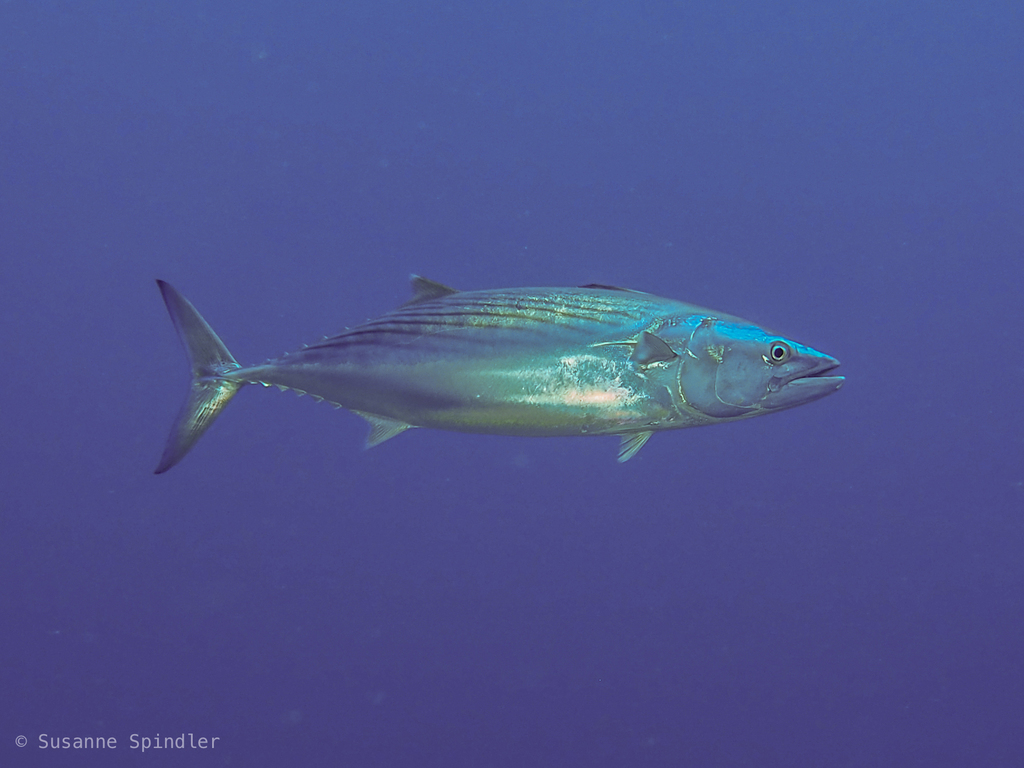
Atlantic Bonito
Sarda sarda
The Atlantic bonito (Sarda sarda) is a large mackerel-like fish of the family Scombridae. It is common in shallow waters of the Atlantic Ocean, the Mediterranean Sea, and the Black Sea, where it is an important commercial and game fish.
From the article Atlantic bonito on Wikipedia (CC BY-SA), quoted section by section
Description
Atlantic bonito belong to a group which have the dorsal fins very near, or separated by a narrow interspace. Its body is completely scaled, with those scales in the pectoral fin area and the lateral line usually larger in size. Bonitos (fishes in the genus Sarda) differ from tuna by their compressed bodies, their lack of teeth on the roof of the mouth, and certain differences in colouration. Atlantic bonito share Atlantic waters with the striped bonito, Sarda orientalis (the Atlantic population of which is sometimes considered a separate species, Sarda velox). The striped bonito has been taken on the Atlantic coast as far north as Cape Cod. It is similar in its habits, but somewhat smaller than the more common Atlantic bonito. The Atlantic bonito can be distinguished from its relative by its dark oblique stripes on the back and with a maxillary only about half as long as the head, whereas the striped bonito has striping on its topside nearly horizontal and a maxillary more than half the length of the head. Atlantic bonito grow up to 75 centimetres (30 in) and weigh 5–6 kilograms (11–13 lb) at this size. The world record, 18 pounds 4 ounces (8.3 kg), was caught in the Azores.
What it does
Atlantic bonito eat mackerel, menhaden, alewives, silversides, sand lances, and other fishes, as well as squid.
Wikipedia: “Diet”
At the table
Bonito is a popular food fish in the Mediterranean; its flesh is similar to tuna and mackerel, and its size is intermediate between the two. Bonito under 1 kg (2.2 lb) or so (called palamut ~ паламуд in Bulgarian) are often grilled as steaks. Larger bonito (torik in Turkish) are cut into steaks and preserved as lakerda. Bonito is also canned, but canned bonito del norte (Spanish) is not bonito, but albacore tuna. In Algeria and Spain, it is often prepared as escabeche, which preserves it for about a week. Bonito may also be baked and served cold.
Wikipedia: “As food”
Where it lives
Recorded sightings
—
geo-referenced records in GBIF, from museums, herbaria and field observers.
Drag the globe to turn it. Dots are where records exist, not a range map; darker means more records.
In the old herbals & bestiaries


In the stacks
Searching the stacks…
Every page naming Sarda sarda in the Biodiversity Heritage Library →
This page is assembled live from iNaturalist, GBIF, Wikipedia, the Source Library and the Internet Archive. It is not yet part of the hand-edited codex. iNaturalist taxon 56940.