- Animals
- ›Chordates
- ›Vertebrates
- ›Mammals
- ›Therians
- ›Placental Mammals
- ›Ungulates, Carnivorans, and Allies
- ›Carnivorans
- ›Mustelids
- ›Weasels
- ›Mustela
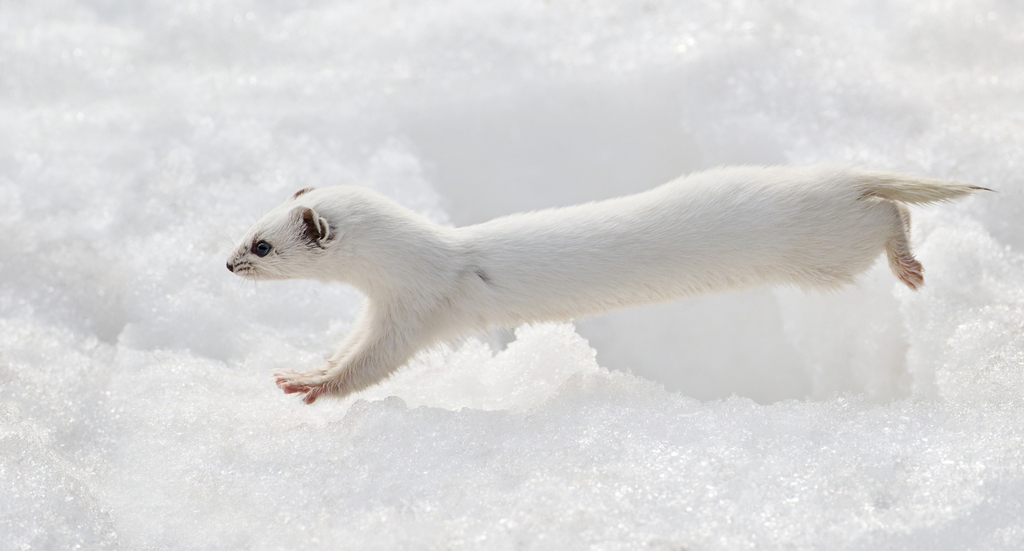
Least Weasel
Mustela nivalis
The least weasel (Mustela nivalis), little weasel, common weasel, or simply weasel is the smallest member of the genus Mustela, family Mustelidae and order Carnivora. It is native to Eurasia, North America and North Africa, and has been introduced to New Zealand, Malta, Crete, the Azores, and São Tomé. It is classified as least concern by the IUCN, due to its wide distribution and large population throughout the Northern Hemisphere. Eighteen subspecies are recognised.
The least weasel varies greatly in size over its range. The body is slender and elongated, and the legs and tail are relatively short. The colour varies geographically, as does the pelage type and length of tail. The dorsal surface, flanks, limbs and tail of the animal are usually some shade of brown while the underparts are white. The line delineating the boundary between the two colours is usually straight. At high altitudes and in the northern part of its range, the coat becomes pure white in winter.
From the article Least weasel on Wikipedia (CC BY-SA), quoted section by section
Description
The least weasel has a thin, greatly elongated and extremely flexible body with a small, yet elongated, blunt-muzzled head which is no thicker than the neck. The eyes are small in relation to their head size and are bulging and dark colored. The legs and tail are relatively short, the latter constituting less than half the body length. The feet have sharp, dark-coloured claws, and the soles are heavily haired. The skull, especially that of the small rixosa group, has an infantile appearance when compared with that of other members of the genus Mustela (in particular, the stoat and kolonok). This is expressed in the relatively large size of the cranium and shortened facial region. The skull is, overall, similar to that of the stoat, but smaller, though the skulls of large male weasels tend to overlap in size with those of small female stoats. There are usually four pairs of nipples but these are only visible in females. The baculum is short, 16 to 20 mm (0.63 to 0.79 in), with a thick, straight shaft. Fat is deposited along the spine, kidneys, gut mesentries and around the limbs. The least weasel has muscular anal glands under the tail, which measure 7 by 5 mm (0.28 by 0.20 in), and contain sulphurous volatiles, including thietanes and dithiacyclopentanes. The smell and chemical composition of these chemicals are distinct from those of the stoat. …
Range & habitat
The least weasel has a circumboreal, Holarctic distribution, encompassing much of Europe and North Africa, Asia and parts of northern North America. It has been introduced to New Zealand, Malta, Crete, the Azores Islands and also São Tomé off West Africa. It occurs throughout Europe, except Ireland, and on all major Mediterranean islands. It also occurs on Honshu and Hokkaido Islands in Japan and on Kunashir, Iturup, and Sakhalin Islands in Russia. The least weasel inhabits fields, open woodland, bushy and rocky areas, parks and gardens at elevations of up to about 3,000 m (9,800 ft). Fossilised remains of the least weasel are known from Denisova Cave.
Wikipedia: “Distribution and habitat”
What it does
The least weasel mates in April–July and there is a 34- to 37-day gestation period. In the Northern Hemisphere, the average litter size consists of 6 kits and these reach sexual maturity in 3 to 4 months. Males may mate during their first year of life, though this is usually unsuccessful. They are fecund in February–October, though the early stages of spermatogenesis do occur throughout the winter months. Anestrus in females lasts from September until February. The female raises her kits without help from the male. They are 1.5 to 4.5 g (0.053 to 0.159 oz) in weight at birth. Newborn kits are born pink, naked, blind and deaf, but gain a white coat of downy fur at the age of 4 days. At 10 days, the margin between the dark upper parts and light under parts becomes visible. The milk teeth erupt at 2 to 3 weeks of age, at which point the young start to eat solid food, though lactation can last 12 weeks. The eyes and ears open at 3 to 4 weeks of age, and by 8 weeks, killing behaviour is developed. The family breaks up after 9 to 12 weeks. There is a single litter each year and least weasels can live for 7 or 8 years.
Wikipedia: “Reproduction and development”
In human culture
The Ancient Macedonians believed that to see a least weasel was a good omen. In some districts of Macedon, women who suffered from headaches after having washed their heads in water drawn overnight would assume that a weasel had previously used the water as a mirror, but they would refrain from mentioning the animal's name for fear that it would destroy their clothes. Similarly, a popular superstition in southern Greece had it that the least weasel had previously been a bride, who was transformed into a bitter animal which would destroy the wedding dresses of other brides out of jealousy. According to Pliny the Elder, the least weasel was the only animal that was capable of killing the basilisk:
To this dreadful monster the effluvium of the weasel is fatal, a thing that has been tried with success, for kings have often desired to see its body when killed; so true is it that it has pleased Nature that there should be nothing without its antidote. The animal is thrown into the hole of the basilisk, which is easily known from the soil around it being infected. The weasel destroys the basilisk by its odour, but dies itself in this struggle of nature against its own self.
Wikipedia: “Macedonian and Greek culture”
Listen
Looking for field recordings…
Where it lives
Recorded sightings
—
geo-referenced records in GBIF, from museums, herbaria and field observers.
Drag the globe to turn it. Dots are where records exist, not a range map; darker means more records.
In the stacks
Searching the stacks…
Every page naming Mustela nivalis in the Biodiversity Heritage Library →
This page is assembled live from iNaturalist, GBIF, Wikipedia, the Source Library and the Internet Archive. It is not yet part of the hand-edited codex. iNaturalist taxon 569428.