- Animals
- ›Chordates
- ›Vertebrates
- ›Ray-finned Fishes
- ›Spiny-rayed fishes
- ›Mackerels, Tunas, Butterfishes, and Allies
- ›Scombroidei
- ›Mackerels, Tunas, and Bonitos
- ›Typical Mackerels, Tunas, and Bonitos
- ›Katsuwonus
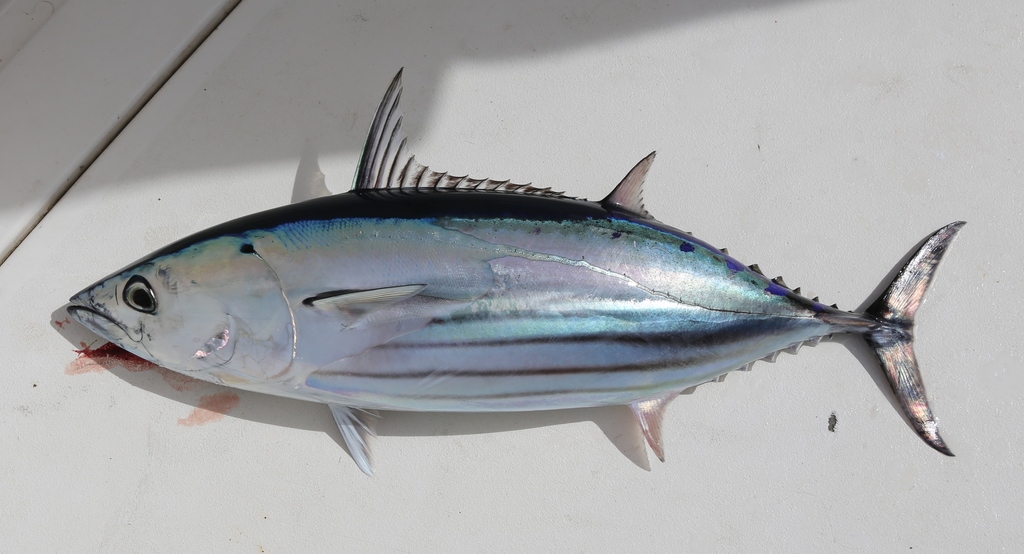
Skipjack Tuna
Katsuwonus pelamis
The skipjack tuna, Katsuwonus pelamis, is a medium-sized perciform fish in the tuna family, Scombridae. It is otherwise known as the aku, arctic bonito, mushmouth, oceanic bonito, striped tuna, or victor fish. It grows up to 1 m (3 ft) in length. It is a cosmopolitan pelagic fish found in tropical and warm-temperate waters. It is a very important species for fisheries.
From the article Skipjack tuna on Wikipedia (CC BY-SA), quoted section by section
Description
It is a streamlined, fast-swimming pelagic fish common in tropical waters throughout the world, where it inhabits surface waters in large shoals (up to 50,000 fish, often in combination with other scombridaes), feeding on fish, crustaceans, cephalopods, and mollusks. It is an important prey species for sharks and large pelagic fishes and is often used as live bait when fishing for marlin. It has no scales, except on the lateral line, and circling around the body behind the head forming a large, thick band called a "corselet". Like other tuna, it lacks a swim bladder, and must keep swimming to stay buoyant. It commonly reaches fork lengths up to 80 cm (2 ft 7 in) and a mass of 8–10 kg (18–22 lb). Its maximum fork length is 108 cm (3 ft 7 in), and its maximum mass is 34.5 kg (76 lb). Determining the age of skipjack tuna is difficult, and estimates of its potential lifespan range between 8 and 12 years. Skipjack tuna has the highest percentage of skeletal muscle devoted to locomotion of all animals, at 68% of the animal's total body mass. Skipjack tuna are highly sensitive to environmental conditions and changes. Climate change effects are significant in marine ecosystems, and ecological factors may change fish distribution and catchability.
Behaviour. Skipjack tuna are batch spawners. …
Where it lives
Recorded sightings
—
geo-referenced records in GBIF, from museums, herbaria and field observers.
Drag the globe to turn it. Dots are where records exist, not a range map; darker means more records.
In the stacks
Searching the stacks…
Every page naming Katsuwonus pelamis in the Biodiversity Heritage Library →
This page is assembled live from iNaturalist, GBIF, Wikipedia, the Source Library and the Internet Archive. It is not yet part of the hand-edited codex. iNaturalist taxon 56943.