- Animals
- ›Chordates
- ›Vertebrates
- ›Birds
- ›Swifts and Hummingbirds
- ›Hummingbirds
- ›Bee Hummingbirds, Emeralds, Mountain-gems, and Allies
- ›Emerald Hummingbirds and Allies
- ›Amazilia
On eBird ↗
Cinnamon Hummingbird
Live sightings near you, the range map, bar charts of when it is seen, and Macaulay Library photos and recordings.
Cinnamon Hummingbird
Amazilia rutila
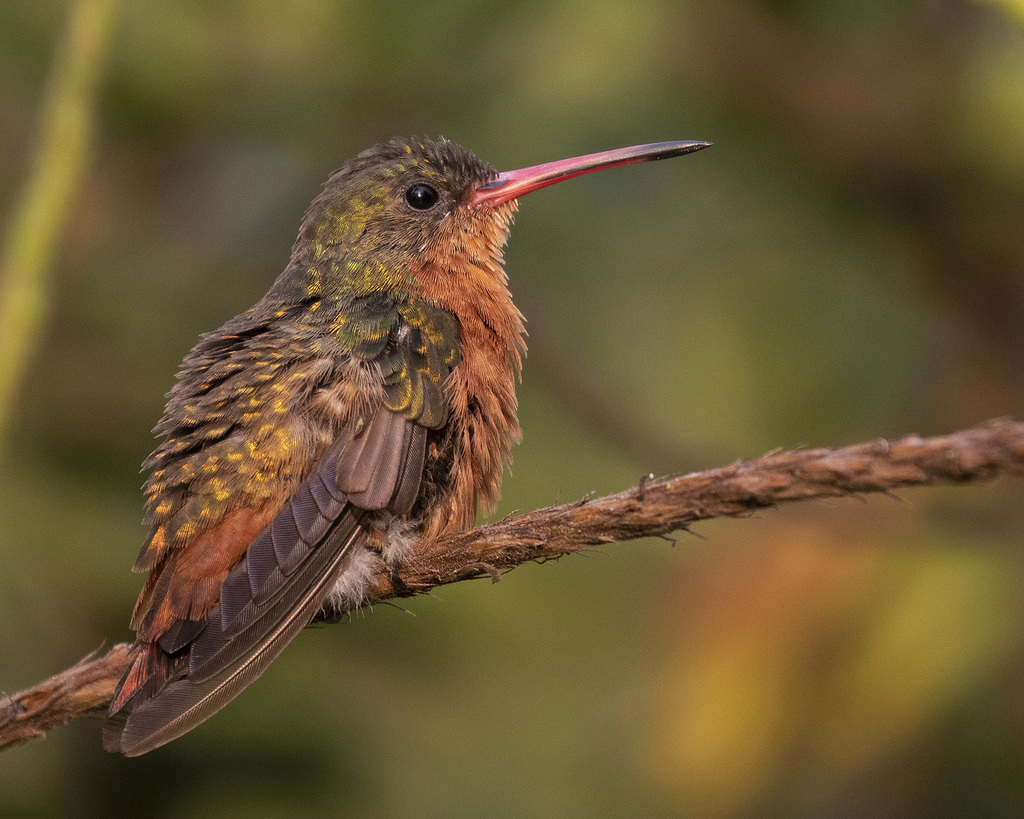
The cinnamon hummingbird (Amazilia rutila) is a species of hummingbird (named for its brilliant brown gold color) in the tribe of the 'emeralds', Trochilini (subfamily Trochilinae). Currently, four regional subspecies are recognized.
Cinnamon hummingbirds are typically found at or just slightly above sea level, often inhabiting coastal and lowland areas, as well as further inland in warmer locations in the southern parts of their range. They are predominantly found along the Pacific western coast of México and south through Guatemala, El Salvador, Honduras, Nicaragua and Costa Rica. They are also found in Belize and the southern Mexican states of Campeche, Quintana Roo and Yucatán.
From the article Cinnamon hummingbird on Wikipedia (CC BY-SA), quoted section by section
Description
The cinnamon hummingbird is 9.5 to 11.5 cm (3.7 to 4.5 in) long and on average weighs about 5 to 5.5 g (0.18 to 0.19 oz). Adults of the nominate subspecies A. r. rutila have metallic bronze green upperparts and cinnamon to cinnamon rufous underparts that are paler on the chin and upper throat. The tail is deep cinnamon rufous to rufous chestnut; the feathers have dark metallic bronze tips and the outermost have dark metallic bronze outer edges. The wings are a dark brownish slate. Males' bills are red with a black tip and females' mostly black with red at the base. Juveniles are similar to adults but have rufous edges to the face, crown, and rump feathers and an all black bill. The song is "varied, high, thin, slightly squeaky chips, si ch chi-chit or tsi si si-si-sit, or chi chi-chi chi chi, etc." Its call has been described as "a buzzy, scratchy tzip" and "a hard to sharp chik". Amazilia rutila diluta is similar to the nominate, with slightly less intense green upperparts and paler and pinker underparts. A. r. corallirostris is also similar to the nominate but overall its colors are richer and deeper. A. r. graysoni is significantly larger and darker than the nominate but otherwise similar.
Range & habitat
The cinnamon hummingbird is resident throughout its range. The subspecies of cinnamon hummingbird are found in the following regions:
Amazilia rutila diluta — NW Mexican states of Sinaloa and Nayarit. A. rutila graysoni — María Madre and Cleopha Islands, part of the Islas Tres Marías archipelago off the coast of Western Mexico. A. r. rutila — Jalisco, Colima, Guerrero, Michoacán and Oaxaca in Mexico; El Salvador, W. Honduras, Nicaragua and Costa Rica. A. rutila corallirostris — Chiapas in S. Mexico through to El Salvador. The populations in Mexico's Yucatán Peninsula, as well as N.E. Honduras, Nicaragua, and Costa Rica, are often attributed to A. r. rutila but have sometimes been considered part of A. r. corallirostris. The cinnamon hummingbird inhabits primary and secondary deciduous and semi-deciduous forests and thorn forest. It ranges from sea level to about 1,600 m (5,200 ft) of elevation.
Wikipedia: “Distribution and habitat”
What it does
The cinnamon hummingbird usually forages from the understory to the mid-story, but also will visit taller flowering trees. It feeds on nectar from a very wide variety of flowering plants and also eats insects. It is territorial and defends feeding sites from intrusion by other hummingbirds, bees, and butterflies.
Wikipedia: “Feeding”
Listen
Looking for field recordings…
Where it lives
Recorded sightings
—
geo-referenced records in GBIF, from museums, herbaria and field observers.
Drag the globe to turn it. Dots are where records exist, not a range map; darker means more records.
In the stacks
Searching the stacks…
Every page naming Amazilia rutila in the Biodiversity Heritage Library →
This page is assembled live from iNaturalist, GBIF, Wikipedia, the Source Library and the Internet Archive. It is not yet part of the hand-edited codex. iNaturalist taxon 5758.