- Animals
- ›Chordates
- ›Vertebrates
- ›Birds
- ›Swifts and Hummingbirds
- ›Hummingbirds
- ›Bee Hummingbirds, Emeralds, Mountain-gems, and Allies
- ›Emerald Hummingbirds and Allies
- ›Amazilia
On eBird ↗
Honduran Emerald
Live sightings near you, the range map, bar charts of when it is seen, and Macaulay Library photos and recordings.
Honduran Emerald
Amazilia luciae
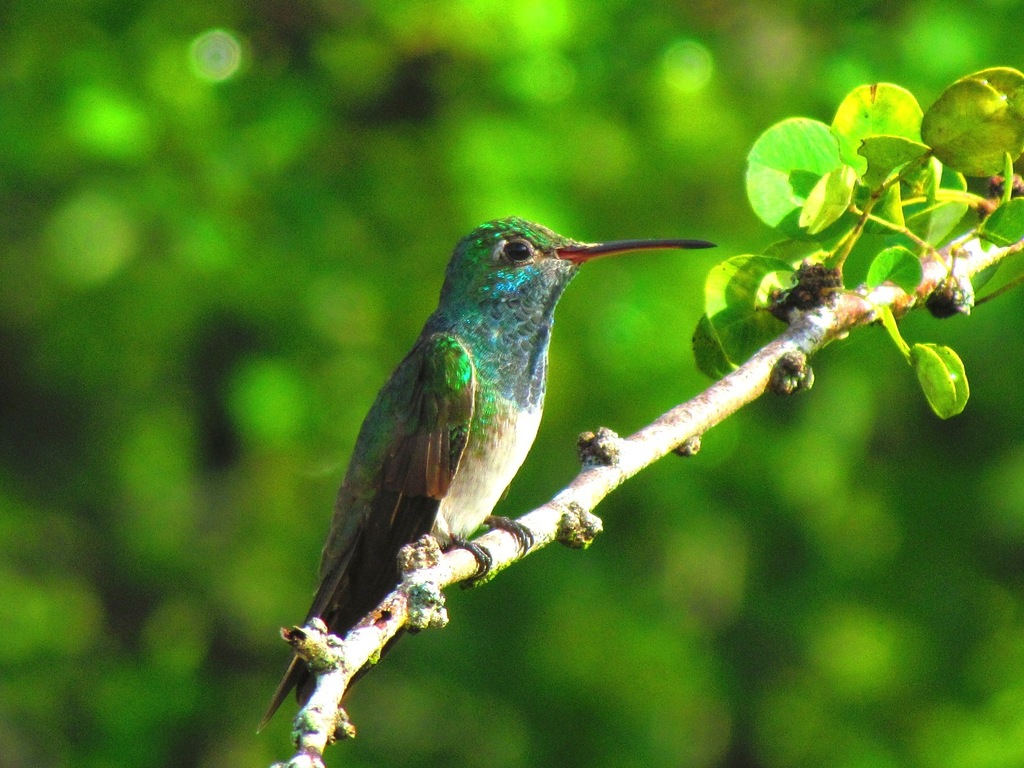
The Honduran emerald (Amazilia luciae) is a vulnerable species of hummingbird in the "emeralds" tribe, Trochilini, of the subfamily Trochilinae. It is endemic to Honduras.
From the article Honduran emerald on Wikipedia (CC BY-SA), quoted section by section
Description
The Honduran emerald is 9 to 10 cm (3.5 to 3.9 in) long. Both sexes have a medium length bill, slightly decurved, with a black maxilla and a red mandible with a black tip. Adult males have a dark green crown and upperparts that become bronzy on the lower back and uppertail coverts. Its central tail feathers are dark green, the rest dark green with a bronzy cast near the end, and all have a purplish band near the tip. Its gorget and upper breast are medium blue that may appear greenish or grayish in different lights. Its breast is grayish white with green sides and duller bronze green flanks. Its undertail coverts are dark green with white edges. The adult female has similar plumage but is overall duller. Its gorget is smaller and greener than the male's and its outer tail feathers have gray tips. Immature birds are similar to the female. The call is "a hard, slightly metallic ticking call, often steadily repeated 'chik, chik-chik, chik chik..." and "a hard, slightly buzzy chattering given in flight 'zzchi ---' and 'chik chi zzhi ---'." Other vocalizations include "a dry, quiet gruff warbling" (which might be its song), "a hard buzzy chatter 'chirr-rr-irr-rr-rr'", and "a high sharp 'siik' given in pursuit."
Range & habitat
The Honduran emerald is found in three widely separated areas of northern Honduras, in the departments of Santa Bárbara, Cortés, Yoro, and Olancho. Until the 1950s the species was known only from a few specimens taken in the last two of them. It was not again observed until 1988, in Yoro, and was first documented in Santa Bárbara and Cortés in 2007. Since then the species has been observed somewhat more widely than before within each of the three general areas. The Honduran emerald's movements are imperfectly known. In the east in some seasons it is "one of the most conspicuous bird species" in its habitat; at other times it is almost absent. Short distance migration is a potential explanation. The Honduran emerald inhabits tropical dry forests, typically in intermontane valleys. The forests are generally of low to medium height with an open to partially close canopy. Those in the western departments of Santa Bárbara and Cortés are the taller and denser and are described as semi-deciduous. The emerald has also been observed in those departments in thorn forest, pine-oak forest, and the edges of pasture. In the west it tends to inhabit the valley slopes at elevations between 200 and 500 m (660 and 1,600 ft). …
Wikipedia: “Distribution and habitat”
What it does
The Honduran emerald forages for nectar at a wide variety of flower sources, seeking it at all levels of the forest. At least 22 species of plants have been documented as nectar sources; examples include cacti, thorny shrubs and trees, vine, herbs, epiphytes, and parasitic plants. In the west its primary source is Helicteres guazumaefolia, which flowers year-round. In the east the species seems to favor Pedilanthus camporum and Nopalea hondurensis. It appears to sometimes defend nectar sources. In addition to nectar the Honduran emerald feeds on small arthropods. Anderson et al. (2010) provide a detailed dietary analysis.
Wikipedia: “Feeding”
Listen
Looking for field recordings…
Where it lives
Recorded sightings
—
geo-referenced records in GBIF, from museums, herbaria and field observers.
Drag the globe to turn it. Dots are where records exist, not a range map; darker means more records.
In the stacks
Searching the stacks…
Every page naming Amazilia luciae in the Biodiversity Heritage Library →
This page is assembled live from iNaturalist, GBIF, Wikipedia, the Source Library and the Internet Archive. It is not yet part of the hand-edited codex. iNaturalist taxon 5764.