- Plants
- ›red algae
- ›true red algae
- ›Florideophycean algae
- ›Rhodymeniophycidae
- ›Bonnemaisoniales
- ›Bonnemaisoniaceae
- ›Asparagopsis
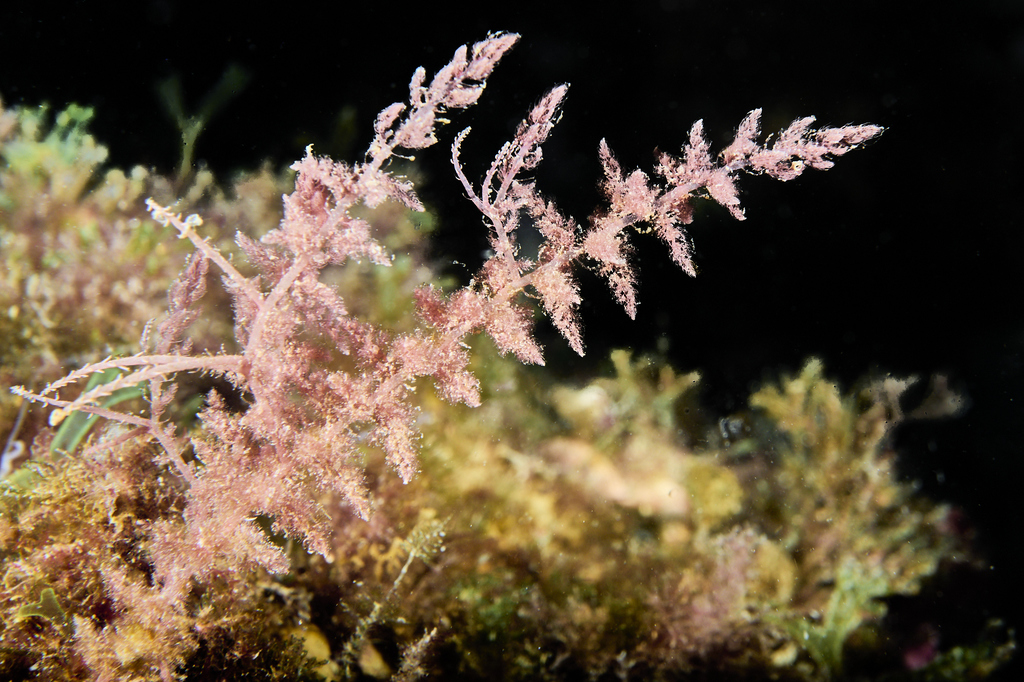
Harpoonweed
Asparagopsis armata
Asparagopsis armata is a species of marine red algae, in the family Bonnemaisoniaceae. English name(s) include red harpoon weed. They are multicellular eukaryotic organisms. This species was first described in 1855 by Harvey, an Irish botanist who found the algae on the Western Australian coast. A. armata usually develops on infralittoral rocky bottoms around the seawater surface to around 40m of depth. Marine algae like A. armata are considered "autogenic ecosystem engineers" as they are at the very bottom of the food chain and control resource availability to other organisms in the ecosystem.
From the article Asparagopsis armata on Wikipedia (CC BY-SA), quoted section by section
Description
The fully grown A. armata has sparse branches on which long stolons with harpoon-like hooks and erect shoots develop in all directions. The branches, stolons, and shoots ramify over and over again which give A. armata the thallus-like appearance. The ultimate branchlets are filamentous and composed of three cell rows whereas the larger branches consist of a central medullary filament and a gelatinous matrix surrounded by a cortex 3 – 6 cells thick. Gametophytes are terete and are around 200 mm in height. They form dense, pink intertwining clumps. A characteristic feature of this species is barbs, which attach the A. armata to the ocean benthic substrates.
Wikipedia: “Morphology”
Range & habitat
A. armata is a species native to southern Australia and New Zealand (Southern hemisphere) and is thought to have slowly spread to the Northern hemisphere through the Mediterranean sea, as it is highly invasive. It can now also be found along the British Isles to Senegal as well. The first Mediterranean A. armata was reported in Algeria in 1923. When first found, it was considered abnormal to find A. armata in this location due to the high summer seawater surface temperatures along southern Mediterranean coasts. However, it was later found that the particular cool water temperatures that stay below 25 °C would allow the species to survive locally during the summer.
Wikipedia: “Population distribution”
What it does
A. armata has a triphasic diplohaplontic heteromorphic life cycle. In this cycle, the three phases include: haploid carposporophyte, gametophyte and diploid zygote. Multiple phases of different morphology and ploidy contribute differently to the expansion potential of A. armata. Gametophytes of this species are microscopic carposoporophytes, which divide into tetrasporophytes that go through meiosis to be developed into the gametophyte. A. armata has two morphologically different stages of development– the gametophyte stage and the tetrasporophyte stage.
A. armata goes through haploid and gametophytic phases in a heteromorphic diplo-haplontic life cycle. The A. armata gametophyte grows into adult form and goes through fecundation to produce diploid carposporophyte; which, then, divide into tetrasporophyte that goes through meiosis to be developed into the gametophyte.
Wikipedia: “Life cycle”
Where it lives
Recorded sightings
—
geo-referenced records in GBIF, from museums, herbaria and field observers.
Drag the globe to turn it. Dots are where records exist, not a range map; darker means more records.
In the stacks
Searching the stacks…
Every page naming Asparagopsis armata in the Biodiversity Heritage Library →
This page is assembled live from iNaturalist, GBIF, Wikipedia, the Source Library and the Internet Archive. It is not yet part of the hand-edited codex. iNaturalist taxon 57779.