- Animals
- ›Chordates
- ›Vertebrates
- ›Birds
- ›Swifts and Hummingbirds
- ›Hummingbirds
- ›Mango Hummingbirds and Allies
- ›Polytmus
On eBird ↗
Tepui Goldenthroat
Live sightings near you, the range map, bar charts of when it is seen, and Macaulay Library photos and recordings.
Tepui Goldenthroat
Polytmus milleri
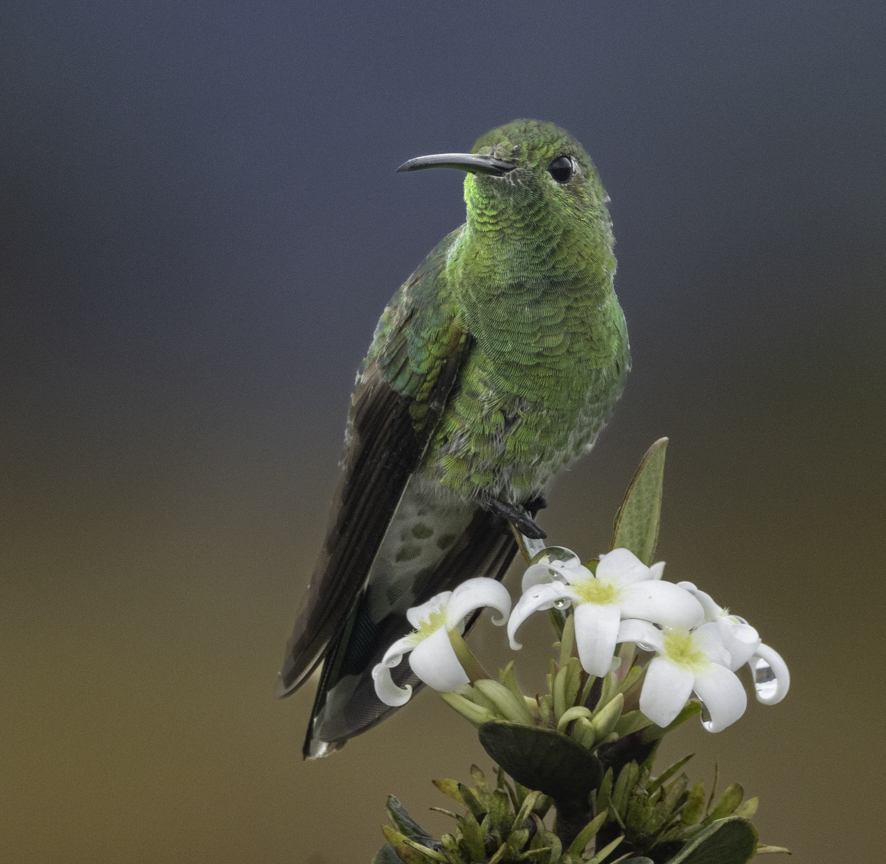
The Tepui goldenthroat (Polytmus milleri) is a species of hummingbird in the family Trochilidae. It is found in Brazil, Guyana, and Venezuela. Its natural habitats are subtropical or tropical moist montane forests and subtropical or tropical seasonally wet or flooded lowland grassland.
From the article Tepui goldenthroat on Wikipedia (CC BY-SA), quoted section by section
Description
The tepui goldenthroat is 11 to 12 cm (4.3 to 4.7 in) long. Males weigh 4.5 to 6.1 g (0.16 to 0.22 oz) and females 4.1 to 5 g (0.14 to 0.18 oz). Males have bronzy green upperparts and glittering green underparts. The tail is shades of green with a wide white band at the base and white tips. The area around the eye is dusky gray with white streaks above and below it. The female is smaller than the male and has dull white underparts heavily dotted with golden-green, especially on the breast. Juveniles are like the adults but with buffy edges to the head's feathers.
Range & habitat
The tepui goldenthroat is found only on the eponymous tepuis of southern and southeastern Venezuela and slightly into western Guyana and extreme northern Brazil. On these isolated flat-topped mountains it inhabits the edge of cloudforest and scrublands with scattered trees at elevations between 1,300 and 2,200 m (4,300 and 7,200 ft).
Wikipedia: “Distribution and habitat”
What it does
The tepui goldenthroat is "trap-line" feeder, visiting a circuit of a variety of flowering plants for nectar. It also catches insects on the wing and gleans spiders from vegetation and rock cavities.
Wikipedia: “Feeding”
Listen
Looking for field recordings…
Where it lives
Recorded sightings
—
geo-referenced records in GBIF, from museums, herbaria and field observers.
Drag the globe to turn it. Dots are where records exist, not a range map; darker means more records.
In the stacks
Searching the stacks…
Every page naming Polytmus milleri in the Biodiversity Heritage Library →
This page is assembled live from iNaturalist, GBIF, Wikipedia, the Source Library and the Internet Archive. It is not yet part of the hand-edited codex. iNaturalist taxon 5782.