- Animals
- ›Chordates
- ›Vertebrates
- ›Birds
- ›Swifts and Hummingbirds
- ›Hummingbirds
- ›Brilliants, Coquettes, and Allies
- ›Coquettes and Allies
- ›Phlogophilus
On eBird ↗
Peruvian Piedtail
Live sightings near you, the range map, bar charts of when it is seen, and Macaulay Library photos and recordings.
Peruvian Piedtail
Phlogophilus harterti
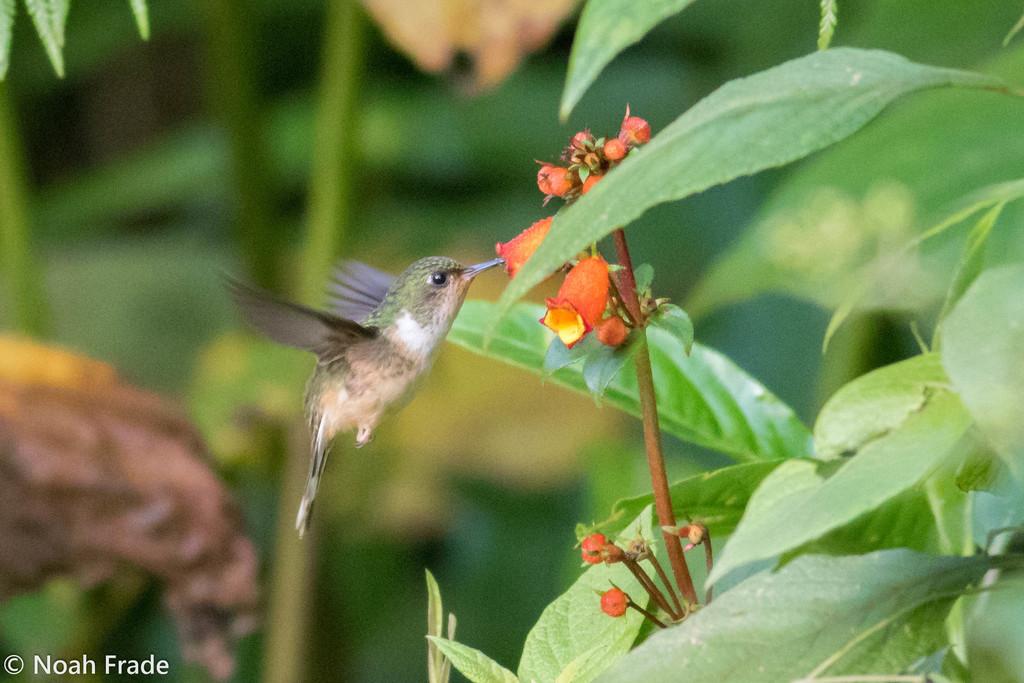
The Peruvian piedtail, Colibri de Hartert, or ColibrÍ Colipinto Peruano (Phlogophilus harterti) is a species of hummingbird in the family Trochilidae. It is found only in Peru. Its natural habitat is subtropical or tropical moist montane forests. It is threatened by habitat loss.
From the article Peruvian piedtail on Wikipedia (CC BY-SA), quoted section by section
Description
The Peruvian piedtail is 7.2 to 7.5 cm (2.8 to 3.0 in) long and weighs 2.2 to 2.7 g (0.078 to 0.095 oz). The adult male and female are alike. They have a short, straight, black bill. Their upperparts are green. They have a white spot behind the eye. The throat and center of the breast and belly are white and the rest of the underparts buff. The innermost pair of tail feathers are green with a wide black tip; the others are buff with a wide diagonal black band. Juveniles resemble the adults but their head and neck feathers have buff fringes.
Range & habitat
The Peruvian piedtail has a discontinuous distribution in central and southeastern Peru. It occurs in the east Andean foothills of Huánuco, Pasco, Cuzco, and Puno departments. It inhabits the interior of primary and secondary forest. In elevation it is most numerous around 1,000 m (3,300 ft) but ranges between 750 and 1,500 m (2,500 and 4,900 ft).
Wikipedia: “Distribution and habitat”
What it does
The Peruvian piedtail perches to take nectar from flowers and to glean small insects from foliage.
Wikipedia: “Feeding”
Listen
Looking for field recordings…
Where it lives
Recorded sightings
—
geo-referenced records in GBIF, from museums, herbaria and field observers.
Drag the globe to turn it. Dots are where records exist, not a range map; darker means more records.
In the stacks
Searching the stacks…
Every page naming Phlogophilus harterti in the Biodiversity Heritage Library →
This page is assembled live from iNaturalist, GBIF, Wikipedia, the Source Library and the Internet Archive. It is not yet part of the hand-edited codex. iNaturalist taxon 5791.