- Animals
- ›Chordates
- ›Vertebrates
- ›Birds
- ›Swifts and Hummingbirds
- ›Hummingbirds
- ›Mango Hummingbirds and Allies
- ›Anthracothorax
On eBird ↗
Green-throated Mango
Live sightings near you, the range map, bar charts of when it is seen, and Macaulay Library photos and recordings.
Green-throated Mango
Anthracothorax viridigula
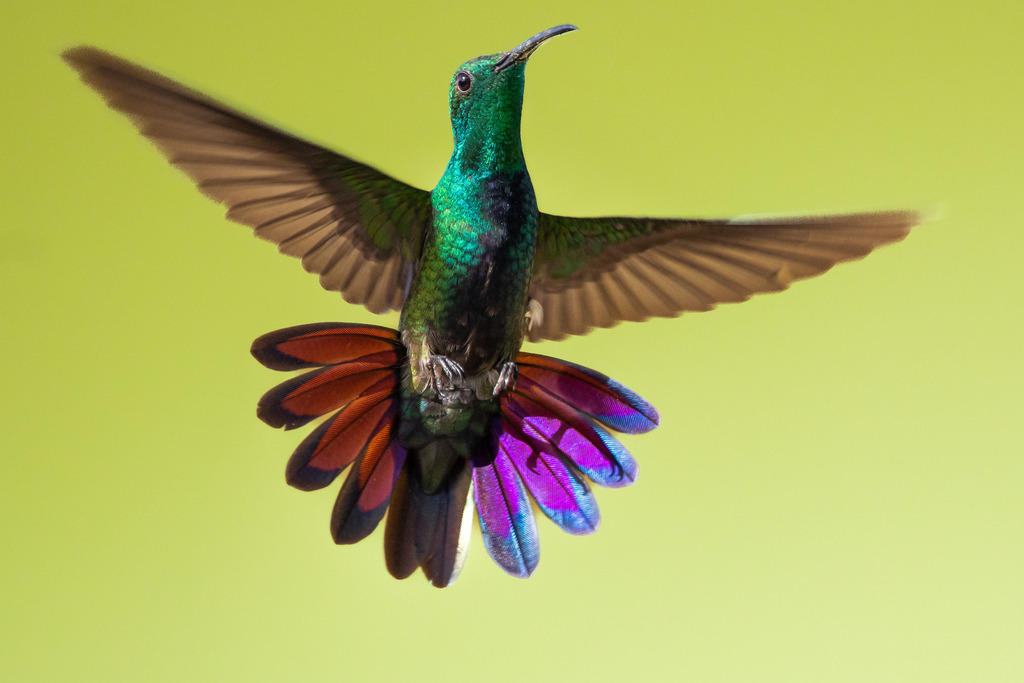
The green-throated mango (Anthracothorax viridigula) is a hummingbird that breeds from northeastern Venezuela, Trinidad and the Guianas south to northeasterm Brazil. In Brazil, the bird is only found on the narrow Atlantic coastal strip north and south of the Amazon River outlet, and a strip along the river proper, about 1500 km upstream. It is a local or seasonal migrant, although its movements are not well understood.
From the article Green-throated mango on Wikipedia (CC BY-SA), quoted section by section
Description
The green-throated mango is 10.5 to 12.5 cm (4.1 to 4.9 in) long. Males weigh 7.5 to 8.5 g (0.26 to 0.30 oz), and females weigh about 6.0 g (0.21 oz). The longish black bill is slightly decurved. The male has glossy bronzy-green upperparts. Its throat and underparts are green with a black central line on the breast and belly. The central tail feathers are dark brown to green, and the others are shiny purple, with the outermost ones having dark blue tips. The female green-throated mango's upperparts are also bronzy-green but with more of a reddish tinge than the male's. She has white underparts with a black central stripe. The tail is similar to the male's but with white tips on the outermost feathers. Juveniles resemble females but have chestnut underparts. This species closely resembles the related black-throated mango. While the male green-throated mango has less extensive black coloring on the underparts, confirming the bird's identity can be challenging in the field as both species may appear entirely black. The females of the two species are nearly indistinguishable, though the green-throated mango typically exhibits more extensive coppery upperparts than its relative.
Range & habitat
The green-throated mango is found along the coast from northeastern Venezuela through Guyana, Suriname, and French Guiana into Brazil, as far east as Maranhão and along the Amazon River inland to the Negro River. It is also present in Trinidad but not Tobago. This bird inhabits mangrove swamp, moist lowland savannas, and similar swampy areas with scattered large trees. Its elevation range is from sea level up to 500 m (1,600 ft).
Wikipedia: “Distribution and habitat”
What it does
The green-throated mango feeds on the nectar of tall flowering trees, where males defend feeding territories. The species is also notably insectivorous, catching small arthropod prey on the wing or by gleaning from foliage.
Wikipedia: “Feeding”
Listen
Looking for field recordings…
Where it lives
Recorded sightings
—
geo-referenced records in GBIF, from museums, herbaria and field observers.
Drag the globe to turn it. Dots are where records exist, not a range map; darker means more records.
In the stacks
Searching the stacks…
Every page naming Anthracothorax viridigula in the Biodiversity Heritage Library →
This page is assembled live from iNaturalist, GBIF, Wikipedia, the Source Library and the Internet Archive. It is not yet part of the hand-edited codex. iNaturalist taxon 5808.