- Animals
- ›Chordates
- ›Vertebrates
- ›Birds
- ›Swifts and Hummingbirds
- ›Hummingbirds
- ›Bee Hummingbirds, Emeralds, Mountain-gems, and Allies
- ›Mountain-gems and Allies
- ›Lampornis
On eBird ↗
Purple-throated Mountain-gem
Live sightings near you, the range map, bar charts of when it is seen, and Macaulay Library photos and recordings.
Purple-throated Mountain-gem
Lampornis calolaemus
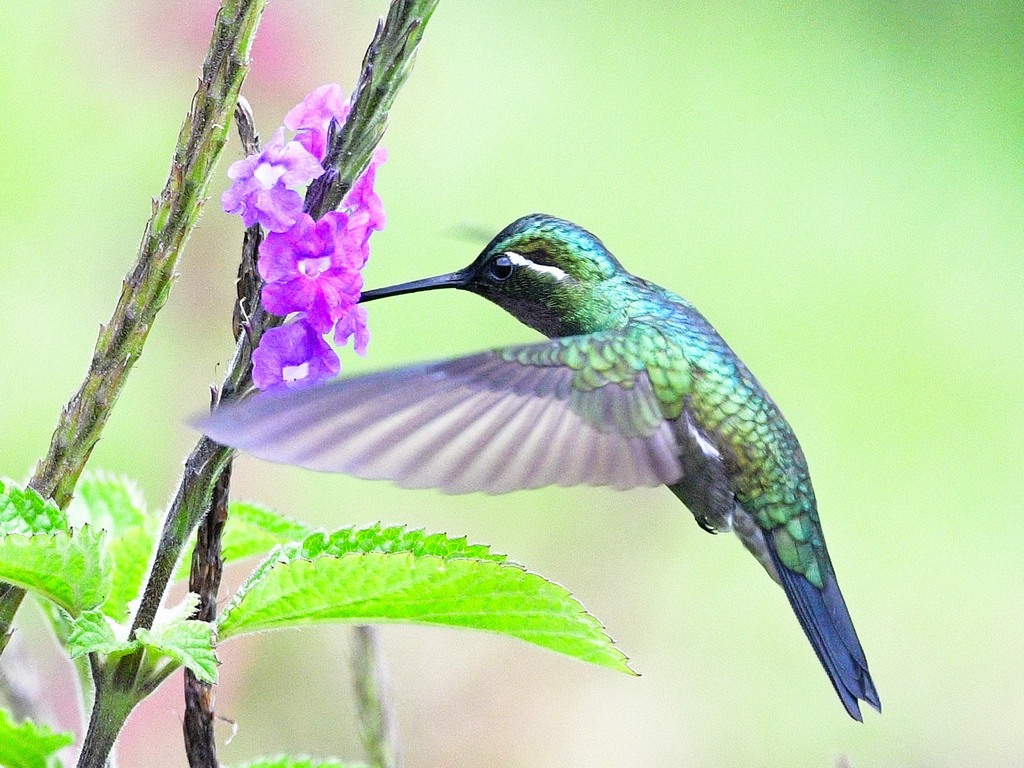
The purple-throated mountaingem (Lampornis calolaemus) is a hummingbird which breeds in the mountains of southern Nicaragua, northern Costa Rica and western Panama. This bird inhabits forested areas in hilly terrain, and is found at altitudes from 800 to 2,500 m (2,600 to 8,200 ft).
From the article Purple-throated mountaingem on Wikipedia (CC BY-SA), quoted section by section
Description
The purple-throated mountaingem is 10 to 11.5 cm (3.9 to 4.5 in) long and weighs 4.5 to 6 g (0.16 to 0.21 oz). Both sexes of all subspecies have a medium-length straight black bill, a white to pale buff stripe behind the eye, and a fairly long tail. Adult males of the nominate subspecies L. c. calolaemus have a glittering emerald green to bluish green forehead and crown. The rest of their upperparts are metallic bronze-green that shades to bluish or grass green on the uppertail coverts. Much of the face is dusky bronze green and the gorget is metallic violet or purple. The breast is bright metallic green with duller flanks and belly that tend to bronzy green or gray. The undertail coverts are deep bronzy gray with paler gray margins. The tail is dull blue-black. Adult females of the nominate subspecies have bright metallic green upperparts that are somewhat bluish on the uppertail coverts and a bit bronzish elsewhere. The face is mostly blackish. The throat, breast, and belly are tawny yellow and the undertail coverts dull white to tawny buff. The central tail feathers and the upper half of the others are dull metallic green or bronze green. …
Range & habitat
Subspecies L. c. pectoralis of purple-throated mountaingem is found from far southwestern Nicaragua to the Cordillera de Guanacaste in northwestern Costa Rica. The nominate L. c. calolaemus is found in the Cordillera Central and northern part of the Cordillera de Talamanca of northern and central Costa Rica. L. c. homogenes is found in western Panama from Chiriquí Province to Coclé Province and probably also in southern Costa Rica. The species inhabits humid montane evergreen forest and cloudforest, where it favors steep slopes and broken terrain. In central Costa Rica it ranges in elevation from 1,200 to 2,500 m (3,900 to 8,200 ft) and is found as low as 800 m (2,600 ft) in northern Costa Rica.
Wikipedia: “Distribution and habitat”
What it does
The purple-throated mountaingem feeds mostly on nectar. Males defend patches of flowers from other hummingbird species, from males of its own species, and also from females after courtship. Females are less territorial and often feed by trap-lining. The species takes nectar from a wide variety of flowers. It is the primary pollinator of Psychotria elata and Palicourea lasiorrachis (Rubiaceae). Females have slightly longer bills than males. There is some degree of niche differentiation between the sexes. Though both prefer flowers with a corolla 14 to 21 mm (0.55 to 0.83 in) long by 3.5 to 8 mm (0.14 to 0.31 in) wide, females far more often than males utilize plants with longer and thinner corollas. Like most hummingbirds, the purple-throated mountaingem also feeds on insectes. Males capture them by hawking from a perch. Females hover-glean, often beating their wings against foliage which apparently flushes prey.
Wikipedia: “Feeding”
Listen
Looking for field recordings…
Where it lives
Recorded sightings
—
geo-referenced records in GBIF, from museums, herbaria and field observers.
Drag the globe to turn it. Dots are where records exist, not a range map; darker means more records.
In the stacks
Searching the stacks…
Every page naming Lampornis calolaemus in the Biodiversity Heritage Library →
This page is assembled live from iNaturalist, GBIF, Wikipedia, the Source Library and the Internet Archive. It is not yet part of the hand-edited codex. iNaturalist taxon 5840.