- Animals
- ›Chordates
- ›Vertebrates
- ›Birds
- ›Swifts and Hummingbirds
- ›Hummingbirds
- ›Bee Hummingbirds, Emeralds, Mountain-gems, and Allies
- ›Mountain-gems and Allies
- ›Lampornis
On eBird ↗
White-bellied Mountain-gem
Live sightings near you, the range map, bar charts of when it is seen, and Macaulay Library photos and recordings.
White-bellied Mountain-gem
Lampornis hemileucus
The white-bellied mountaingem or white-bellied mountain-gem (Lampornis hemileucus) is a species of hummingbird in tribe Lampornithini of subfamily Trochilinae. It is found in Costa Rica and Panama.
From the article White-bellied mountaingem on Wikipedia (CC BY-SA), quoted section by section
Description
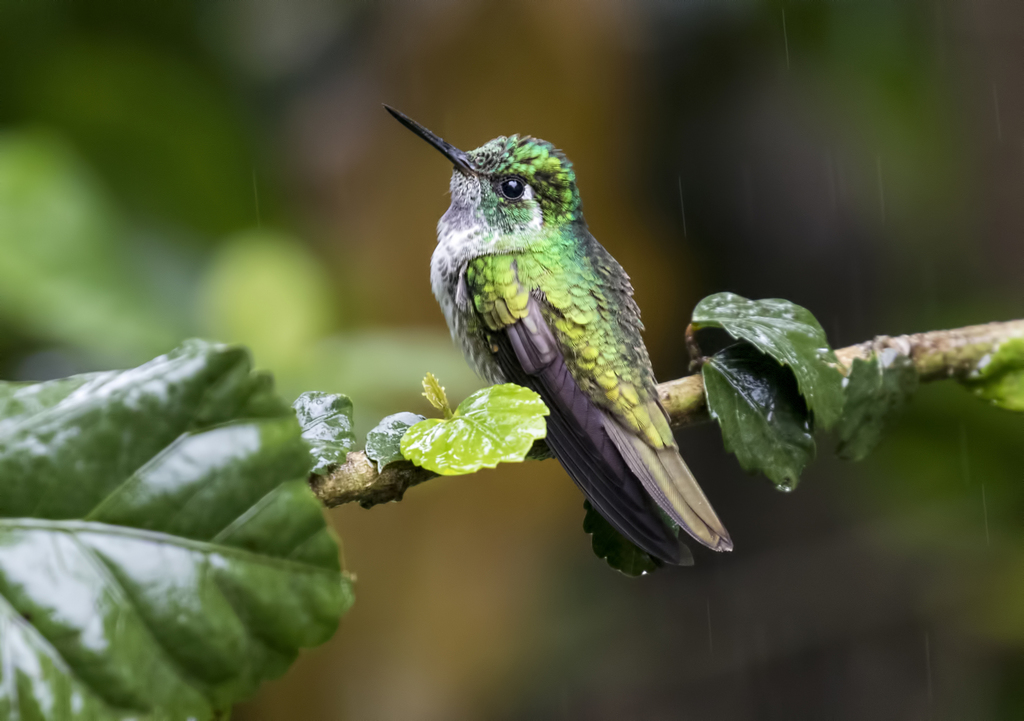
The white-bellied mountaingem is 10 to 11 cm (3.9 to 4.3 in) long. Males weigh about 6.2 g (0.22 oz) and females 5.1 g (0.18 oz). Both sexes have a medium-length black bill, a long white stripe behind the eye, and pinkish feet. Adult males' face and crown are glittering green, much of the rest of the upperparts bronzy green, and the uppertail coverts bronzy. The tail is also bronzy, with dusky gray bands near the end of the outer feathers. The gorget is blue-violet and the rest of the underparts white with green speckles along the sides. Adult females are similar, but the face and crown are less glittering and the throat is white with green speckles. Juveniles of both sexes have rusty fringes on the green feathers; males have a dull bronze gorget.
Range & habitat
The white-bellied mountaingem is found on the Caribbean slope from north-central Costa Rica south and east into western Panama as far as Veraguas Province, and also locally on the Pacific slope in Panama. It inhabits the canopy of cool and very wet subtropical forest and also occurs at the shrub level at the forest edge and in gaps and clearings. It mostly shuns secondary forest and other semi-open landscapes.
Wikipedia: “Distribution and habitat”
What it does
The white-bellied mountaingem forages for nectar in flowering trees and shrubs, and is especially partial to epiphytes of family Ericaceae and genus Columnea. It is aggressive when feeding; males dominate most other hummingbirds, even larger ones, at clumps of flowering epiphytes. In addition to nectar, it also feeds on insects captured by hawking; females sometimes glean arthropods from foliage.
Wikipedia: “Feeding”
Listen
Looking for field recordings…
Where it lives
Recorded sightings
—
geo-referenced records in GBIF, from museums, herbaria and field observers.
Drag the globe to turn it. Dots are where records exist, not a range map; darker means more records.
In the stacks
Searching the stacks…
Every page naming Lampornis hemileucus in the Biodiversity Heritage Library →
This page is assembled live from iNaturalist, GBIF, Wikipedia, the Source Library and the Internet Archive. It is not yet part of the hand-edited codex. iNaturalist taxon 5844.