On eBird ↗
Tibetan Snowcock
Live sightings near you, the range map, bar charts of when it is seen, and Macaulay Library photos and recordings.
Tibetan Snowcock
Tetraogallus tibetanus
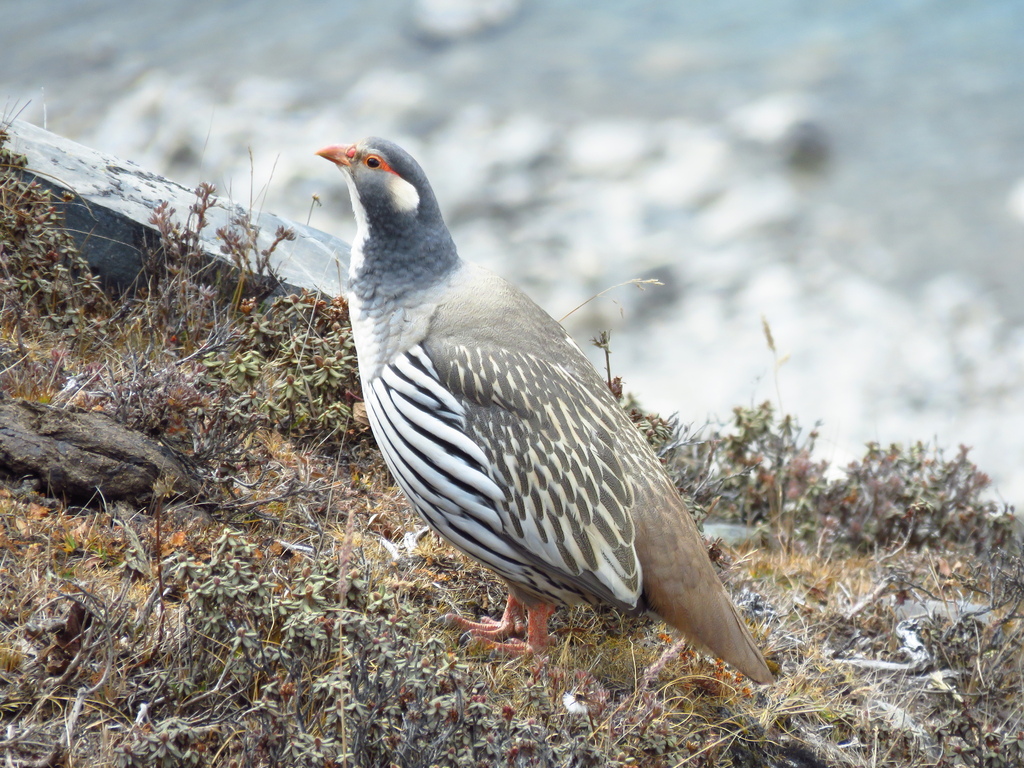
The Tibetan snowcock (Tetraogallus tibetanus) is a bird in the pheasant family Phasianidae of the order Galliformes, gallinaceous birds. This species is found in high-altitude regions of the Western Himalayas and the Tibetan Plateau, where it overlaps in part with the larger Himalayan snowcock. The head is greyish and there is a white crescent patch behind the eye and underside is white with black stripes. In flight the secondaries show a broad white trailing edge.
From the article Tibetan snowcock on Wikipedia (CC BY-SA), quoted section by section
Description
Smaller than Himalayan snowcock, this species has a grey head and neck with a white patch behind the eye and above the dark cheek. Chin, throat and breast are white, with two grey bands on the breast. Grey wing coverts and tertials have a white trim. The secondaries have a broad white trailing edge that forms a wing band. Underparts are white with black streaks on flanks and belly. The tail is rufous brown and the undertail coverts are black. Legs and beaks are reddish. Sexes are similar, but female has buff in postocular patch, blackish and buff marks on sides of head, neck and breast-band, and lacks the tarsal spurs of the male.
Range & habitat
Tibetan snowcock are found on alpine pastures stony ridges above the tree line in the Pamirs of Tajikistan, Himalayas (from Ladakh to Arunachal Pradesh), Tibet, Pakistan and China. They are found in lower altitudes during winter or when there is heavy snowfall. In parts of its range there appears to be a clear separation of the distribution of this and the Himalayan snowcock while in others they appear to overlap. Since the Tibetan snowcock has a large distribution range and no visible declines in population, it has been considered a species of "least concern" by the IUCN.
Wikipedia: “Distribution and status”
What it does
This species is similar to the Himalayan snowcock, but prefers higher altitudes. During winter, they descend to lower altitudes and move around in coveys. When approached from below on a hill slope, they move up, stopping every now and then to look at the intruder, but when alarmed they fly away downwards crossing the valley/ravine. The flight is swift and will often make a whistling call in flight. They call several times while alighting and on settling from flight they shake their tails several times in the manner of willow ptarmigan. They call in the morning and evening, becoming quiet in the middle of the day. They keep to grass-covered plateaus and ridges or to the more barren and stony plains with very little vegetation. Though they do not keep sentries during feeding, while resting in the middle of the day, one or more of adult birds mount high boulders and keep a watch, warning the flocks on the approach of danger with loud prolonged whistles. Several calls have been described that include a chuckling that gradually becomes louder, a whistle and a curlew-like call. During summer, they form pairs and males are believed to be monogynous. The nest is a scrape, sparsely lined and sheltered under a stone or bush usually on the leeward side of a bare hill, and avoiding ground with vegetation. About 4 to 6 eggs are laid. The male stands sentinel while the females incubate. …
Wikipedia: “Behaviour and ecology”
Listen
Looking for field recordings…
Where it lives
Recorded sightings
—
geo-referenced records in GBIF, from museums, herbaria and field observers.
Drag the globe to turn it. Dots are where records exist, not a range map; darker means more records.
In the stacks
Searching the stacks…
Every page naming Tetraogallus tibetanus in the Biodiversity Heritage Library →
This page is assembled live from iNaturalist, GBIF, Wikipedia, the Source Library and the Internet Archive. It is not yet part of the hand-edited codex. iNaturalist taxon 585.