- Animals
- ›Chordates
- ›Vertebrates
- ›Ray-finned Fishes
- ›Spiny-rayed fishes
- ›Freshwater Sunfishes, Grunters, and Allies
- ›Freshwater Sunfishes and relatives
- ›Freshwater Sunfishes
- ›Lepominae
- ›Lepomis
- ›Lepomis megalotis
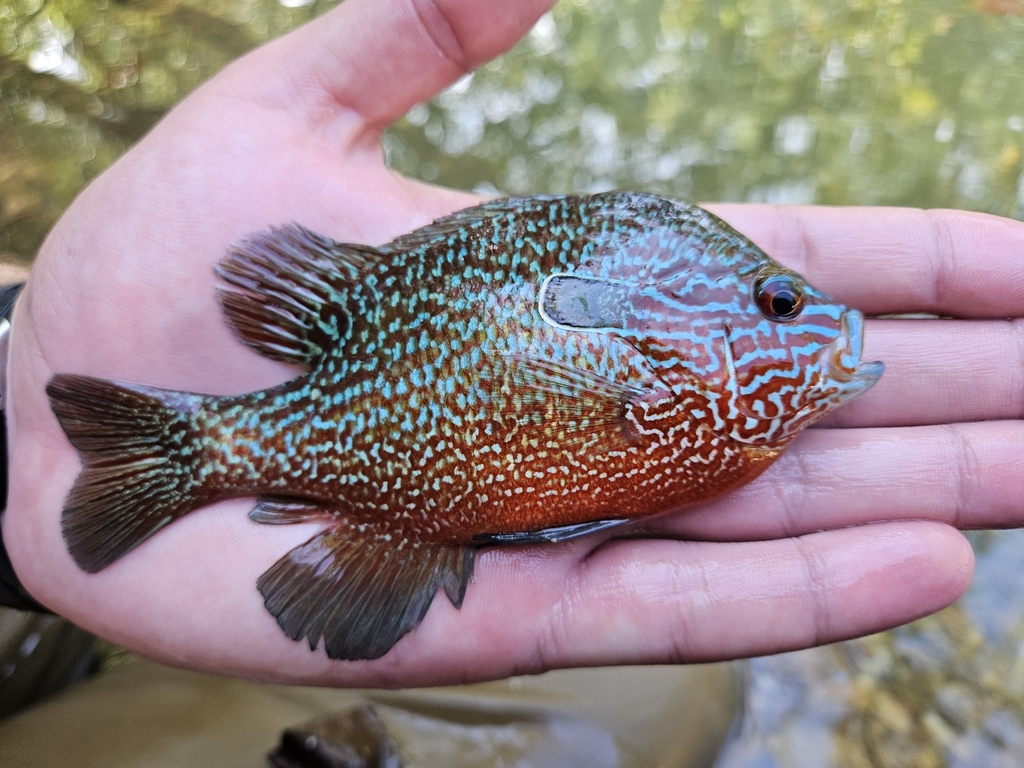
Longear Sunfish
Lepomis megalotis
The longear sunfish (Lepomis megalotis) is a freshwater fish in the sunfish family, Centrarchidae, of order Centrarchiformes. It is native to the area of eastern North America stretching from the Great Lakes down to northeastern Mexico. The longear sunfish reaches a maximum recorded length of about 24 cm (9.4 in), with a maximum recorded weight of 790 g (1.74 lb). Most do not live beyond six years. The longear sunfish is quite colorful, with an olive to rusty-brown back, bright orange belly and vermiculate blue-green bars on the sides of its head, the latter two features most pronounced in breeding males. A unique characteristic of longear sunfish is their elongated operculum flap, giving an appearance of a "long ear". It is black and often has a white margin. The pectoral fin is relatively short and would not reach the snout if it were reflected anteriorly. In breeding males, iridescent blue spots develop on the dorsum and sides and the fin membranes turn orange in all fins except the ventral ones, which may be blue to black, and the pectoral ones. Lepomis megalotis can be distinguished from closely related dollar sunfish L. marginatus by a greater number of cheek scale rows, by having one to two additional pectoral fin rays and by the slope of the opercular flap, which is distinctly upward in L. marginatus but is closer to horizontal in males of L. megalotis, although female and subadult L. megalotis may have upward slanting opercular flaps.
The species prefers densely vegetated, shallow waters in lakes, ponds, and sluggish streams.
From the article Longear sunfish on Wikipedia (CC BY-SA), quoted section by section
Range & habitat
Longear sunfish are found in North America, primarily in the Mississippi and Great Lakes regions. Longear sunfish are mostly found in freshwater areas west of the Appalachian Mountains. Some Lepomis populations are located as far north and west as southern Quebec and Minnesota. The species has also been spotted in places as far south and west as central Mexico and New Mexico. The species has been introduced to stream ecosystems along the eastern coast of the United States. The distribution of the longear sunfish throughout North America has not been affected since the species has been followed. This may be due to the species' ability to travel throughout large bodies of water, thus avoiding dams and man-made interferences along smaller streams. They are also able to occupy different body of water types, thus making them more resilient to a decrease in their range distribution.
Wikipedia: “Geographic distribution”
What it does
Longear sunfish feed more extensively near the surface of the water than other sunfish species. Lepomis megalotis is mostly a carnivorous fish that eats aquatic insects, small crustaceans, fish eggs, young bass, and even young sunfish. They have also been observed eating dragonflies and other insects which travel over the surface of the water. Other observed prey have been detritus, gnat larvae, snails, day flies and leeches. The diets of adult longear (longer than 102 mm) are composed of terrestrial insects (37%), fish (31%), aquatic insects (21%), and fish eggs (7%). Largemouth bass, smallmouth bass and wading birds are all natural predators to the longear sunfish. Smaller species of longear can be preyed on by larger sunfish populations. Sunfish are an important link in the food chain. They act as both predator and prey within their ecosystems. Other sunfish species and larger predatory fishes compete with the longear for food and resources. Longear sunfish, like additional members of the family Centrarchidae, are freshwater fish. They prefer streams with a firm clay bottom or gravel with clear waters and they typically stay nearby aquatic vegetation. Although more abundant near the sources of streams, sunfish can be found in water sources of all sizes and are also found in lakes. Longear sunfish usually reside in shallower, warmer headwaters of streams with a steady flow. …
Wikipedia: “Ecology”
In human culture
Longear sunfish tend to breed during the late spring and early summer (late May to late August). During breeding seasons they are generally found in shallower, warmer waters near the sources of streams which have pools. Like most other members of Lepomis, longear sunfish are colonial nesters. Male longear sunfish build the nests without assistance from the females. Preferred substrate for nesting is gravel, if available, but they will build in sand or hard mud if necessary. A male longear will guard the nest territory during all phases of reproduction. The clutch size can be anywhere from 140 to 2800 eggs per reproductive cycle. After hatching, it only takes the longear sunfish two to three years to reach sexual maturity. The average life-span of the Lepomis megalotis in the wild is usually four to six years, but there have been cases where individuals have lived up to nine years. Longear sunfish cannot tolerate cloudy or mucky water. Throughout the 20th century their populations have been reduced in areas where their native streams have suffered increased cloudiness. This cloudiness could potentially be a result of human induced erosion for agriculture or industry purposes. Increased human disturbance along streams and rivers could continue to increase the reduction of longear populations due to the murkiness of rivers and streams.
Wikipedia: “Life history”
Where it lives
Recorded sightings
—
geo-referenced records in GBIF, from museums, herbaria and field observers.
Drag the globe to turn it. Dots are where records exist, not a range map; darker means more records.
In the stacks
Searching the stacks…
Every page naming Lepomis megalotis in the Biodiversity Heritage Library →
This page is assembled live from iNaturalist, GBIF, Wikipedia, the Source Library and the Internet Archive. It is not yet part of the hand-edited codex. iNaturalist taxon 58635.