- Animals
- ›Chordates
- ›Vertebrates
- ›Ray-finned Fishes
- ›Spiny-rayed fishes
- ›Freshwater Sunfishes, Grunters, and Allies
- ›Freshwater Sunfishes and relatives
- ›Freshwater Sunfishes
- ›Lepominae
- ›Lepomis
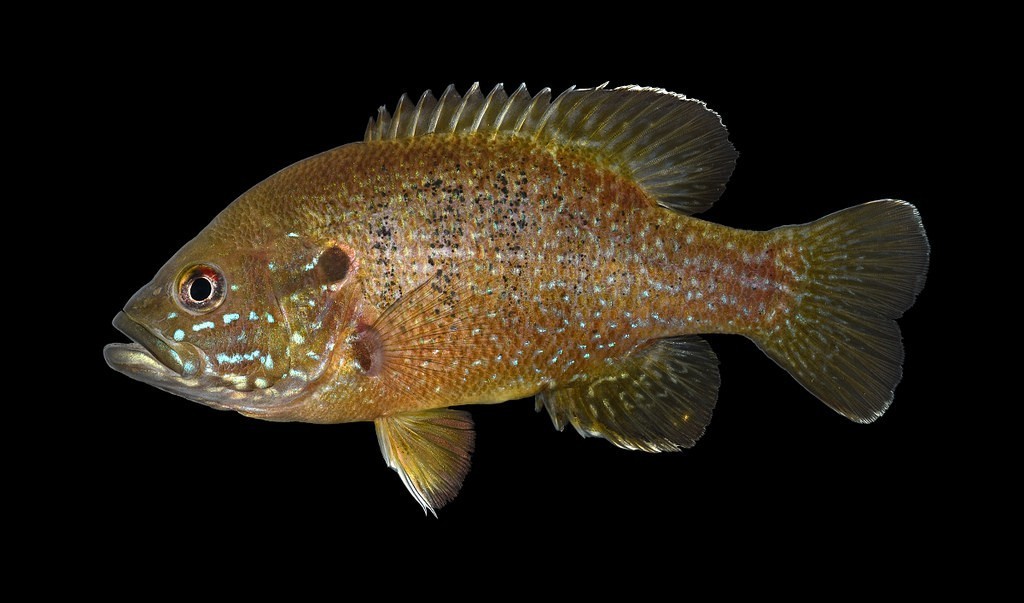
Green Sunfish
Lepomis cyanellus
The green sunfish (Lepomis cyanellus) is a species of freshwater fish in the sunfish family (Centrarchidae) of order Perciformes. A panfish popular with anglers, the green sunfish is also kept as an aquarium fish by hobbyists. They are usually caught by accident, while fishing for other game fish. Green sunfish can be caught with live bait such as nightcrawlers, waxworms, and mealworms. Grocery store baits such as pieces of hot dog or corn kernels can even...
From the article Green sunfish on Wikipedia (CC BY-SA), quoted section by section
Description
The green sunfish is blue-green in color on its back and sides with yellow-flecked bony-ridged (ctenoid) scales, as well as yellow coloration on the ventral sides. The gill covers and sides of head have broken bright blue stripes, causing some to mistakenly confuse them with bluegill. They also have a dark spot located near the back end of the dorsal fin, the base of the anal fin and on the opercular flap. The margins of the soft-rayed portion of the dorsal fin, the caudal fin, the ventral fins and the anal fin are orange or yellow, most pronounced in individuals during breeding periods. L. cyanellus has a relatively big mouth and long snout that extends to beneath the middle of the eye. Its pectoral fins are short with rounded edges containing 13 to 15 pectoral fin rays, a dorsal fin with about 10 dorsal spines followed by 10 to 12 rays and a homocercal tail. The typical length ranges from about 3–7 in and the fish usually weighs less than a pound. The green sunfish reaches a maximum recorded length of about 30 cm (12 in), with a maximum recorded weight of 960 g (2.12 lb). Identification of sunfish species from one another can sometimes be difficult as these species frequently hybridize.
Range & habitat
The green sunfish is native to a wide area of North America, from the Rocky Mountains in the west to the Appalachian Mountains in the east and from the Hudson Bay basin in Canada to the Gulf Coast in the United States and northern Mexico. They are specifically indigenous to a number of lakes and rivers, such as the Great Lakes and some of the basins of the Mississippi River. Green sunfish have been introduced to many bodies of water all across the United States. The green sunfish is considered an invasive species by the states of Arizona, California, Florida, Georgia and New Jersey, with unconfirmed presence in Vermont and New Hampshire, namely the Connecticut River and its tributaries. Their invasive potential is due in part to their penchant for chasing other sunfish away from mutually preferred habitat of submerged vegetation, a form of interference competition, their relatively large mouth, high fecundity and ability to tolerate sediment pollution. In the state of New Jersey, as of 2021, anglers must destroy green sunfish when caught and should report their catch to a state fisheries biologist. In the state of Florida, a permit is required in order to possess green sunfish as it is listed as a prohibited non-native species there. L. cyanellus has been transplanted to countries in Africa, Asia, and Europe, and has become established in some areas.
Wikipedia: “Geographic distribution”
What it does
Its diet can include aquatic insects and larvae, insects that fall into the water, crayfish, snails, other molluscs, turtle food, frogs, some small fish, fish eggs, bryozoans, zooplankton, other small invertebrates, and sometimes plant material. They are omnivores.
Wikipedia: “Diet”
In human culture
The generic name Lepomis derives from the Greek λεπίς (scale) and πώμα (cover, plug, operculum). The specific epithet, cyanellus, derives from the Greek κυανός (blue).
Wikipedia: “Etymology”
Where it lives
Recorded sightings
—
geo-referenced records in GBIF, from museums, herbaria and field observers.
Drag the globe to turn it. Dots are where records exist, not a range map; darker means more records.
In the stacks
Searching the stacks…
Every page naming Lepomis cyanellus in the Biodiversity Heritage Library →
This page is assembled live from iNaturalist, GBIF, Wikipedia, the Source Library and the Internet Archive. It is not yet part of the hand-edited codex. iNaturalist taxon 58636.