- Animals
- ›Chordates
- ›Vertebrates
- ›Ray-finned Fishes
- ›Carps, Characins, Catfishes and Allies
- ›Minnows, Suckers, Carps, and Loaches
- ›Suckers
- ›Suckers
- ›Typical Suckers
- ›Erimyzon
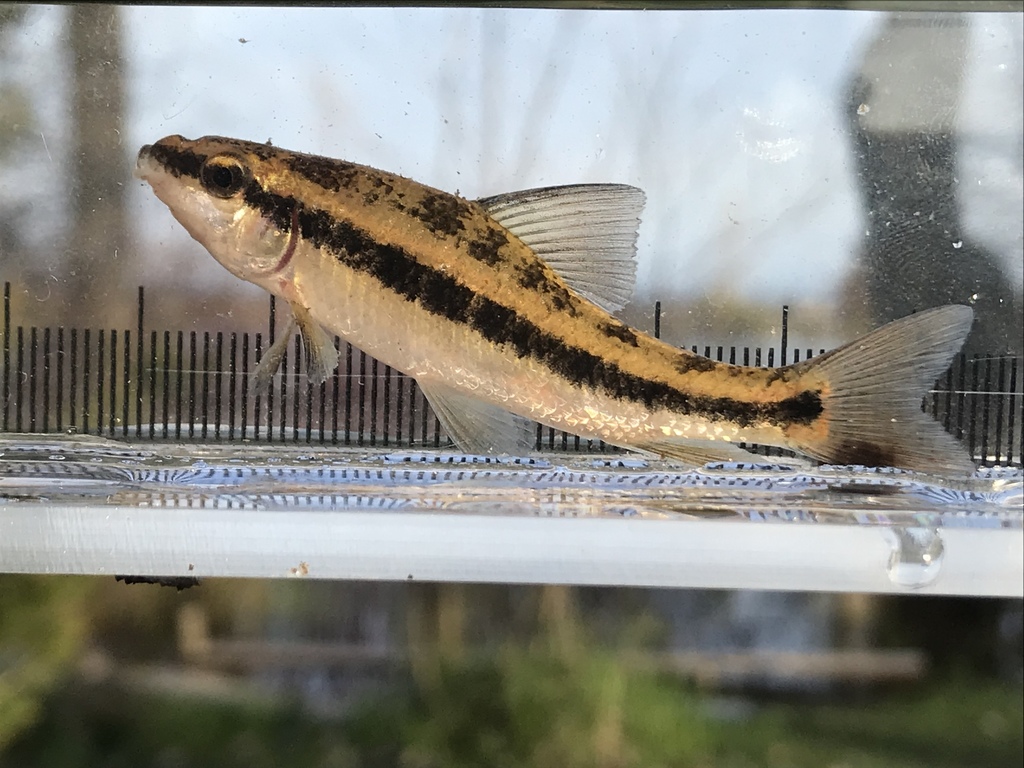
Lake Chubsucker
Erimyzon sucetta
The lake chubsucker (Erimyzon sucetta) is a species of freshwater fish endemic to North America, found in the Great Lakes and the Mississippi River basin, as far north as Ontario, Canada, extending south to the Gulf of Mexico. It is mainly found in lakes, ponds, and swamps, rarely in streams.
The fish is an intermediate level consumer that feeds on benthic detritus, specifically on microcrustacea and midge larvae. Its average length is 25.8 cm. E. sucetta reportedly scatters its eggs randomly over aquatic vegetation and submerged grass in ponds or over gravelly areas cleared by males.
From the article Lake chubsucker on Wikipedia (CC BY-SA), quoted section by section
Range & habitat
The lake chubsucker is found in North America in the Great Lakes and Mississippi River basin lowlands. Its range extends from southern Ontario to the Gulf of Mexico, west to Wisconsin and Texas, and east to Southern Virginia and South Florida. In the US it has been extirpated from areas of Southern Illinois, Iowa, and Pennsylvania. It is also declining in abundance in Missouri, Arkansas, Tennessee, and Ohio. This decline in abundance is largely due to habitat modification or destruction, such as changing the level of turbidity of the water, changing sedimentation levels, introducing exotic, invasive species, altering nutrient levels, and introducing toxins. In some of these areas, it is possible that the fish is still around in small numbers, but it is very difficult to collect and therefore hard to establish extirpation conclusively. In Canada the fish is thought to have been extirpated from Jeanette's Creek and areas of Big Creek and Tea Creek.
Wikipedia: “Geographic distribution”
What it does
The lake chubsucker is found in warmer waters, approximately 28°- 34 °C. Other specifications include clear, still water, with low turbidity. A high level of vegetative cover is also often present, often more than 70% coverage. Wetlands, ponds, and floodplain lakes are areas where the chubsucker is typically found. It is a benthic fish, preferring shallow, freshwater. They are found where the lakes have sand or silt mixed with organic debris. The chubsucker is an omnivore, eating both vegetation and invertebrates, such as small crustaceans, chironomid larvae, and algae. Vegetation can make up to 70% of its diet. When chubsuckers are small (83–103mm) filamentous algae had a 100% occurrence, cladocerans and chironomid larvae had a 25%, and copepods a 13% occurrence. However, when they are larger, (127–152mm) copepods becomes more important with a 50% occurrence, followed by algae with a 25% occurrence, and cladocera, ostracods, and chironomid larvae all had 13% occurrences. The fish's predators include largemouth bass (Micropterus salmoides), and other basses. Humans have the power to interfere with the chubsucker, particularly when it comes to coal combustion. Studies performed by Snodgrass et al. …
Wikipedia: “Ecology”
In human culture
This fish breeds in late March and continues until early July, and in individual areas the breeding period lasts about two weeks. The eggs are spread either over vegetation or in gravelly areas, which have been previously cleared by the male. The number of eggs varies between 3000 and 20,000. Its eggs hatch after one week and the juveniles become sexually mature at three, while its lifespan generally ranges five to six years. Juveniles and first-time breeders are most sensitive to changes in the environment, as are often caused by humans, such as diverting rivers, and thereby changing turbidity of the water. Increased siltation also hit these two stages the hardest as such activity changes the substrates on which the fish breeds, as well as where the small juveniles are trying to survive.
Wikipedia: “Life history”
Where it lives
Recorded sightings
—
geo-referenced records in GBIF, from museums, herbaria and field observers.
Drag the globe to turn it. Dots are where records exist, not a range map; darker means more records.
In the stacks
Searching the stacks…
Every page naming Erimyzon sucetta in the Biodiversity Heritage Library →
This page is assembled live from iNaturalist, GBIF, Wikipedia, the Source Library and the Internet Archive. It is not yet part of the hand-edited codex. iNaturalist taxon 58660.