- Animals
- ›Chordates
- ›Vertebrates
- ›Birds
- ›Swifts and Hummingbirds
- ›Hummingbirds
- ›Bee Hummingbirds, Emeralds, Mountain-gems, and Allies
- ›Mountain-gems and Allies
- ›Heliomaster
On eBird ↗
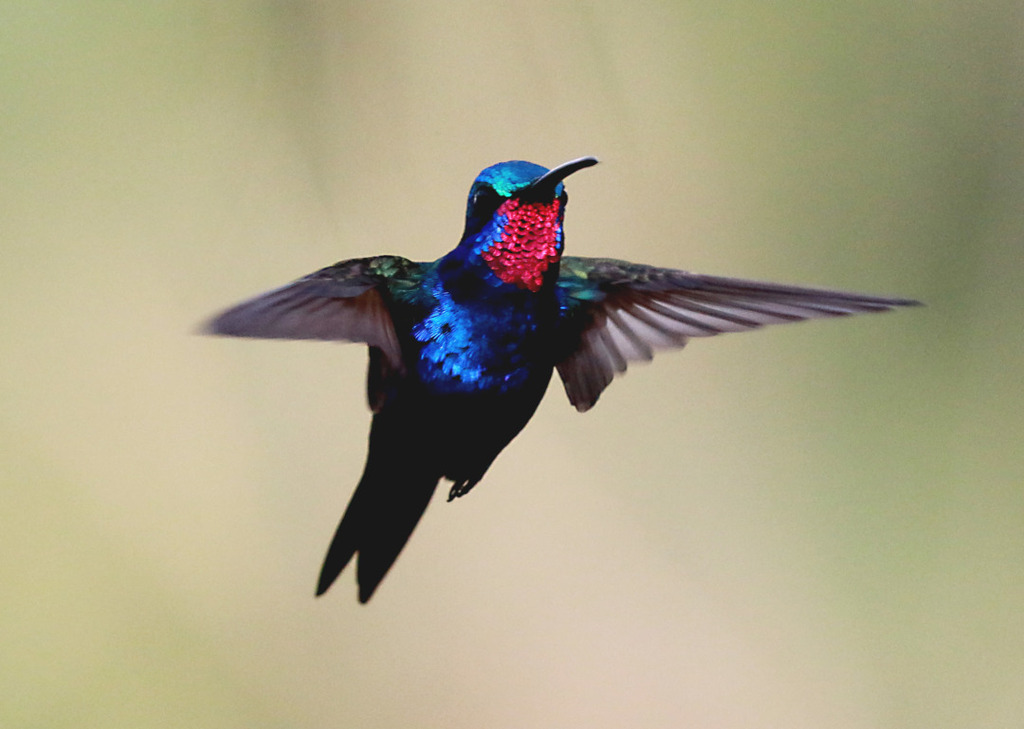
Blue-tufted Starthroat
Live sightings near you, the range map, bar charts of when it is seen, and Macaulay Library photos and recordings.
Blue-tufted Starthroat
Heliomaster furcifer
The blue-tufted starthroat (Heliomaster furcifer) is a species of hummingbird in the family Trochilidae. It is found in Argentina, Bolivia, Brazil, Colombia, Paraguay, Uruguay, and possibly Ecuador. Its natural habitats are subtropical or tropical dry forest, subtropical or tropical moist lowland forest, and dry savanna.
From the article Blue-tufted starthroat on Wikipedia (CC BY-SA), quoted section by section
Description
The blue-tufted starthroat is 12.6 to 13 cm (5.0 to 5.1 in) long and weighs 5 to 6.5 g (0.18 to 0.23 oz). Both sexes of all subspecies have a long, decurved, black bill and a small white spot behind the eye. Both have a forked tail but the female's is less deeply indented than the male's. Males in breeding plumage have an emerald green crown, nape, and upper back; the rest of the upperparts are shining coppery green. The throat is glittering violet. The underparts and elongated feathers on the sides of the neck are iridescent ultramarine. The tail is dark green on its upper side and blue-green below. Non-breeding males are grayish below like females. Females have coppery green upperparts. The throat and underparts are gray, with a white line down the middle of the belly and green spots on the flanks. The tail is bronze green above with black tips on the central feathers; it is shining blue-green below with white tips on the outer feathers.
Range & habitat
The core of the blue-tufted starthroat's range is eastern Bolivia, southern Brazil, Paraguay, northern Argentina, and northern Uruguay. It has also been documented in Colombia and Peru and has one undocumented sight record in Ecuador. It inhabits open landscapes such as forest edges, cerrado, and grasslands.
Wikipedia: “Distribution and habitat”
What it does
The blue-tufted starthroat feeds on nectar from a wide variety of flowering plants. It is one of the major pollinators of Dolichandra cynanchoides, a flowering vine. It typically forages between 2 and 8 m (7 and 30 ft) above the ground. Males defend flower patches. In addition to nectar, it also feeds on small insects captured by hawking.
Wikipedia: “Feeding”
Listen
Looking for field recordings…
Where it lives
Recorded sightings
—
geo-referenced records in GBIF, from museums, herbaria and field observers.
Drag the globe to turn it. Dots are where records exist, not a range map; darker means more records.
In the stacks
Searching the stacks…
Every page naming Heliomaster furcifer in the Biodiversity Heritage Library →
This page is assembled live from iNaturalist, GBIF, Wikipedia, the Source Library and the Internet Archive. It is not yet part of the hand-edited codex. iNaturalist taxon 5868.