- Animals
- ›Chordates
- ›Vertebrates
- ›Birds
- ›Swifts and Hummingbirds
- ›Hummingbirds
- ›Bee Hummingbirds, Emeralds, Mountain-gems, and Allies
- ›Mountain-gems and Allies
- ›Heliomaster
On eBird ↗
Long-billed Starthroat
Live sightings near you, the range map, bar charts of when it is seen, and Macaulay Library photos and recordings.
Long-billed Starthroat
Heliomaster longirostris
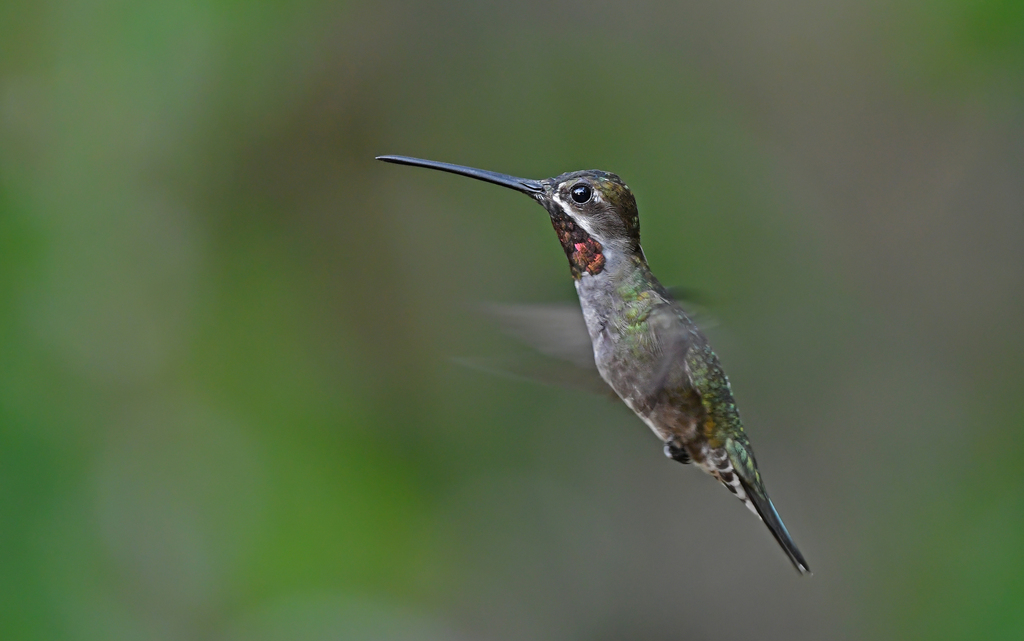
The long-billed starthroat (Heliomaster longirostris) is a hummingbird that breeds from southern Mexico to Panama, from Colombia south and east to Bolivia and Brazil, and on Trinidad. It is present throughout South and Central America and is an uncommon but widespread species, which appears to be a local or seasonal migrant, although its movements are not well understood.
From the article Long-billed starthroat on Wikipedia (CC BY-SA), quoted section by section
Description
The long-billed starthroat is 11 to 12 cm (4.3 to 4.7 in) long. Males weigh 5.5 to 7.1 g (0.19 to 0.25 oz) and females about 6.5 g (0.23 oz). Both sexes of all subspecies have a long, almost straight, black bill and a small white spot behind the eye. Males of the nominate subspecies have a glittering blue to greenish blue crown; the rest of its upperparts are dark bronzy green with the exception of a white stripe down the center of the rump. The face is black below the crown and has a white malar stripe below the black. Its tail is rather short and square-tipped. The feathers are bronzy green near the body and black away from it, and the outer two or three pairs have white tips. The chin is black, the gorget dark metallic purple, the breast gray with bronzy green sides, and the lower breast and belly dull white. The undertail coverts are gray with white edges. Nominate females are very similar but the blue of the crown is much reduced or absent and the gorget is narrower and dusky gray. Subspecies H. l. pallidicepts has a more greenish blue crown than the nominate and the sides of the breast are golden bronze. H. l. albicrissa is identical to the nominate except that its undertail coverts are mostly to entirely white.
Range & habitat
Subspecies H. l. pallidicepts of long-billed starthroat is the northernmost; it is found from southern Mexico through Belize, Guatemala, Honduras, and El Salvador into Nicaragua. The nominate H. l. longirostris is the most widespread. It is found from Costa Rica through Panama, into South America as far south as eastern Peru and eastern Bolivia and east through the Guianas well into Brazil, and on Trinidad. H. l. albicrissa has a restricted range in western Ecuador and northwestern Peru. The species inhabits a variety of humid semi-open landscapes including the edges of woodland, isolated woodlands, pastures with trees, gallery forest, and secondary forest. It shuns the interior of closed forest. It is a bird of the lowlands and foothills that ranges in elevation from sea level to about 1,500 m (4,900 ft).
Wikipedia: “Distribution and habitat”
What it does
The long-billed starthroat feeds on nectar, especially at the flowers of large trees but also those of vines, shrubs, and Heliconia. It forages both by trap-lining (visiting a circuit of flowering plants) and by defending flower-laden trees. It also feeds on small insects, often capturing them on the wing high in the air and sometimes by gleaning from vegetation.
Wikipedia: “Feeding”
Listen
Looking for field recordings…
Where it lives
Recorded sightings
—
geo-referenced records in GBIF, from museums, herbaria and field observers.
Drag the globe to turn it. Dots are where records exist, not a range map; darker means more records.
In the stacks
Searching the stacks…
Every page naming Heliomaster longirostris in the Biodiversity Heritage Library →
This page is assembled live from iNaturalist, GBIF, Wikipedia, the Source Library and the Internet Archive. It is not yet part of the hand-edited codex. iNaturalist taxon 5869.