On eBird ↗
Cackling Goose
Live sightings near you, the range map, bar charts of when it is seen, and Macaulay Library photos and recordings.
Cackling Goose
Branta hutchinsii
The cackling goose (Branta hutchinsii) is a North American bird of the genus Branta of black geese, which contains species with largely black plumage, distinguishing them from the grey Anser species.
From the article Cackling goose on Wikipedia (CC BY-SA), quoted section by section
Description
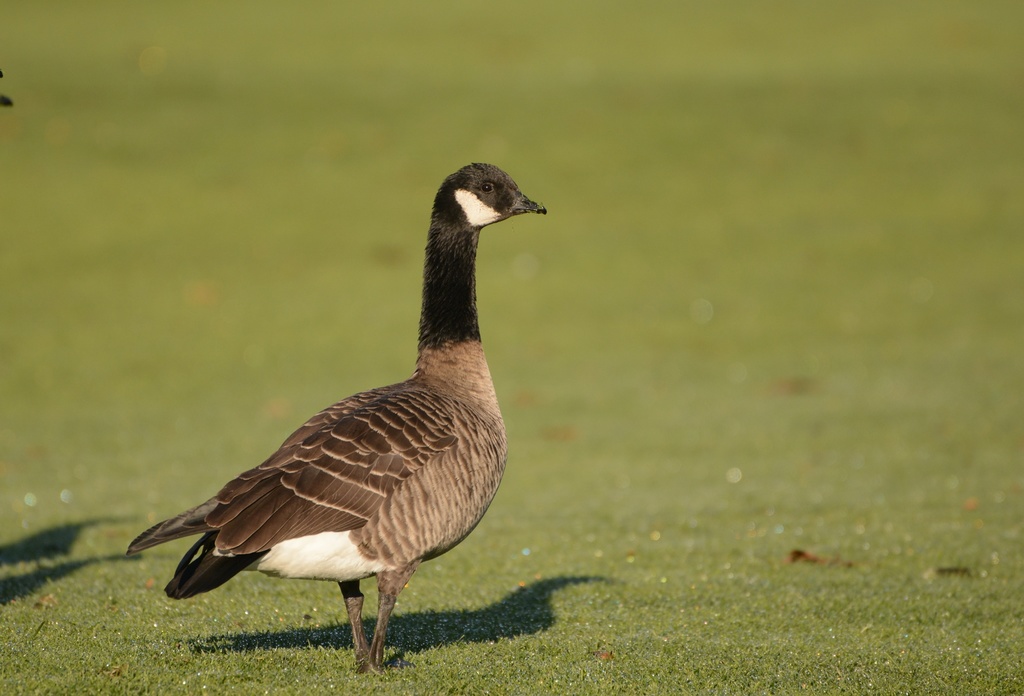
The black head and neck with white "chinstrap" distinguish this goose from all other geese except the larger Canada goose (Branta canadensis) and the similarly sized barnacle goose (B. leucopsis). There are up to five subspecies of cackling goose of varying sizes and plumage details. The female looks virtually identical but is slightly lighter and has a different voice. Some are hard to distinguish from the Canada goose, with which the cackling goose was long assumed to form one species, the cackling goose and the smaller Canada goose subspecies being called the lesser Canada goose. The smallest 1.4 kg (3.1 lb) cackling geese (B. h. minima) are much smaller than any Canada goose, but the subspecies B. h. hutchinsii, at up to 3 kg (6.6 lb), grows to the same size as some Canada geese. The distinctness of the extinct population of the Komandorski and Kuril Islands B. h. asiatica is controversial. The barnacle goose differs in having a black breast and grey, rather than brownish, body plumage. Measurements:
Length: 24.8–25.6 in (63–65 cm) Weight: 49.3–84.0 oz (1,400–2,380 g) Wingspan: 42.5–43.7 in (108–111 cm)
Range & habitat
This species is native to North America, breeding in Northern Canada and Alaska in a variety of tundra habitats, where the nest is usually located in an elevated area near water. The eggs are laid in a shallow depression, lined with plant materials and down. However, as the nests are made close-to, or directly on, the ground, the eggs (along with lone nesting females and newly-hatched goslings) are particularly vulnerable to predation by certain mammalian carnivores. Depending on the region, potential threats may vary from free-ranging domestic or feral cats and dogs, to foxes, coyotes, rats and other animals, such as some species of snakes. Thus, as a result, both geese—especially the male—in a nesting pair become highly aggressive and defensive of the nesting site, even chasing people away who may happen to walk by. A pair may mate for life (up to around 20 years). Adult geese are often seen leading their goslings in a line with one parent at the front, and the other at the back of the "parade". Like most geese, the cackling goose is naturally migratory, with their overwintering range being most of the U.S. (locally in Western Canada, the West Coast of the U.S. and northern Mexico). The calls overheard from large flocks of cackling geese, flying in their typical "V"-shaped formation, signal the transitions into spring and fall. …
Wikipedia: “Range”
What it does
These birds feed mainly on plant material. When feeding in water, they submerge their heads and necks to reach aquatic plants, sometimes tipping forward like a dabbling duck. Flocks of these birds often feed on leftover cultivated grains in fields, especially during migration or in winter. They also eat some insects, molluscs and crustaceans.
Wikipedia: “Feeding”
Listen
Looking for field recordings…
Where it lives
Recorded sightings
—
geo-referenced records in GBIF, from museums, herbaria and field observers.
Drag the globe to turn it. Dots are where records exist, not a range map; darker means more records.
In the stacks
Searching the stacks…
Every page naming Branta hutchinsii in the Biodiversity Heritage Library →
This page is assembled live from iNaturalist, GBIF, Wikipedia, the Source Library and the Internet Archive. It is not yet part of the hand-edited codex. iNaturalist taxon 59220.