- Animals
- ›Chordates
- ›Vertebrates
- ›Birds
- ›Perching Birds
- ›Old World Flycatchers, Robins, and Chats
- ›Myophonus
On eBird ↗
Malayan Whistling-Thrush
Live sightings near you, the range map, bar charts of when it is seen, and Macaulay Library photos and recordings.
Malayan Whistling-Thrush
Myophonus robinsoni
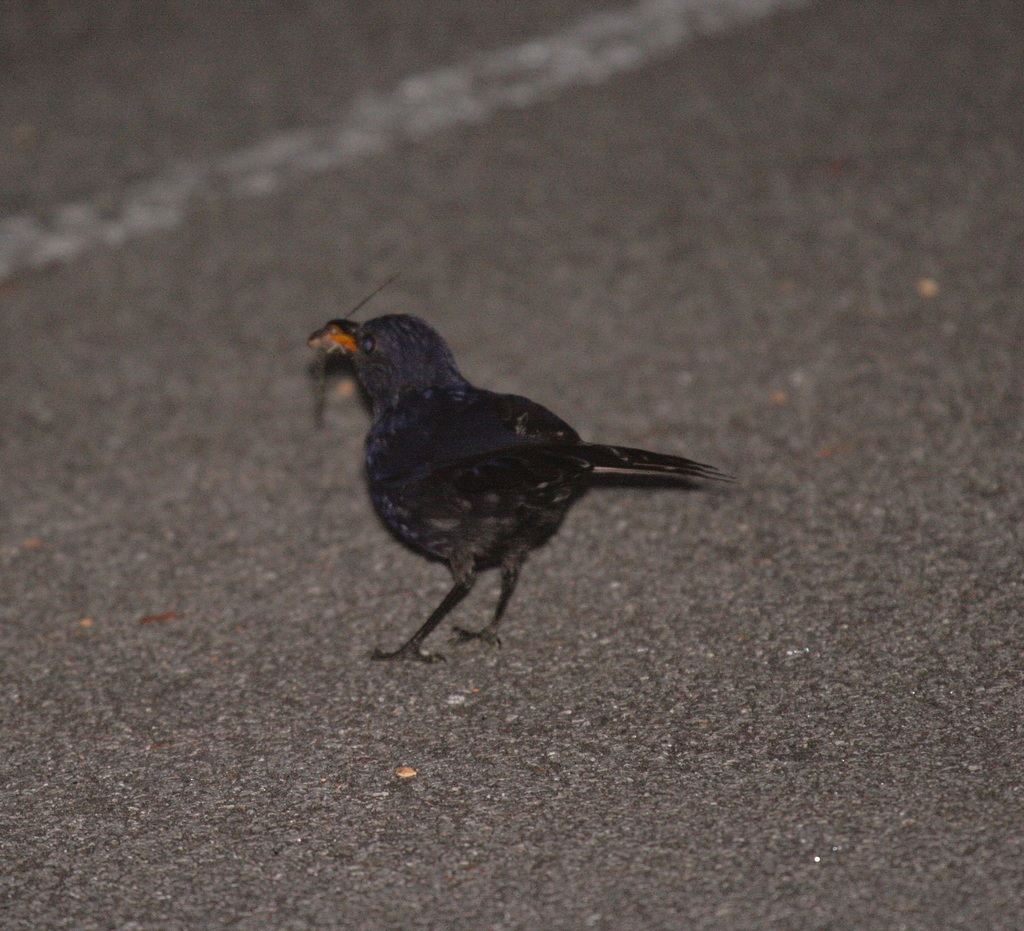
The Malayan whistling thrush or Malaysian whistling-thrush (Myophonus robinsoni) is a species of bird in the family Muscicapidae. It is endemic to the Malay Peninsula. Due primarily to habitat loss, its population is thought to be in decline.
From the article Malayan whistling thrush on Wikipedia (CC BY-SA), quoted section by section
Description
The species is monotypic. Its length is 25–26 cm (9.8–10.2 in). The length of the wings of the male is 14–15 cm (5.5–5.9 in). The wing length of the female is 13 cm (5.1 in). Its weight is 87–105 g (3.1–3.7 oz). The male is mostly black-blue. Parts of the head are deep purplish-blue. There is a patch of metallic blue in the lesser coverts. The male and female are very similar. The female is slightly browner and slightly smaller. The juvenile is sootier.
Range & habitat
Its natural habitat is montane forests. It is usually found near streams. It is situated at elevations of about 750–1,750 m (2,460–5,740 ft) in central peninsular Malaysia. The Malayan whistling thrush historically ranged from the Cameron Highlands to the Genting Highlands. It was present in the Cameron Highlands, where it was trapped in the 1950s and 1960s, but a further survey in 2009–2010 failed to find it there, bringing into question the reliability of intermediate sightings; it is possible that there may have been confusion with the subspecies dicrorhynchus of the blue whistling thrush (Myophonus caeruleus). Since 1980, it has been trapped and recorded with certainty only in Fraser's Hill.
Wikipedia: “Distribution and habitat”
What it does
Its call is a tseee. Its song contains "fluty and scratchy notes". Its diet is probably insects. Breeding has been observed in March and September. The clutch size is 1–2 eggs. The eggs are bluish-grey with pinkish-brown specks. The nest is built of dried plant material and is in a half-cup shape.
Wikipedia: “Behaviour and ecology”
Listen
Looking for field recordings…
Where it lives
Recorded sightings
—
geo-referenced records in GBIF, from museums, herbaria and field observers.
Drag the globe to turn it. Dots are where records exist, not a range map; darker means more records.
In the stacks
Searching the stacks…
Every page naming Myophonus robinsoni in the Biodiversity Heritage Library →
This page is assembled live from iNaturalist, GBIF, Wikipedia, the Source Library and the Internet Archive. It is not yet part of the hand-edited codex. iNaturalist taxon 59846.