On eBird ↗
Nilgiri Laughingthrush
Live sightings near you, the range map, bar charts of when it is seen, and Macaulay Library photos and recordings.
Nilgiri Laughingthrush
Montecincla cachinnans
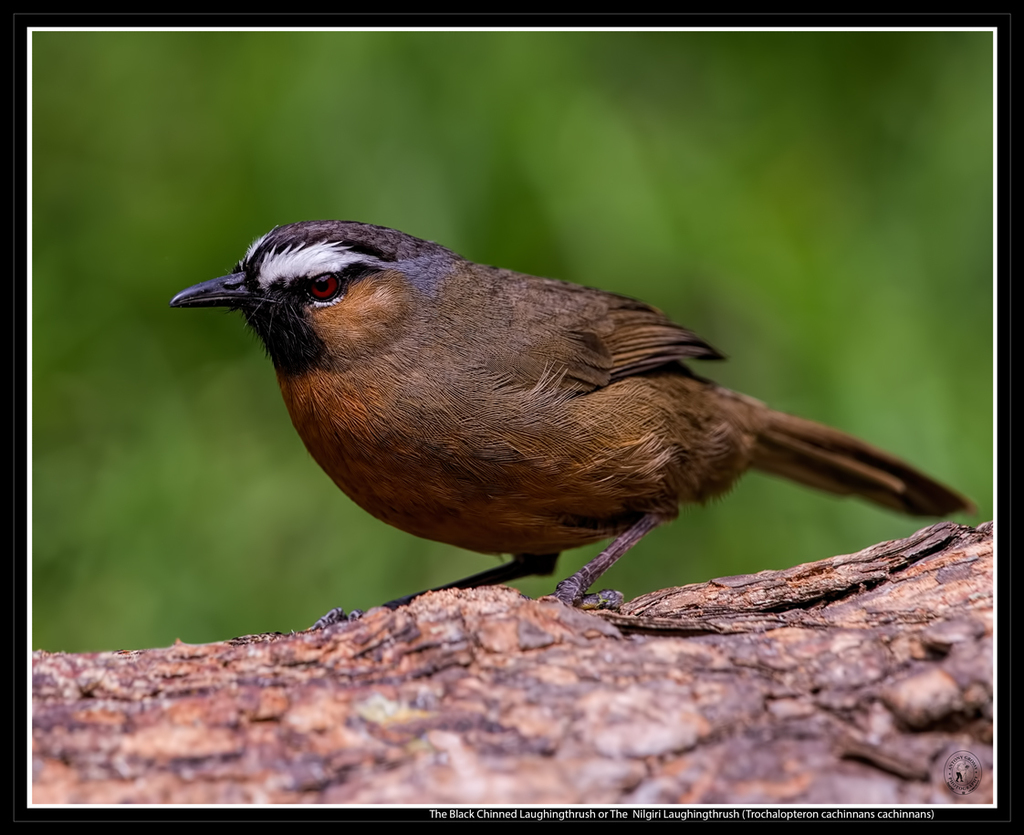
The Nilgiri laughingthrush (Montecincla cachinnans) is a species of laughingthrush endemic to the high elevation areas of the Nilgiris and adjoining hill ranges in Peninsular India. The mostly rufous underparts, olive brown upperparts, a prominent white eyebrow and a black throat make it unmistakable. It is easily detected by its loud series of nasal call notes and can be hard to spot when it is hidden away inside a patch of dense vegetation. The species has a confusing taxonomic history, leading to a range of names. In the past the species was considered to have two subspecies, the nominate form in the Nilgiris (earlier called the black-chinned laughingthrush or rufous-breasted laughingthrush) and jerdoni (which is now treated as a full species, the Banasura laughingthrush) with a grey upper breast and found in the Brahmagiris of Coorg and Banasura range of Wayanad. They are omnivorous, feeding on a range of insects, berries and nectar.
From the article Nilgiri laughingthrush on Wikipedia (CC BY-SA), quoted section by section
Description
This laughingthrush is about 24 cm long with a rufous underside and a dark olive grey upper body. The crown is slaty brown and there is a jagged and broad white supercilium margined with black. The throat, lores and a streak behind the eye are black. The tail is olive brown. The iris is reddish brown and the legs and bill are black. The upper breast is grey in the Banasura laughingthrush which can appear somewhat like fairbanki although the throat of the latter is grey and the two do not overlap in range. It is unmistakable in plumage although at a quick glance it can be mistaken for an Indian scimitar babbler.
What it does
The Nilgiri laughingthrush lives in dense forest patches on the Nilgiri and Wayanad ranges above the elevation of 1,200 m (3,900 ft). It forages along the forest edge singly or in small groups low in the trees and sometimes on the ground. They are active in the early morning and late afternoon and are extremely vocal. While one bird calls in a series of loud ascending and descending nasal notes, another in a nearby bush produces a series of sharp kek notes. They feed on the nectar of Lobelia excelsa and Rhododendron in winter. When Strobilanthes is in bloom, the birds feed on its nectar as well as its petals. They feed on the fruits of Ilex spp., Solanum auriculatum, Eurya japonica, Rhamnus wightii, Pyrus baccata, Rubus spp., Mahonia leschenaultii and Rhodomyrtus tomentosa ("hill guava"). Insects are crushed before swallowing and sometimes battered against a hard substrate. Small tree-frogs are sometimes taken. Large fruits are sometimes held under their foot and torn apart. They tend to forage on the open ground at dawn and dusk and mostly glean from vegetation during the rest of the day.
The Nilgiri laughingthrush nests from February to the beginning of June. The nest is a cup placed at about 1–2 m (3 ft 3 in – 6 ft 7 in) above the ground in a clump of dense undergrowth, often close to a stream or marsh in the edge of a shola. The male as well as the female build the nest. …
Wikipedia: “Behaviour and ecology”
Listen
Looking for field recordings…
Where it lives
Recorded sightings
—
geo-referenced records in GBIF, from museums, herbaria and field observers.
Drag the globe to turn it. Dots are where records exist, not a range map; darker means more records.
In the stacks
Searching the stacks…
Every page naming Montecincla cachinnans in the Biodiversity Heritage Library →
This page is assembled live from iNaturalist, GBIF, Wikipedia, the Source Library and the Internet Archive. It is not yet part of the hand-edited codex. iNaturalist taxon 602390.