On eBird ↗
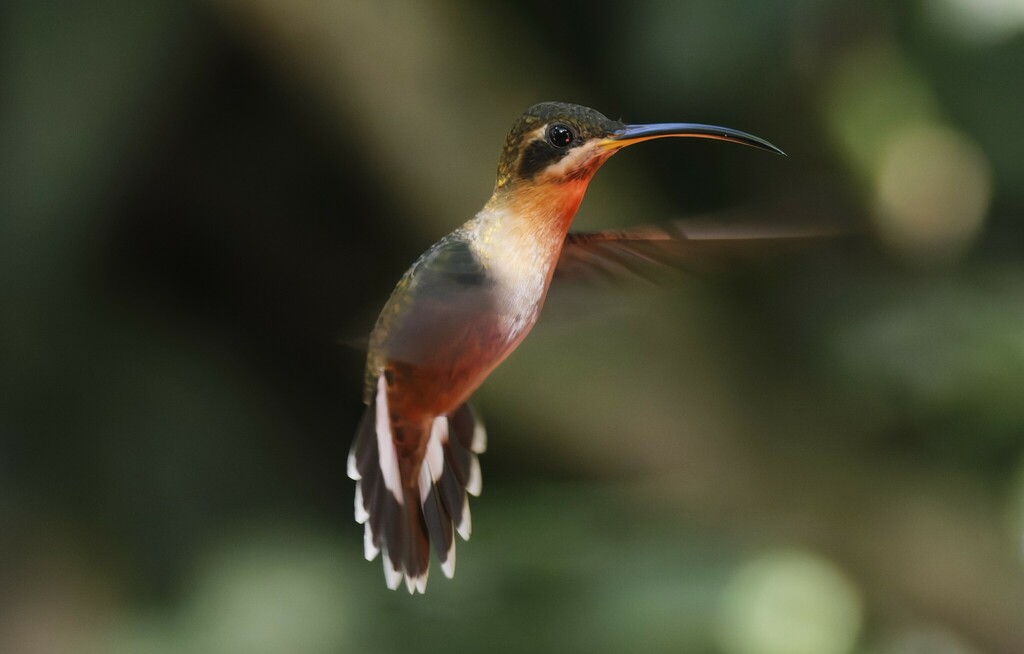
Band-tailed Barbthroat
Live sightings near you, the range map, bar charts of when it is seen, and Macaulay Library photos and recordings.
Band-tailed Barbthroat
Threnetes ruckeri
The band-tailed barbthroat (Threnetes ruckeri) is a medium-sized hummingbird which is a resident breeder from southeastern Guatemala and Belize to western Ecuador and western Venezuela.
From the article Band-tailed barbthroat on Wikipedia (CC BY-SA), quoted section by section
Description
The band-tailed barbthroat is 10 to 11 cm (3.9 to 4.3 in) long. Males weigh 5.5 to 7 g (0.19 to 0.25 oz) and females 5 to 7 g (0.18 to 0.25 oz).The adult male of the nominate subspecies has bronze-green upperparts, a dark ear patch and chin, and a dusky malar stripe. The tail is dark with white bases and tips to the feathers that create a black band near the end. The throat is ochraceous and the underparts are otherwise gray with some green feathers. It has a nearly straight bill. As with other hermit hummingbirds, the sexes are similar; the female's bill is somewhat more decurved than the male's and the plumage has less contrast among the throat, breast, and belly. Young birds resemble the adult but have ochraceous feather edges. T. r. venezuelensis has a somewhat larger ochraceous throat patch than the nominate. T. r. ventosus has a much larger and bright orange throat patch and an ochraceous tinge to the belly.
Range & habitat
T. r. ventosus is the northernmost subspecies of band-tailed barbthroat. It is found from eastern Guatemala and Belize through Honduras, Nicaragua, and Costa Rica into Panama. The nominate T. r. ruckeri is found from northern and western Colombia south through western Ecuador almost to Peru. T. r. venezuelensis is found in northwestern Venezuela. The species inhabits the understory and edges of primary forest and old second growth, and also semi-open shrublands, thickets, and plantations. In elevation it ranges from sea level to 1,200 m (3,900 ft).
Wikipedia: “Distribution and habitat”
What it does
Like other hermit hummingbirds, the band-tailed barbthroat is a "trap-line" feeder, visiting a circuit of flowering plants. It feeds on nectar at Heliconia and other tubular flowers and also on small arthropods, especially spiders. In addition to probing flowers for nectar, it also "robs" by piercing the base of the tube.
Wikipedia: “Feeding”
Listen
Looking for field recordings…
Where it lives
Recorded sightings
—
geo-referenced records in GBIF, from museums, herbaria and field observers.
Drag the globe to turn it. Dots are where records exist, not a range map; darker means more records.
In the stacks
Searching the stacks…
Every page naming Threnetes ruckeri in the Biodiversity Heritage Library →
This page is assembled live from iNaturalist, GBIF, Wikipedia, the Source Library and the Internet Archive. It is not yet part of the hand-edited codex. iNaturalist taxon 6032.