- Animals
- ›Chordates
- ›Vertebrates
- ›Reptiles
- ›Snakes and Lizards
- ›Snakes
- ›Colubrid Snakes
- ›Colubrine Snakes
- ›Lampropeltis
- ›Lampropeltis getula
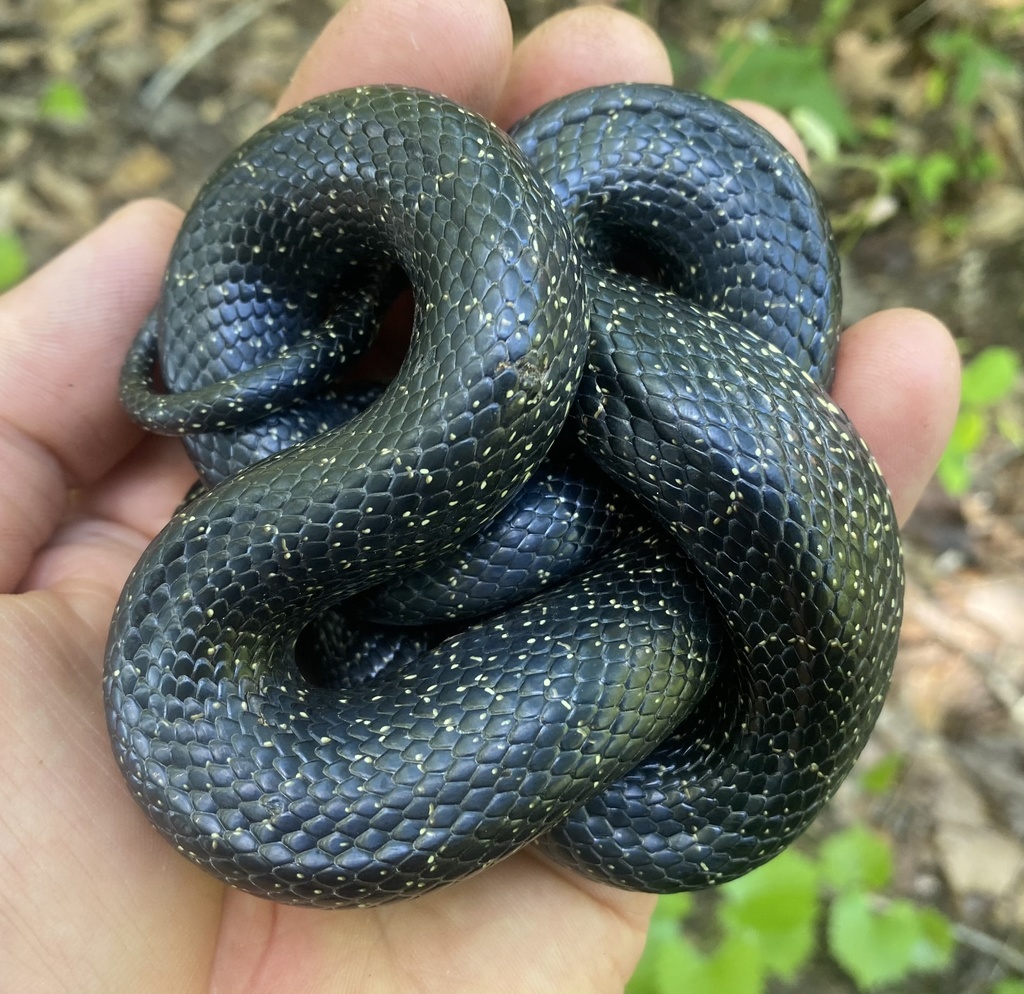
Black Kingsnake
Lampropeltis nigra
Lampropeltis nigra, commonly known as the black kingsnake, is a species of nonvenomous colubrid snake indigenous to the United States. It is a species of kingsnake.
From the article Lampropeltis nigra on Wikipedia (CC BY-SA), quoted section by section
Description
The black kingsnake is a large to medium constrictor. Adult specimens attain an average size of 90 to 122 centimetres (35 to 48 in) in total length, with some reaching maximum total lengths of 147 to 183 centimetres (58 to 72 in). It is generally similar to L. getula getula, although it can be distinguished by its geography and appearance. It has a black body that is interspersed with widely spaced yellow or cream-colored speckles, larger and more numerous along the sides. The dorsum in some is unpatterned and in others crossbanded. The venter displays a checked black and yellow (or cream) pattern. Ventral scales range from 197 to 222 in both sexes, with subcaudal scales ranging from 45 to 59 in males and 37 to 51 in females. Black kingsnakes are also ophiophagous (snake-eating) and are immune to the venom of some snake species.
Range & habitat
The black kingsnake is found in the southeastern quarter of the United States, ranging from southern Illinois to Ohio, then down along the foothills of the Appalachian Mountains and the Alabama River watershed to the northern Gulf Coast in south Alabama and along the coast to the Mississippi River in Louisiana.
Wikipedia: “Geographic range”
Where it lives
Recorded sightings
—
geo-referenced records in GBIF, from museums, herbaria and field observers.
Drag the globe to turn it. Dots are where records exist, not a range map; darker means more records.
In the stacks
Searching the stacks…
Every page naming Lampropeltis nigra in the Biodiversity Heritage Library →
This page is assembled live from iNaturalist, GBIF, Wikipedia, the Source Library and the Internet Archive. It is not yet part of the hand-edited codex. iNaturalist taxon 60348.