On eBird ↗
Crimson-crowned Fruit-Dove
Live sightings near you, the range map, bar charts of when it is seen, and Macaulay Library photos and recordings.
Crimson-crowned Fruit Dove
Ptilinopus porphyraceus
The crimson-crowned fruit dove, also the Tongan fruit dove or purple-capped fruit dove (Ptilinopus porphyraceus), is a species of bird in the family Columbidae. In the Samoan language, it is known as the manutagi. In Tonga and Niue, it is known as the kulukulu.
It is found in American Samoa, Fiji, the Marshall Islands, Niue, Samoa, Tonga, and Wallis and Futuna. Its natural habitats are subtropical or tropical moist lowland forest and subtropical or tropical mangrove forest.
From the article Crimson-crowned fruit dove on Wikipedia (CC BY-SA), quoted section by section
Description
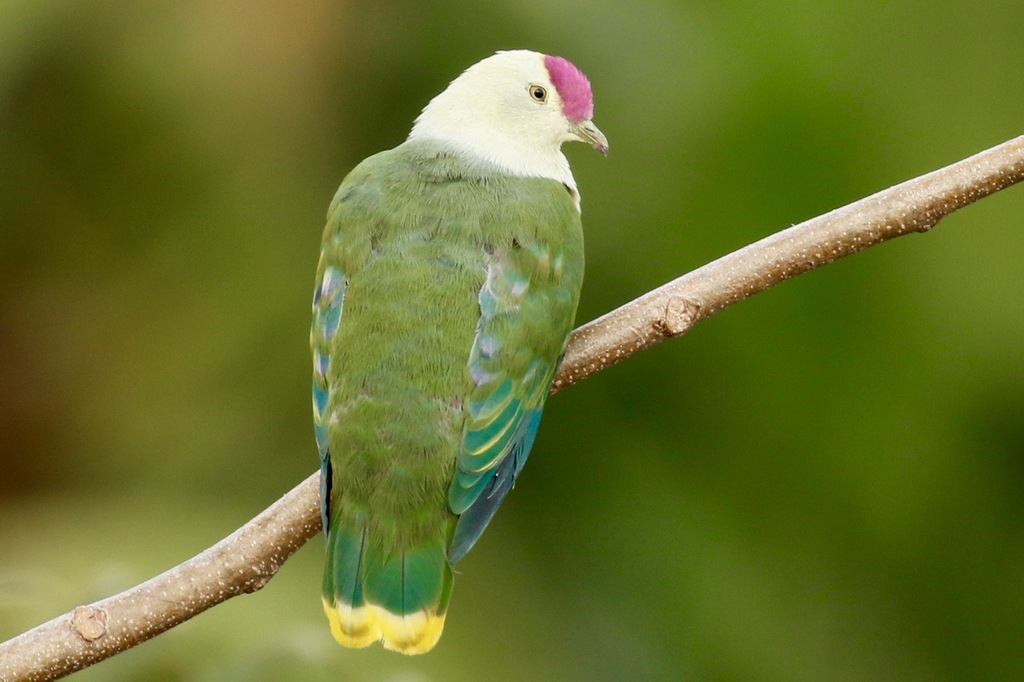
The crimson-crowned fruit dove (Ptilinopus porphyraceus) is a small dove in the genus Ptilinopus, about 23 cm (9 in) in length. Its plumage is two-toned green, with a distinctive purple-crimson cap and pale greenish-gray head, neck, breast, and upper back. A dusky patch marks the area between the breast and belly, while the undertail-coverts are orange-yellow. The tail ends in a pale band, which is gray in birds from Fiji and Tonga. There is limited demonstration of sexual dimorphism in this species, as males and females have similar plumage. However, the species demonstrates ontogenetic variation, as juveniles are bright green with yellow edges on their feathers.
Range & habitat
The distribution of this species extends across islands in Fiji, Tonga, Niue, and the Samoan Islands. Its populations occur on separate islands and island groups throughout the southwestern Pacific, rather than inhabiting a continuous geographic range. The species is associated with the biogeographic region of western Polynesia, which includes Fiji, Tonga, and Samoa. However, its precise distribution depends partly on which taxonomic classification is followed. The crimson-crowned fruit dove inhabits tropical island environments, particularly forested areas that supply fruit and suitable trees for feeding and shelter. Studies have documented it in mature native forest, secondary forest, regenerating woodland, bush clearings, and some agricultural landscapes. Although the species can occupy disturbed environments, research indicates that mature or relatively undisturbed forest often supports greater numbers of birds.
Ptilinopus p. porphyraceus. The nominate subspecies, P. p. porphyraceus, occurs in Fiji, Tonga, and Niue. In Tonga, researchers documented the species throughout the Vava'u island group, where it occurred on all 16 islands surveyed or was considered likely to occur there. The birds were common and widespread across this group, demonstrating that they can persist on numerous islands of different sizes. …
Wikipedia: “Distribution and habitat”
What it does
The crimson-crowned fruit dove is a frugivore, feeding primarily on fruit in forest canopies. In Tonga, the birds gather at fruiting trees, particularly figs, although they maintain separate breeding territories. On Rotuma, researchers observed the doves feeding on fruits of ylang-ylang (Cananga odorata) and figs. They also recorded the birds feeding on flowers of the ivory nut palm (Metroxylon warburgii), demonstrating that their diet includes plant material beyond fruit.
Wikipedia: “Diet”
At the table
People in the Samoan islands refer to this bird as manutagi, which means "lamenting bird" or "crying bird". In 1873, missionary and naturalist Samuel James Whitmee reported that Samoans commonly kept this bird in captivity. He described how hunters carried a manutagi into the woods in an open-topped wicker cage. The dove's calls attracted other birds, including the lupe, which entered the cage and were captured to be eaten later. Hunting of the manutagi continued into modern times in American Samoa. A survey of hunters on Tutuila in 1990–1991 estimated an annual harvest of approximately 500 manutagi after accounting for an unusually large, opportunistic harvest following a hurricane in 1990. The survey described bird hunting as a source of food and recreation, but these figures document twentieth-century use rather than pre-contact hunting levels. The crimson-crowned fruit dove, like the related many-colored fruit dove, may have had special spiritual connotations that made consuming or harming the bird taboo for the pre-contact Samoans, but direct documentation of the manutagi (as opposed to the manumā) in this context is lacking. In Tonga and Niue, ornithological studies record the local name kulukulu for the crimson-crowned fruit dove. Research on Niue found that people did not usually hunt the species at the time of a 2004 survey. …
Wikipedia: “Indigenous Names and Traditional Uses”
In human culture
The English name for this species is literal, and is derived from the purple-crimson plumage on the bird's head. The name for the bird in the Samoan language is manutagi, and is a compound of the words manu, meaning "bird", and tagi, meaning “to cry,” “to call,” or “to lament.” In all, the Samoan name for the bird calls it a "crying bird". The name for the bird for people in Niue and Tonga is kulukulu. This word is likely an onomatopoeia, as the name given to the bird phonetically mimics the sound that the bird makes. The scientific name of the bird is largely derived from Greek; porphyraceus means “purple-colored” or “purplish", which comes from the ancient Greek word porphyra (πορφύρα), meaning “purple dye” or “purple cloth,” and is also related to the Greek adjective porphyreos, meaning “purple-colored.”
Wikipedia: “Etymology”
Listen
Looking for field recordings…
Where it lives
Recorded sightings
—
geo-referenced records in GBIF, from museums, herbaria and field observers.
Drag the globe to turn it. Dots are where records exist, not a range map; darker means more records.
In the stacks
Searching the stacks…
Every page naming Ptilinopus porphyraceus in the Biodiversity Heritage Library →
This page is assembled live from iNaturalist, GBIF, Wikipedia, the Source Library and the Internet Archive. It is not yet part of the hand-edited codex. iNaturalist taxon 604095.