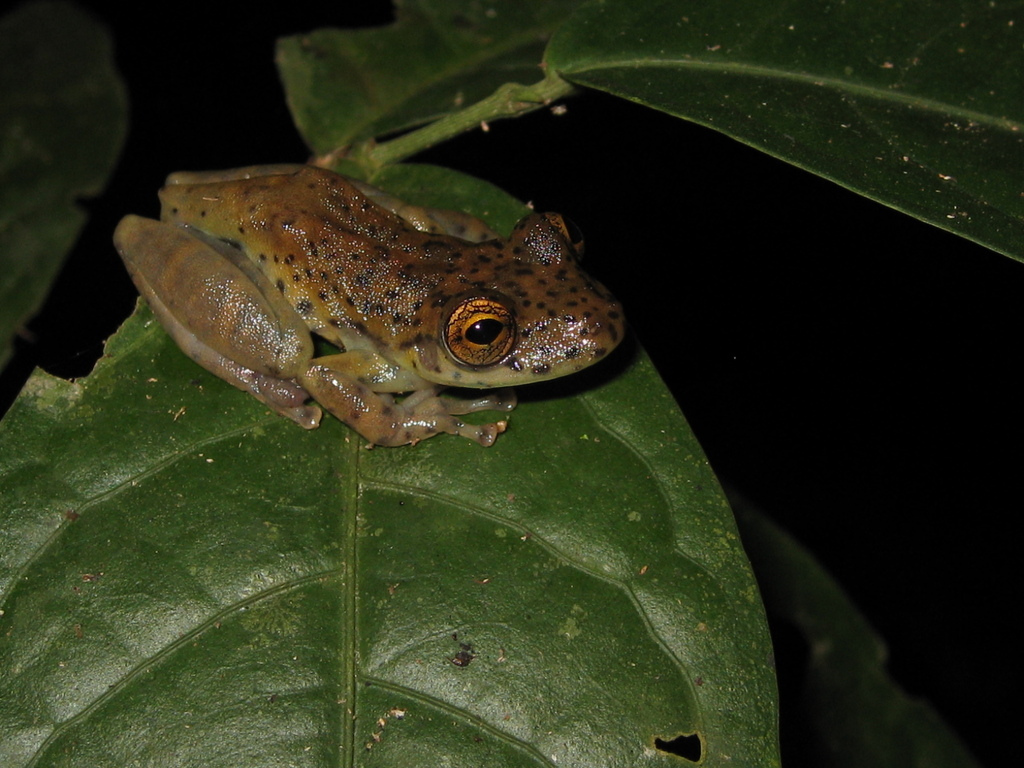
Jaguar Snouted Tree Frog
Scinax onca
Scinax onca (common name: jaguar snouted tree frog) is a species of frog in the family Hylidae. It is endemic to Brazil and known from the middle and southern parts of the Purus-Madeira interfluvial region in the Amazonas and Rondônia states. The specific name onca is derived from the local common name for jaguar (Pantera onca) and refers to the frog's blotchy color pattern; jaguars were also frequently spotted in the Purus–Madeira interfluvial region during the field work.
From the article Scinax onca on Wikipedia (CC BY-SA), quoted section by section
Description
Adult males measure 31–35 mm (1.2–1.4 in) and adult females 36–40 mm (1.4–1.6 in) in snout–vent length. The snout is truncate in dorsal view and bluntly rounded in lateral view. The tympanum is distinct and a supra-tympanic fold is present but weak. The canthus rostralis is rounded. The forelimbs are slender with long fingers that have narrow lateral fringes and bear horizontally expanded discs; toes II–IV hase basal webbing. The hind limbs are long. The toe discs are more rounded than the finger discs. The toes are moderately webbed. The holotype has light brown dorsal ground colour. There is a W-shaped mark between the eyes, an irregular dark brown spot in scapular region, a Λ-shaped mark in sacral region, and numerous randomly distributed round dark brown spots on the head and body. A dark brown canthal stripe extends to tip of snout and a dark brown supra-tympanic stripe extends from corner of eye to anterior region of flanks. The limbs have brown transverse bars. The belly is yellowish laterally and white medially and has some randomly distributed round dark brown spots. The iris is bright orange. Manipulation of specimens changes their coloration: individuals became darker and spots and blotches became more conspicuous. Males have a subgular, bilobate vocal sac. …
Range & habitat
Scinax onca is known from few lowland rainforest localities at elevations of 59–105 m (194–344 ft) above sea level. Breeding takes place during or after heavy rains at middle-sized or large temporary forest ponds. Males call from shrubs growing in water or next to water some 0.5–2 m (2–7 ft) above the ground. As of late 2017, the International Union for Conservation of Nature (IUCN) has not assessed this species, but Ferrão and colleagues suggest that is should be considered "data deficient". Reconstruction of the Trans-Amazonian Highway BR-319 and the associated immigration and deforestation represent serious potential threats to it. One population, however, occurs in the Tapauá State Forest, representing a refuge.
== References ==
Wikipedia: “Habitat and conservation”
Listen
Looking for field recordings…
Where it lives
Recorded sightings
—
geo-referenced records in GBIF, from museums, herbaria and field observers.
Drag the globe to turn it. Dots are where records exist, not a range map; darker means more records.
In the stacks
Searching the stacks…
Every page naming Scinax onca in the Biodiversity Heritage Library →
This page is assembled live from iNaturalist, GBIF, Wikipedia, the Source Library and the Internet Archive. It is not yet part of the hand-edited codex. iNaturalist taxon 604161.