- Animals
- ›Chordates
- ›Vertebrates
- ›Ray-finned Fishes
- ›Spiny-rayed fishes
- ›Puffers and Filefishes
- ›Pufferfishes, Porcupinefishes, and Molas
- ›Molas
- ›Mola
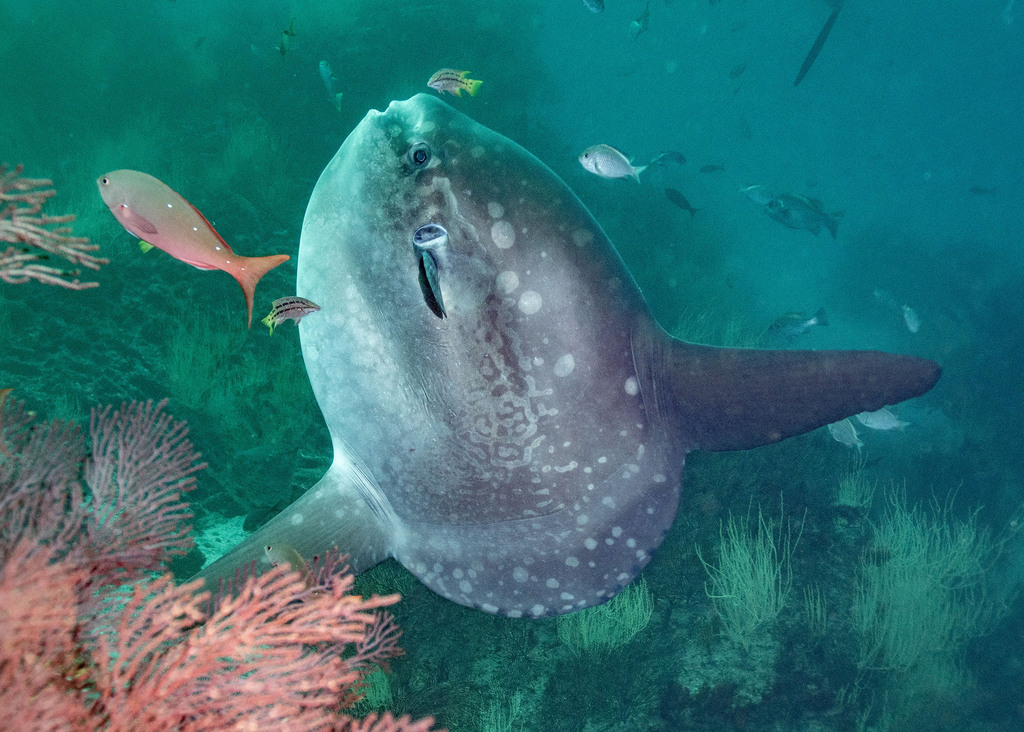
Bump-head Mola
Mola alexandrini
The giant sunfish or bumphead sunfish (Mola alexandrini), also known as the Ramsay's sunfish, southern sunfish, southern ocean sunfish, short sunfish or bump-head sunfish, is a fish belonging to the family Molidae. It is closely related to the more widely known Mola mola, and is found in the Southern Hemisphere. With a specimen found in the Azores in 2021 weighing 2744 kg (6049 lb), being by large the heaviest extant ray-finned fish in the world . It can be found basking on its side occasionally near the surface, which is thought to be used to re-heat itself after diving in cold water for prey, recharge its oxygen stores, and attract gulls to free itself of parasites.
From the article Giant sunfish on Wikipedia (CC BY-SA), quoted section by section
Description
Mola alexandrini has a relatively small mouth, and its teeth are fused into a parrot-like beak. It can reach up to 3.3 m (11 ft) in length and 2,700 kilograms (6,000 lb) in mass, making it the heaviest bony fish. Their bodies are flat and round, with large fins that they swish back and forth to propel themselves with as they swim horizontally. Their skin has rough denticles and a leathery texture, with brown and gray coloring with pale blotches; at death, their scales turn white. The body has a thick white subcutaneous gelatinous layer that is smooth to the touch, with a laterally compressed body covered in small rectangular scales. All mola species have no caudal bones, ribs, or pelvic fins, and have fused vertebrae, leaving only their median fins to propel themselves. Mola alexandrini can be distinguished from Mola mola by its smaller number of ossicles and lack of a vertical band of denticles at its base. In Mola, the lower jaws are intact while the upper jaws are slightly forked. On the head, the lateral lines have small, white, rounded otoconia. On the sides are small gill openings covered by a soft gill membrane and gill rakers, which are covered under a subcutaneous gelatinous layer. All fins are spineless and triangular. …
Range & habitat
Mola alexandrini has been found all over the globe and is widely distributed throughout the world's oceans, except for the polar regions. These species have been collected from waters off Japan, Taiwan, the Galapagos Islands, New Zealand, Australia, Turkey, Oman, and Spain. It can be found in the southwest Pacific, especially around Australia and New Zealand, and the southeast Pacific around Chile. Its range also extends to the southeast Atlantic near South Africa. During seasonal changes in climate on the Pacific side of Japan, M. alexandrini moves northwards in the summer and southwards in the winter. Seasonal migration is driven by temperature differences and productive frontal areas.
Wikipedia: “Distribution”
What it does
Sunfish spawn in the outer circulation of the temperate Atlantic and Pacific Oceans, as well as in the Mediterranean Sea. The optimal time for sunfish to spawn in the wild is not known, but research has shown that spawning in fall or winter, especially during the month of September, results in bigger fish. Fertilization occurs when sperm and eggs are shed in the water. Being that sunfish are so large, a single adult female can produce 300 million eggs. Unfertilized eggs were measured at 0.42-0.45 mm in diameter.
Wikipedia: “Reproduction”
Where it lives
Recorded sightings
—
geo-referenced records in GBIF, from museums, herbaria and field observers.
Drag the globe to turn it. Dots are where records exist, not a range map; darker means more records.
In the stacks
Searching the stacks…
Every page naming Mola alexandrini in the Biodiversity Heritage Library →
This page is assembled live from iNaturalist, GBIF, Wikipedia, the Source Library and the Internet Archive. It is not yet part of the hand-edited codex. iNaturalist taxon 604230.