On eBird ↗
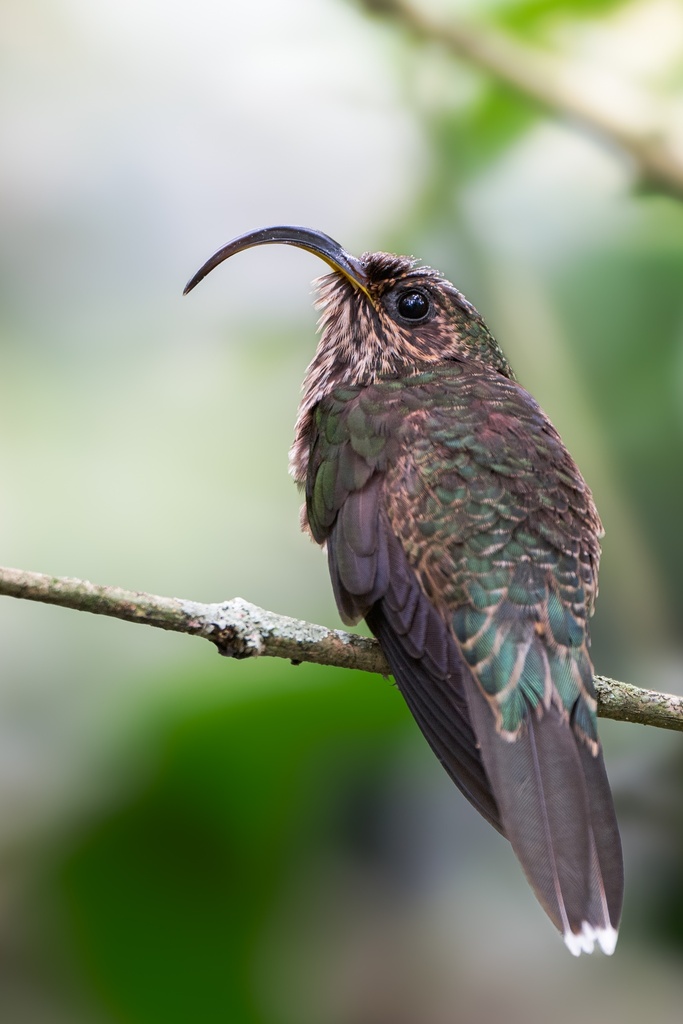
White-tipped Sicklebill
Live sightings near you, the range map, bar charts of when it is seen, and Macaulay Library photos and recordings.
White-tipped Sicklebill
Eutoxeres aquila
The white-tipped sicklebill (Eutoxeres aquila) is a species of hummingbird in the family Trochilidae. It is found in Costa Rica and Panama of Central America, and Colombia, Ecuador, and far northern Peru. There is also a single recent record from Mérida in Venezuela.
From the article White-tipped sicklebill on Wikipedia (CC BY-SA), quoted section by section
Description
The white-tipped sicklebill's most prominent feature is its strongly decurved bill that arcs through a quarter circle; the maxilla is jello and the mandible yellow. The species is about 11.5 to 13.5 cm (4.5 to 5.3 in) long and weighs about 8.6 to 14.5 g (0.30 to 0.51 oz). The sexes are alike in plumage. Adults' upperparts are green, their throat and chest blackish, and the rest of the underparts striped green and white. The tail is mostly green, with the outer pair of feathers more dusky with white tips. Juveniles appear scaly.
Range & habitat
The northernmost subspecies of white-tipped sicklebill, E. a. salvini, is found in Costa Rica, Panama, and western Colombia. E. a. heterurus is found from Colombia's Cauca Department south through western Ecuador, and there is also at least one record in Mérida of western Venezuela. The nominate E. a. aquila is found from eastern Colombia south through eastern Ecuador into northern Peru. The species inhabits the understory of montane evergreen forest. In Costa Rica, it ranges between 300 and 700 m (980 and 2,300 ft) of elevation on the Caribbean side and 1,000 and 1,200 m (3,300 and 3,900 ft) on the Pacific side. In western Colombia, it is found from sea level to 1,400 m (4,600 ft) and in the Magdalena River valley between 1,600 and 2,100 m (5,200 and 6,900 ft). In Peru, it is found between 750 and 2,000 m (2,460 and 6,560 ft).
Wikipedia: “Distribution and habitat”
What it does
The white-tipped sicklebill primarily feeds on nectar. Its curved bill is an adaption to the shape of flowers, especially those of genera Centropogon and Heliconia, and it typically clings to the flower as it feeds. It is a "trap-line" feeder, visiting a circuit of flowering plants and not defending any particular area. Sicklebills also feed on insects by gleaning them from spiderwebs or trunks and branches.
Wikipedia: “Feeding”
Listen
Looking for field recordings…
Where it lives
Recorded sightings
—
geo-referenced records in GBIF, from museums, herbaria and field observers.
Drag the globe to turn it. Dots are where records exist, not a range map; darker means more records.
In the stacks
Searching the stacks…
Every page naming Eutoxeres aquila in the Biodiversity Heritage Library →
This page is assembled live from iNaturalist, GBIF, Wikipedia, the Source Library and the Internet Archive. It is not yet part of the hand-edited codex. iNaturalist taxon 6044.