On eBird ↗
Australian Rufous Fantail
Live sightings near you, the range map, bar charts of when it is seen, and Macaulay Library photos and recordings.
Australian Rufous Fantail
Rhipidura rufifrons
The Australian rufous fantail (Rhipidura rufifrons) is a small passerine bird, most commonly known also as the black-breasted rufous-fantail or rufous-fronted fantail, which can be found in Australia.
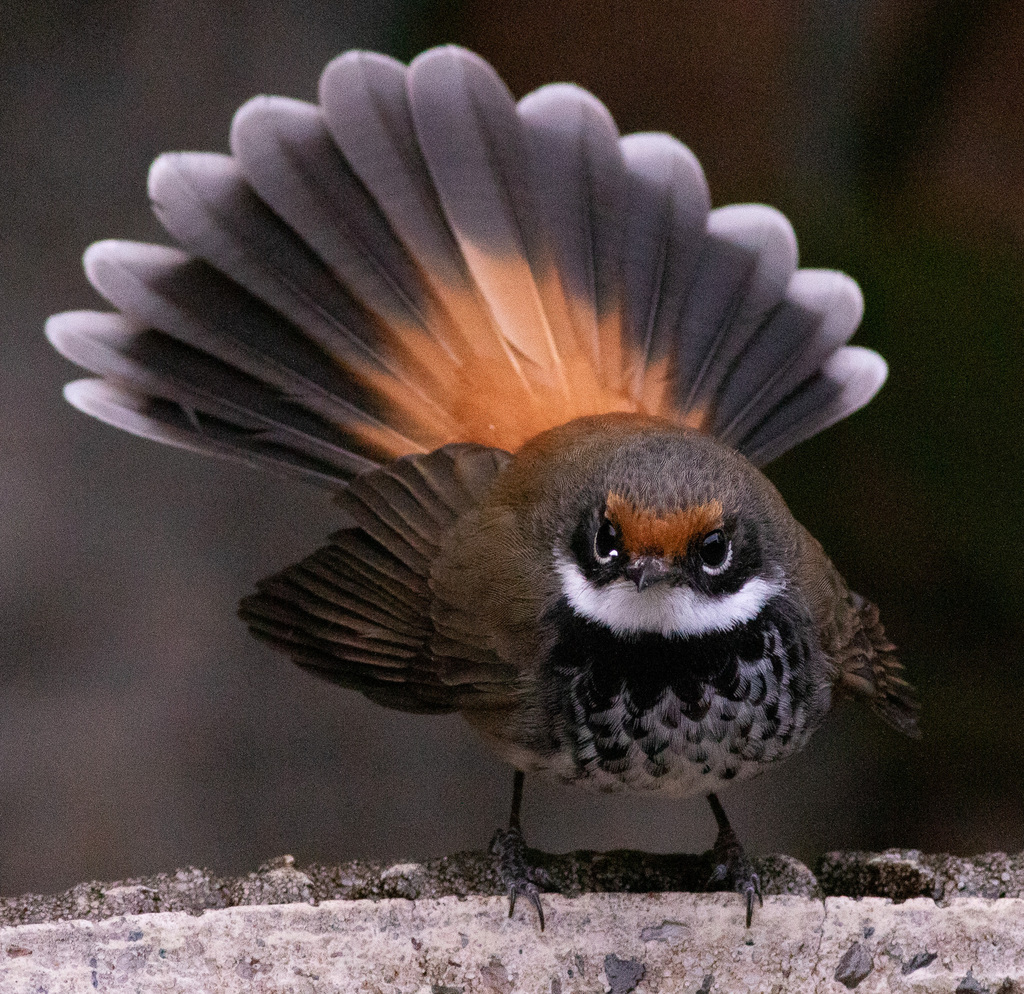
Characteristic of species that have a large range, the Australian rufous fantail has many subspecies. However the taxonomic treatment of its subspecies and other relatives is still debated. The Australian rufous fantail is easily distinguished by their orange-reddish-brown back, rump and base of tail. They have a black and white breast that grades into a white colour on the chin and throat.
From the article Australian rufous fantail on Wikipedia (CC BY-SA), quoted section by section
Description
Adults are medium-sized birds, generally ranging from 14.5 cm – 18.5 cm in length, averaging at around 15 cm; their wingspan is between 18 cm – 22.5 cm, averaging at around 21 cm. They weigh roughly 10 grams. The male and female of the species look identical. However, females are generally smaller than the males. The forehead is a richly reddish-brown colour across the eyes. The eyes have a white arc just below them. The top of the head, back of the neck and the upper back, transition from an olive to reddish-brown colour, which then blends into a blackish-brown, long, fan-shaped tail. This blackish-brown tail, contrasts with the base of the tail, which is tipped with a paler colour, often white. It has black ear-coverts (feathers over the ears, just below and behind the eyes). The throat is white (in most subspecies), and there is a black bar across the upper breast. Below this, the lower breast is off-white with black scale-like spots which transitions into an off-white colour towards the centre of the abdomen. The eyes, bill and feet of the bird are all a brown colour. The aforementioned colours do not change during different seasons. However, compared to the adults, the juveniles have generally duller coloured backs and marginally browner tails and underparts. …
Range & habitat
The Australian rufous fantail can be found in parts of Australia, southeast Asia, and in the Oceanic regions of Micronesia and Melanesia. They are residents of the Lesser Sunda Islands and the Maluku Islands of Indonesia, southern New Guinea and its associated islands, the Solomon Islands, the Marianas and the Carolinian island of Yap. In Australia, they are found in the northern and eastern coastal regions. Certain subspecies tend to be restricted to some ranges. See the subspecies section of this article for more detailed information.
Wikipedia: “Distribution”
What it does
Studies on Australian rufous fantail's social behaviour are sparse. Some observers have anecdotally described them as curious and trustful, whilst others depict them as shy creatures. However, there is consensus in that they are almost always portrayed as hyperactive, constantly on the move, fidgeting and waving a fanned-out tail. They are usually observed flitting about in the lower layers of their habitat, in close association with the shade, making short, frequent flights separated by brief moments of perching and sometimes hopping between foliage or onto the ground.
Breeding. When they are spotted, they are usually either on their own or in pairs. Although their social bonding is not well known, they nest in pairs and are thought to be monogamous. Males will produce vocal songs to both defend and advertise their territory. Sometimes this can result in intense, rapid and prolonged vocal "battles". After pairing, both will search for a suitable breeding site. The female has the final say on nest location. Some males have been known to feed their paired females for up to 2–3 weeks before and during the selection of the nest site and building of the nest. Their breeding sites are mainly in rainforest regions or sheltered, humid gullies with an abundance of dense cover such as trees, saplings, shrubs and vines. …
Wikipedia: “Behaviour and ecology”
In human culture
The Australian rufous fantail was first described by Latham in his 1801 work, Index Ornithologicus initially as Muscicapa rufifrons. It was later reclassified into the genus Rhipidura by Vigors and Horsfield. The Australian rufous fantail's scientific name is consequently Rhipidura rufifrons. Rhipidura is derived from Greek: ρϊπός (pronounced rhipido), meaning fan-like and οὐρά (pronounced oura), meaning tail. Rufifrons comes from two Latin words: rufus meaning red and frons meaning the forehead.
Wikipedia: “History of naming”
Listen
Looking for field recordings…
Where it lives
Recorded sightings
—
geo-referenced records in GBIF, from museums, herbaria and field observers.
Drag the globe to turn it. Dots are where records exist, not a range map; darker means more records.
In the stacks
Searching the stacks…
Every page naming Rhipidura rufifrons in the Biodiversity Heritage Library →
This page is assembled live from iNaturalist, GBIF, Wikipedia, the Source Library and the Internet Archive. It is not yet part of the hand-edited codex. iNaturalist taxon 604523.