- Animals
- ›Chordates
- ›Vertebrates
- ›Ray-finned Fishes
- ›Spiny-rayed fishes
- ›Cichlids and Allies
- ›Cichlids
- ›South and Central American Cichlids
- ›Satanoperca
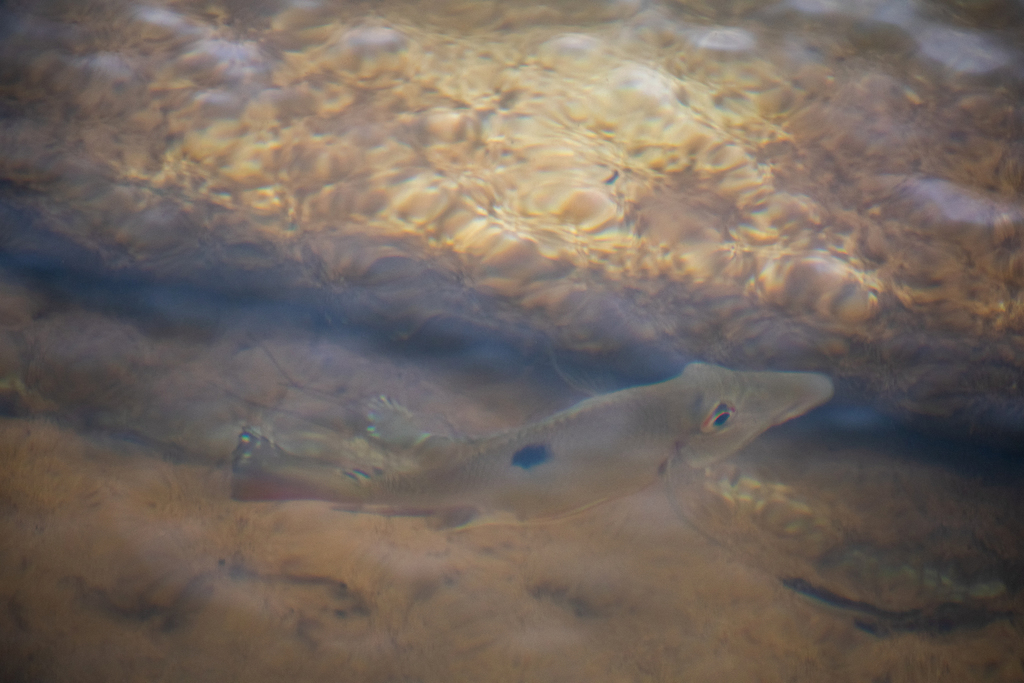
Satanoperca lilith
Satanoperca lilith, also known as the one-spotted eartheater or Lilith's eartheater, is a large species of eartheater cichlid endemic to blackwater rivers in Brazil, in the states of Amazonas, Pará, and Roraima. It is widely distributed throughout the northern Amazon basin.
From the article Satanoperca lilith on Wikipedia (CC BY-SA), quoted section by section
Description
Satanoperca lilith is one of the largest species in Satanoperca, on average measuring 14 cm (5.5 in) standard length (SL), with a maximum recorded length of 25.5 cm (10.0 in) SL. It is only exceeded in length by Satanoperca jurupari, which can grow up to 26 cm (10 in) SL. The easiest way of distinguishing Satanoperca lilith from related species is the presence of a single dark blotch on its flanks, which is situated on or above scales 11–13 of its lateral line. Satanoperca daemon has two, Satanoperca auticeps has three, and members of the Satanoperca jurupari group have none.
Range & habitat
Satanoperca lilith is native to blackwater rivers in the northern Amazon basin. Its native range extends from the Rio Japurá to the Trombetas River, and it has also been observed within the Rio Negro and Branco River basins. Due to its wide distribution, abundance throughout its range, and lack of significant threats to its survival, the IUCN Red List considers Satanoperca lilith to be a least concern species. Like other members of its genus, Satanoperca lilith is omnivorous, and will vary its diet and foraging strategies depending on seasonal variations in the water level of its environment. During the wet season, when water levels are high, Satanoperca lilith will mostly feed on aquatic insect larvae (such as larval flies, beetles, and caddisflies) and planktonic crustaceans (such as ostracods, water fleas, and clam shrimp) – roughly 65% of their dietary volume during this time will consist of arthropods alone, with only 8.6% of their diet consisting of plant matter (mostly fruits and seeds). The dry season corresponds with a marked shift in their diet from arthropods (now comprising just 28.3% of their diet) towards feeding on plant matter (now up to 27.3%, and mostly consisting of leaves). …
Wikipedia: “Habitat and ecology”
In human culture
The holotype specimen of this species, catalogued by the Museum of Zoology of the University of São Paulo's natural history collection as MZUSP 33003, was collected on October 6, 1979, in the Rio Negro drainage of Brazil. The generic name of this species, Satanoperca, is a portmanteau of Satan and perca (Latin for "perch"). The specific name is a matronym dedicated to Lilith, a female demon in Mesopotamian and Jewish folklore, and was given as an allusion to its close relationship with Satanoperca daemon. In Brazil, this species is commonly known as the acará bicudo, cará, cará-bicudo, and cará-pucu. Phylogenetic analysis indicates that the closest known relative of this species is Satanoperca daemon. Together with Satanoperca acuticeps, they form a morphologically distinct species group within the genus Satanoperca, characterized by the presence of a large, ocellated spot on the dorsal side of their caudal peduncle.
Wikipedia: “Taxonomy and etymology”
Where it lives
Recorded sightings
—
geo-referenced records in GBIF, from museums, herbaria and field observers.
Drag the globe to turn it. Dots are where records exist, not a range map; darker means more records.
In the stacks
Searching the stacks…
Every page naming Satanoperca lilith in the Biodiversity Heritage Library →
This page is assembled live from iNaturalist, GBIF, Wikipedia, the Source Library and the Internet Archive. It is not yet part of the hand-edited codex. iNaturalist taxon 604943.