- Animals
- ›Chordates
- ›Vertebrates
- ›Birds
- ›Rollers, Kingfishers, and Allies
- ›Kingfishers
- ›Tree Kingfishers
- ›Todiramphus
On eBird ↗
Tuamotu Kingfisher
Live sightings near you, the range map, bar charts of when it is seen, and Macaulay Library photos and recordings.
Tuamotu Kingfisher
Todiramphus gambieri
The Mangareva kingfisher (Todiramphus gambieri), also known as Tuamotu kingfisher, is a species of kingfisher in the family Alcedinidae, endemic to Niau in French Polynesia. It is classified as critically endangered.
From the article Mangareva kingfisher on Wikipedia (CC BY-SA), quoted section by section
Description
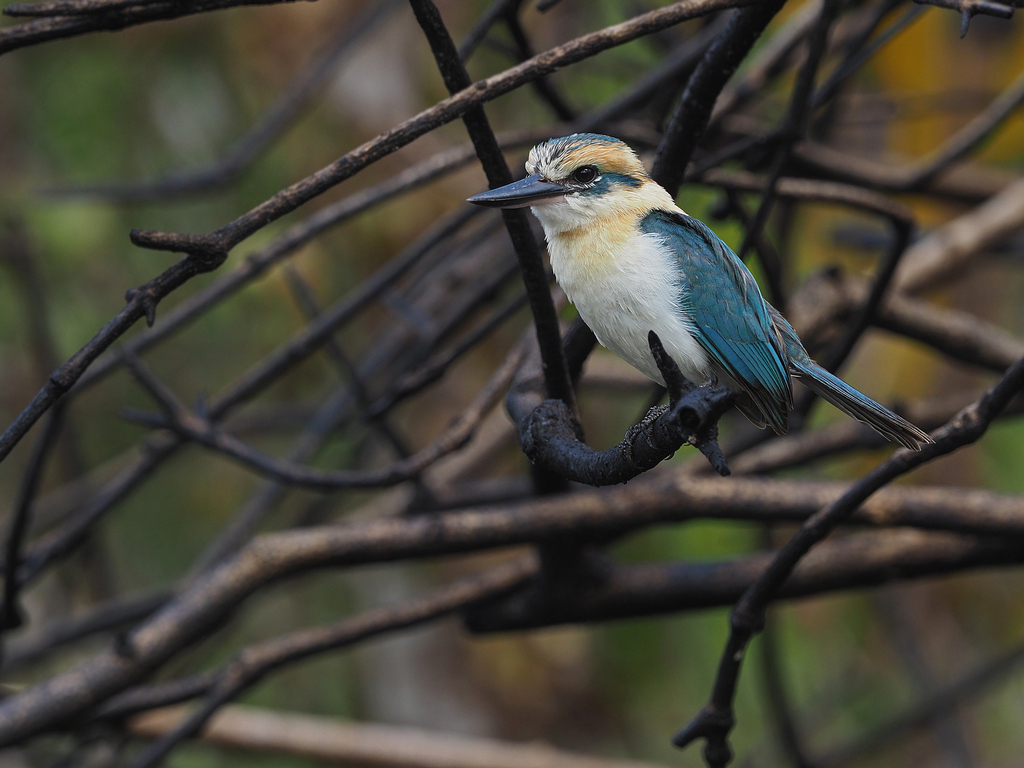
The Mangareva kingfisher has a cream-coloured head and neck, with blue ear-coverts, a white chin and frequently a rufous band across the breast. The crown has a variable amount of blue feathers. Mantle, back, rump, wings and tail are blue.
Range & habitat
The species only occurs on the island of Niau in the Tuamotus, French Polynesia. It prefers semi-open habitat, including coconut plantations, limestone forests, and cultivated areas around villages. Foraging may take place in wetlands and coastal areas.
Wikipedia: “Distribution and habitat”
What it does
Like many kingfishers, the Mangareva kingfisher is a terrestrial perch hunter. Hunting takes place from elevated positions, particularly in coconut plantations with open understory and exposed ground. The species takes insects and small lizards, the latter being the main food for chicks. Breeding takes place primarily from September to January in nest cavities excavated from dead and decaying coconut palms.
Wikipedia: “Ecology”
Listen
Looking for field recordings…
Where it lives
Recorded sightings
—
geo-referenced records in GBIF, from museums, herbaria and field observers.
Drag the globe to turn it. Dots are where records exist, not a range map; darker means more records.
In the stacks
Searching the stacks…
Every page naming Todiramphus gambieri in the Biodiversity Heritage Library →
This page is assembled live from iNaturalist, GBIF, Wikipedia, the Source Library and the Internet Archive. It is not yet part of the hand-edited codex. iNaturalist taxon 605468.