- Animals
- ›Chordates
- ›Vertebrates
- ›Birds
- ›Swifts and Hummingbirds
- ›Hummingbirds
- ›Brilliants, Coquettes, and Allies
- ›Brilliants and Allies
- ›Lafresnaya
On eBird ↗
Mountain Velvetbreast
Live sightings near you, the range map, bar charts of when it is seen, and Macaulay Library photos and recordings.
Mountain Velvetbreast
Lafresnaya lafresnayi
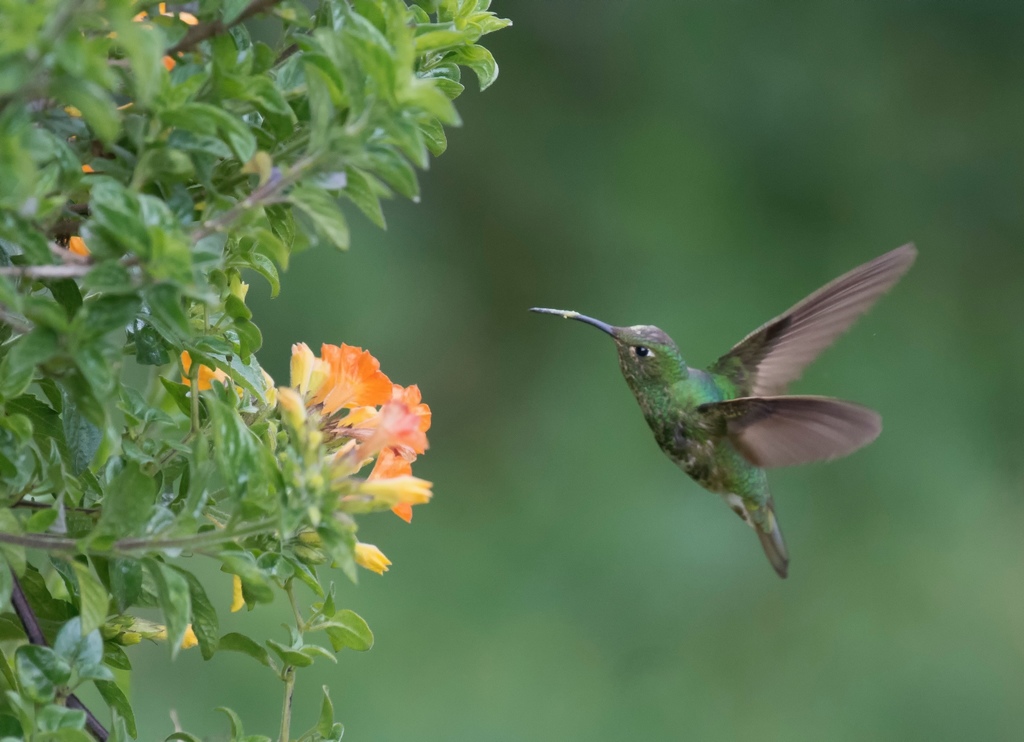
The mountain velvetbreast (Lafresnaya lafresnayi) is a species of hummingbird in the Trochilidae family. It is the only member of its genus. It is found in Colombia, Ecuador, Peru, and Venezuela. Its natural habitats are subtropical or tropical moist montane forests and heavily degraded former forest.
From the article Mountain velvetbreast on Wikipedia (CC BY-SA), quoted section by section
Description
The mountain velvetbreast is 11.5 to 12 cm (4.5 to 4.7 in) long including its 2.7 to 3.2 cm (1.1 to 1.3 in) bill. It weighs 4.5 to 6.3 g (0.16 to 0.22 oz). Males have a thin decurved black bill whose length and curvature vary among the subspecies. The female's bill is less curved than the male's and also varies geographically. All subspecies have a white spot behind the eye. Adult males of the nominate subspecies L. l. lafresnayi have grass green upperparts. Their throat and breast are iridescent emerald green and the belly velvet black. The central tail feathers are bronzy green and the rest buff with black tips. Adult females also have grass green upperparts. Their underparts are buff with iridescent green spots. Juveniles are similar to females but that males have the beginning of the black belly. Males of the other subspecies have whitish, not buff, outer tail feathers, and females have white underparts rather than the nominate's buff. Most of the subspecies have minor differences in bill length and curvature from the nominate, but that of subspecies L. l. saul is more decurved and that of L. l. orestes is even more decurved. The most recently described subspecies, L. l. longirostris, has the longest bill of all, though its curvature is only slightly more than that of the nominate. The subspecies also differ somewhat in plumage. L. l. …
Range & habitat
The subspecies of mountain velvetbreast are found thus:
L. l. liriope, the isolated Sierra Nevada de Santa Marta in northern Colombia L. l. longirostris, the northern part of Colombia's Central Andes L. l. greenewalti, the western Venezuelan states of Trujillo, Mérida, and Táchira L. l. lafresnayi, extreme southwestern Andes of Venezuela and Colombia's Eastern Andes L. l. saul, from the Andes of southwestern Colombia south through Ecuador into extreme northern Peru L. l. orestes, the east slope of the northern Peruvian Andes south of the Marañón River L. l. rectirostris, the Andes of northern and central Peru The mountain velvetbreast primarily inhabits the edges of humid montane forest and also shrubby slopes, though it uncommonly occurs within the forest. In elevation it generally ranges from 1,800 to 3,400 m (5,900 to 11,200 ft) and is most numerous between 2,000 to 2,800 m (6,600 to 9,200 ft). In Ecuador it is regularly found up to 3,500 m (11,500 ft) and locally as high as 3,700 m (12,100 ft).
Wikipedia: “Distribution and habitat”
What it does
The mountain velvetbreast feeds on nectar from a variety of plants that have long tubular flowers; those of genus Siphocampylus seem to be especially favored. Males defend feeding territories but females forage by trap-lining, visiting a circuit of feeding sites. Both sexes also capture small arthropods by gleaning from foliage and by hawking.
Wikipedia: “Feeding”
Listen
Looking for field recordings…
Where it lives
Recorded sightings
—
geo-referenced records in GBIF, from museums, herbaria and field observers.
Drag the globe to turn it. Dots are where records exist, not a range map; darker means more records.
In the stacks
Searching the stacks…
Every page naming Lafresnaya lafresnayi in the Biodiversity Heritage Library →
This page is assembled live from iNaturalist, GBIF, Wikipedia, the Source Library and the Internet Archive. It is not yet part of the hand-edited codex. iNaturalist taxon 6056.