- Animals
- ›Chordates
- ›Vertebrates
- ›Ray-finned Fishes
- ›Spiny-rayed fishes
- ›Perches, Scorpionfishes, Sticklebacks, and Allies
- ›Eelpouts and allies
- ›Wolffishes
- ›Anarrhichthys
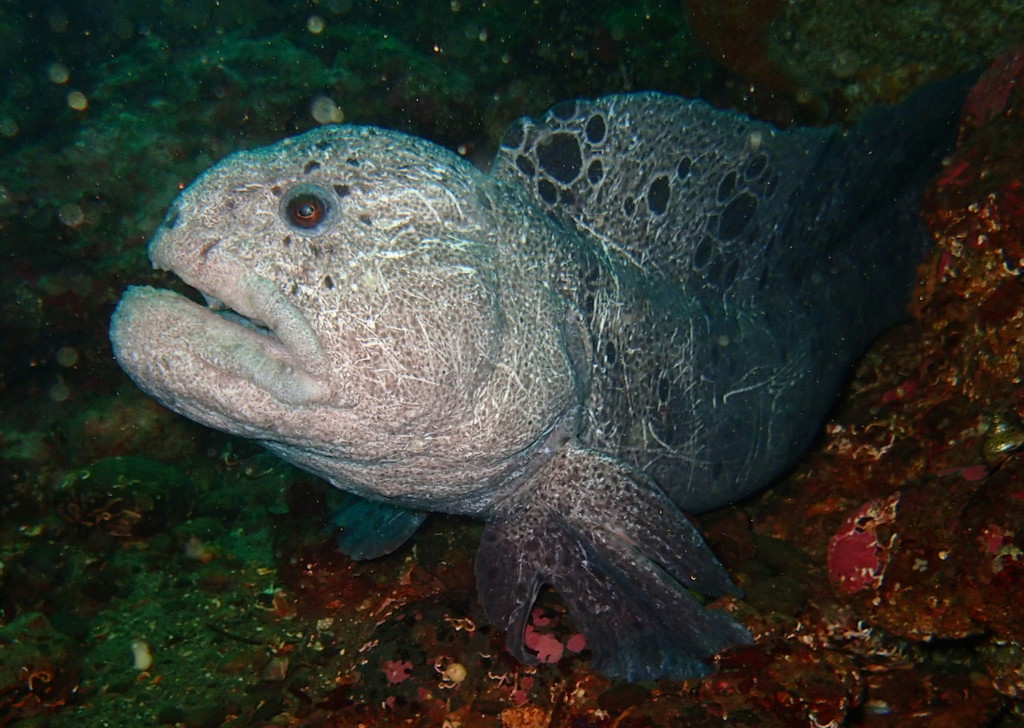
Wolf Eel
Anarrhichthys ocellatus
The wolf eel (Anarrhichthys ocellatus) is a species of marine ray-finned fish belonging to the family Anarhichadidae, the wolf fish. It is found in the North Pacific Ocean. Despite its common name and resemblance, it is not a true eel. It is the only species in the monotypic genus Anarrhichthys.
From the article Wolf eel on Wikipedia (CC BY-SA), quoted section by section
Description
A. ocellatus differs from true eels, as they have paired gill slits and pectoral fins. The animal can grow up to 2.4 m (7 ft 10 in) in length and 18.4 kg (41 lb) in weight. Younger wolf eels are orange with big dark spots in the posterior part of the body. Once older they turn grey, brown greyish or dark olive. They possess powerful jaws with which they crush their prey: canine teeth in the front and molars in the posterior portion of the mouth. In the anal fin, it has no rays and 233 radials. It only has one dorsal fin, that extends from the head to the end of the body, with 228 to 250 flexible fishbones without soft radius. The caudal fin is small. It has no pelvic fins, nor a lateral line. Males have large lips and a protuberance on the superior part of the head. The lifespan of this species is about 20 years.
Range & habitat
A. ocellatus is found in caves, crevices and rocky reefs from shallow waters to a depth of 226 m (741 ft), ranging from the Sea of Japan and the Bering Sea to Northern California.
Wikipedia: “Distribution”
What it does
Wolf eels have a monogamous relationship and tend to mate for life and live in the same cave. They reproduce from October until the end of winter, beginning when they are around seven years old. The male places his head against the female's abdomen and wraps around her, while she extrudes the eggs, up to 10,000 at a time, which he then fertilizes. She coils around the eggs, using her body to shape the eggs into a neat sphere, roughly the size of a grapefruit. The male then coils around her. Together they protect the eggs, and only one leaves the cave at a time, to feed. The eggs hatch after 91 to 112 days, and during this period, in order to ensure their oxygenation, the female circulates water around the eggs and periodically massages and rotates the eggs as they develop.
Wikipedia: “Reproduction”
At the table
The wolf eel has edible, sweet and savory white flesh. In some coastal northwest Native American tribes, the wolf eel was referred to as the sacred "doctorfish". Only the tribal healers were allowed to eat this fish, as it was supposed to enhance their healing powers.
Wikipedia: “As food”
In human culture
The wolf eel's genus name Anarrhichthys combines the wolffish genus Anarhichas, as this taxon has a similar head shape to the wolffishes, and ichthys, which means "fish". The specific name ocellatus means "ocellated", a reference to the eye-like spots, or ocelli, on the dorsal fin and body.
Wikipedia: “Etymology”
Where it lives
Recorded sightings
—
geo-referenced records in GBIF, from museums, herbaria and field observers.
Drag the globe to turn it. Dots are where records exist, not a range map; darker means more records.
In the stacks
Searching the stacks…
Every page naming Anarrhichthys ocellatus in the Biodiversity Heritage Library →
This page is assembled live from iNaturalist, GBIF, Wikipedia, the Source Library and the Internet Archive. It is not yet part of the hand-edited codex. iNaturalist taxon 60635.