- Animals
- ›Chordates
- ›Vertebrates
- ›Reptiles
- ›Snakes and Lizards
- ›Lizards
- ›Wall lizards, amphisbaenians, and allies
- ›Whiptails and Tegus
- ›Whiptails and Ameivas
- ›Pholidoscelis
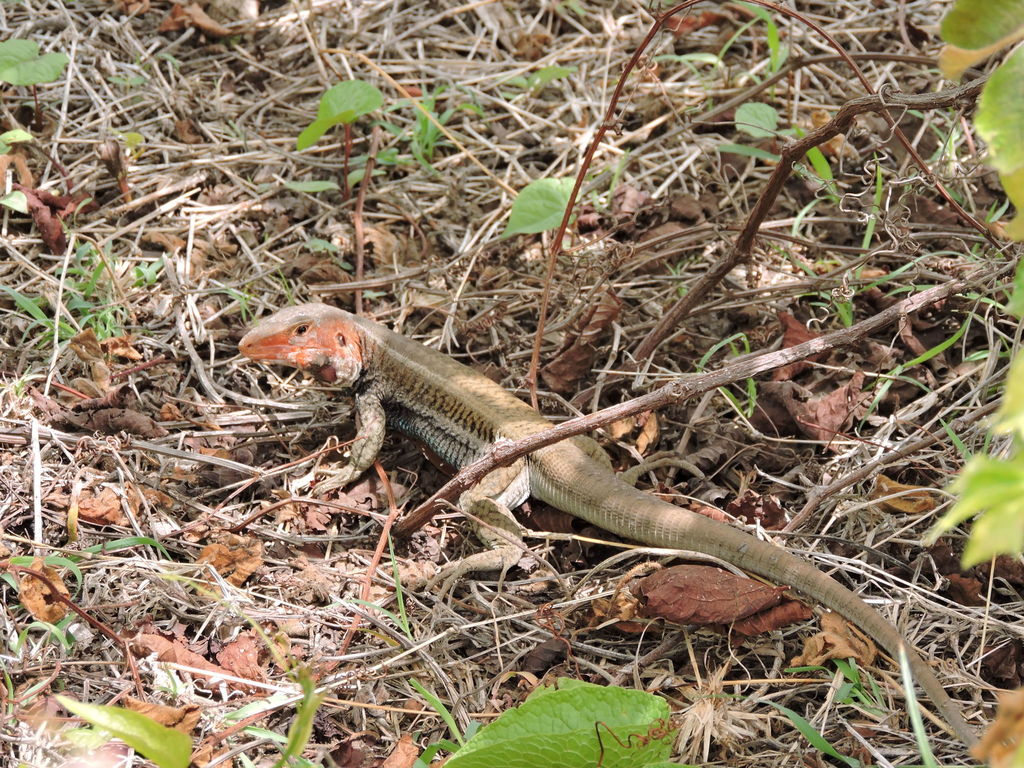
St. Christopher Ameiva
Pholidoscelis erythrocephalus
The St. Christopher ameiva (Pholidoscelis erythrocephalus), also known as the orange-faced whiptail, orange-tailed ameiva or red-tailed ground lizard, is a species of lizard belonging to the family Teiidae, which includes the whiptails and related species. This lizard is found on the Caribbean island of Sint Eustatius, and on Saint Kitts and Nevis, where it is scarcer.
From the article St. Christopher ameiva on Wikipedia (CC BY-SA), quoted section by section
Description
The St Christopher ameiva has a maximum snout-vent length of 140 mm (5.5 in) in males and 103 mm (4.1 in) in females. The back and sides have a dark olive green background colour with darker vermiculations, darkest on the sides. The head is also dark olive green, but as the lizard grows this becomes progessively redder: there is a small area of pink on the snout of juveniles, but in larger specimens the red colour extends to behind the ears. The chin and throat are white, frequently showing some orange tint, and the underside is white. The juveniles also have four thin cream stripes, two on the back and one on each side, but these fade as the individual grows. There are rows of blue scales along the lower sides in the larger adults; in large males this blue extends onto the upper parts of the legs.
Range & habitat
The St Christopher ameiva is endemic to the islands of the Saint Christopher Bank. it is abundant on Sint Eustatius but is only locally common on St Kitts and Nevis, possibly due to predation by the introduced Small Indian mongoose (Urva auropunctata) on these islands. It can be found in forests, parks and gardens.
== References ==
Wikipedia: “Distribution and habitat”
Where it lives
Recorded sightings
—
geo-referenced records in GBIF, from museums, herbaria and field observers.
Drag the globe to turn it. Dots are where records exist, not a range map; darker means more records.
In the stacks
This page is assembled live from iNaturalist, GBIF, Wikipedia, the Source Library and the Internet Archive. It is not yet part of the hand-edited codex. iNaturalist taxon 606390.