- Animals
- ›Chordates
- ›Vertebrates
- ›Reptiles
- ›Snakes and Lizards
- ›Snakes
- ›Colubrid Snakes
- ›Colubrine Snakes
- ›Salvadora
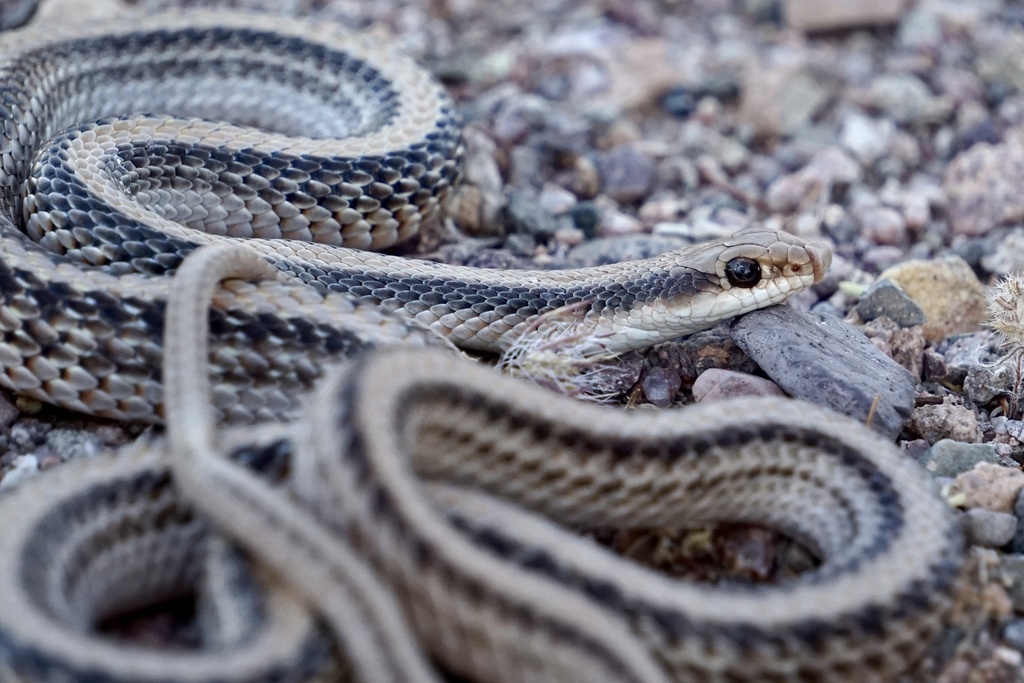
Western Patch-nosed Snake
Salvadora hexalepis
Salvadora hexalepis, the western patch-nosed snake, is a species of non-venomous colubrid snake, which is endemic to the southwestern United States and northern Mexico.
From the article Salvadora hexalepis on Wikipedia (CC BY-SA), quoted section by section
Description
Adults of Salvadora hexalepis are, on average, 20-46 inches (51–117 cm) in total length; the record total length is 58 in (150 cm). They have a distinctive, thick scale curved back over the top of the snout, and free at the edges. All subspecies are yellowish with blackish lateral stripes in various arrangements. The dorsal scales are smooth, and the anal plate is divided.
Range & habitat
It is found in the southwestern United States in the states of Arizona, southern California, Nevada, southern New Mexico, and southwestern Texas. It is also found in northern Mexico in the Mexican states of Baja California, Baja California Sur, Chihuahua, Sinaloa, and Sonora.
Wikipedia: “Geographic range”
What it does
The western patch-nosed snake inhabits arid deserts in its area. It feeds upon lizards, snakes, reptile eggs, and small rodents.
Wikipedia: “Behavior”
Where it lives
Recorded sightings
—
geo-referenced records in GBIF, from museums, herbaria and field observers.
Drag the globe to turn it. Dots are where records exist, not a range map; darker means more records.
In the stacks
Searching the stacks…
Every page naming Salvadora hexalepis in the Biodiversity Heritage Library →
This page is assembled live from iNaturalist, GBIF, Wikipedia, the Source Library and the Internet Archive. It is not yet part of the hand-edited codex. iNaturalist taxon 606618.