- Animals
- ›Chordates
- ›Vertebrates
- ›Cartilaginous Fishes
- ›Sharks and Rays
- ›Rays
- ›Shovelnose Rays
- ›Guitarfishes
- ›Pseudobatos
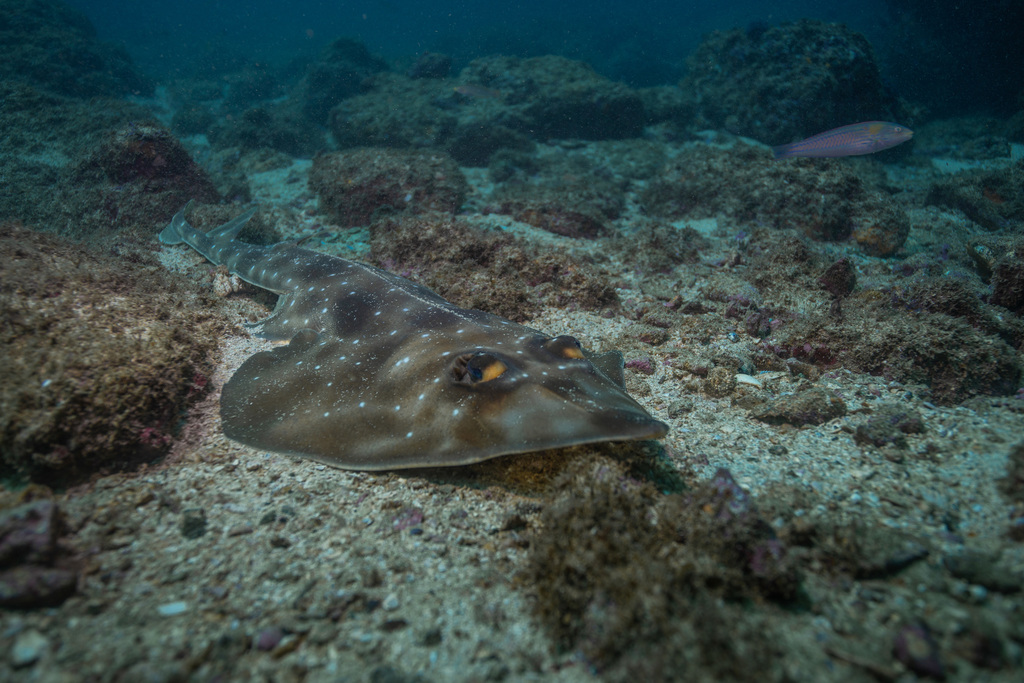
Gorgona Guitarfish
Pseudobatos prahli
Pseudobatos prahli, also known by its common name Gorgona guitarfish is a species from the genus Pseudobatos. It is distinguished from other members of the genus by its coloration and rostral cartilages, and is native to the eastern Pacific Ocean.
From the article Pseudobatos prahli on Wikipedia (CC BY-SA), quoted section by section
Range & habitat
Typically, guitarfish are found in temperate to coastal regions, often in areas of food insecurity and high fishing demands, further putting stress on the group. The family Pseudobatos lives on both sides of the American continent (Eastern Pacific and Western Atlantic), while P. prahli lives in the Eastern Pacific Ocean. The first observance of this species was in the Columbian Pacific, and its range is from northern Peru all the way to the southernmost coast of the Baja peninsula. However, the Gorgana Guitarfish has been under-researched, so it is unknown if the range is patchy or continuous. They dwell on the bottom of the ocean floor, in sandy, slightly rocky areas, around 18–24 m in depth, but have been found in much shallower depths, at 3–4 m. Contrasting this, some believe that they spend most of their time in depths deeper than 60m, since the species has not been reported in trawl nets at depths of 5–62 m. More study should be done on this species to understand what depths it typically inhabits. One explanation for this could be migratory behavior caused by Tehuano winds, which has been observed in other rays. …
Wikipedia: “Distribution”
In human culture
Pseudobatos prahli lives in shallow water, and is often incidentally caught in shrimp trawling nets. They have been observed semipburied in sand at the ocean floor, as show in the photo below. The Pseudobatos genus tends to be a generalist in diet, and typically consumes benthic invertebrates like snails and small, pelagic fish
While it could be due to fishing in the area, one interesting fact about the gorgona guitarfish is the possible sex segregation behavior. Frequent among elasmobranchs, females are primarily found in one area, and males are found in another. The Rhinobatidae, the family of guitarfish, partake in matrotrophy through uterine milk, where the embryo feeds on yolk and then indirect absorption of other fluids, supplemented by the mother. P. prahli females are larger than males when sexual maturity is reached, have a gestation period of 12 months, and give live birth around March. Their offspring are estimated to be 22.5 cm long, but the individuals in that particular study were smaller than average, and so average offspring may be bigger.
Wikipedia: “Life History”
Where it lives
Recorded sightings
—
geo-referenced records in GBIF, from museums, herbaria and field observers.
Drag the globe to turn it. Dots are where records exist, not a range map; darker means more records.
In the stacks
Searching the stacks…
Every page naming Pseudobatos prahli in the Biodiversity Heritage Library →
This page is assembled live from iNaturalist, GBIF, Wikipedia, the Source Library and the Internet Archive. It is not yet part of the hand-edited codex. iNaturalist taxon 607509.