- Animals
- ›Chordates
- ›Vertebrates
- ›Ray-finned Fishes
- ›Carps, Characins, Catfishes and Allies
- ›Characins
- ›Characoidei
- ›Toothed Headstanders
- ›Slender Headstanders
- ›Synaptolaemus
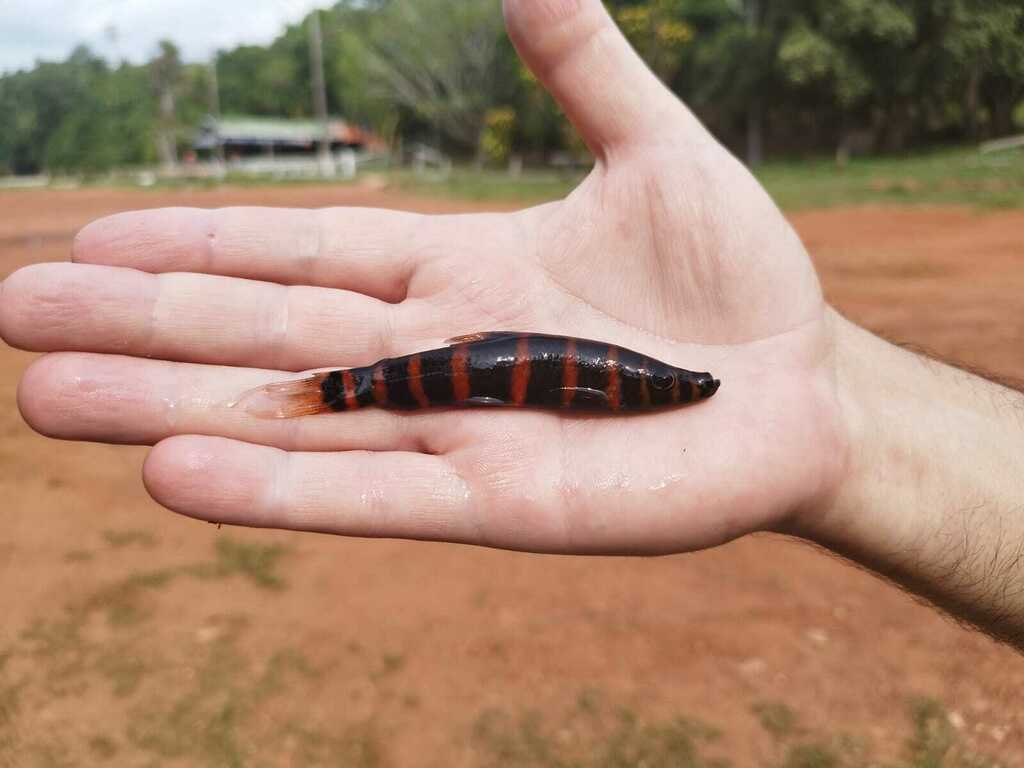
Red Banded Leporinus
Synaptolaemus latofasciatus
Synaptolaemus is a monospecific genus of freshwater ray-finned fish belonging to the family Anostomidae, the toothed headstanders. The only species in the genus is Synaptolaemus latofasciatus, a species found in South America.
From the article Synaptolaemus on Wikipedia (CC BY-SA), quoted section by section
Description
Synaptolaemus is distinguished from other toothed headstanders by having teeth at the symphysis of the lower jaw which are roughly twice as long as they are wide and in the gill membranes having a broad union with the throat. The lower jaw has a width of half its length and is almost vertical when the mouth is closed. The colour pattern consists of vertical bands of orange or yellow alternating with dark brown or black bands which extend below the lateral line and run along the whole body. This species has a maximum standard length of 9.4 cm (3.7 in).
Range & habitat
Synaptolaemus is found in the Orinoco and Amazon basins of Brazil, Colombia and Venezuela. Its occurrence in Guyana or Suriname has yet to be confirmed. It is found in rapids with rocky bottoms in both black and clear waters.
== References ==
Wikipedia: “Distribution and habitat”
In human culture
Synaptolaemus is a combination of the Greek words synaptós, which means "joined together" or "united", with laimós, meaning "throat", an allusion to the wide merging of the gill membranes with the throat. The specific name is a combination of the Latin latus, meaning "wide", with fasciatus, which means "banded", and reference to the yellow and black banded pattern of this fish.
Wikipedia: “Etymology”
Where it lives
Recorded sightings
—
geo-referenced records in GBIF, from museums, herbaria and field observers.
Drag the globe to turn it. Dots are where records exist, not a range map; darker means more records.
In the stacks
Searching the stacks…
Every page naming Synaptolaemus latofasciatus in the Biodiversity Heritage Library →
This page is assembled live from iNaturalist, GBIF, Wikipedia, the Source Library and the Internet Archive. It is not yet part of the hand-edited codex. iNaturalist taxon 608221.