- Animals
- ›Chordates
- ›Vertebrates
- ›Ray-finned Fishes
- ›Spiny-rayed fishes
- ›Anglerfishes
- ›Frogfishes
- ›Fibonacci frogfishes
- ›Nudiantennarius
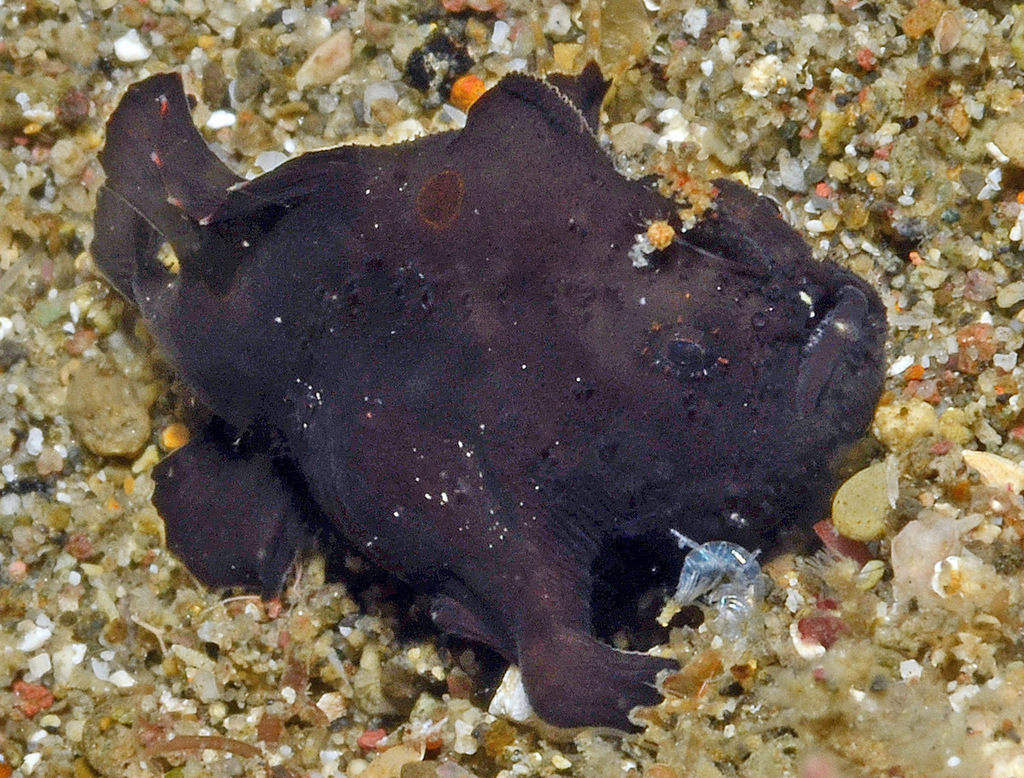
Nudiantennarius subteres
Nudiantennarius subteres, the deep-water frogfish, is a species of frogfish found in the Pacific Ocean around the Philippines and Indonesia. They occur at depths of 64 to 90 metres (210 to 295 ft). This species grows to a length of 7.5 centimetres (3.0 in) SL. This species is the only known member of its genus.
From the article Nudiantennarius on Wikipedia (CC BY-SA), quoted section by section
Description
Nudiantennarius is distinguished from other frogfishes by the reduced number of spinules in the skin: the skin has only a partial covering of bifurcate dermal spinules, so few that the body has the appearance of being naked in comparison to other frogfish. The spinules are each no longer than the distance between their tips. The first dorsal spine, or illicium, has a distinct esca, or lure, and is naked without spinules. The illicium is around half the length of the second dorsal spine which is unusually long in comparison to other frogfishes; it is slender and is not connected to the skin of the head by a posterior membrane. The lobe of the pectoral fin is thin and is somewhat separated from the sides. This species has a caudal peduncle and the rear margins of the dorsal and anal fins are clearly attached to the just in front of the outer rays of the caudal fin. The dorsal fin has 12 soft rays while the anal fin has 7. There is typically at least one large ocellus on the base of the dorsal fin. The esca is small and round, has short filaments and fits into a thin groove beside the second dorsal spine. The deepwater frogfish has a maximum published standard length of 7.5 cm (3.0 in).
Range & habitat
Nudiantennarius is found in the Western Pacific Ocean in the Philippines and Indonesia, and off Japan, inhabiting depths between 3 and 128 m (9.8 and 419.9 ft). This species is usually encountered on substrates of brown or black sand, silt or mud, where there may be some soft coral or gorgonians and sponges, but with very few hard coral. The deepwater frogfish has also been found on pier pilings and rarely among small patches of seaweed. Other records have come from areas dominated by leaf litter and refuse, particularly in areas near human habitation. Others have been recorded in habitats mainly made up of very coarse sand or fine coral rubble, with a few hard corals and gorgonians. In this habitat there were many small cephalopods, numerous decapods and other crustaceans, and a variety of fishes, largely consisting of juveniles of small species of shark, burrowing snake eels, along with numerous species of scorpionfishes and waspfishes such as Rhinopias eschmeyeri and R. frondosa. At another site this species and the striated frogfish (Antennarius striatus were observed on coarse sand and rubble covered slopes with scatterred encrusting sponges, hydroids and litter covered in organic growth.
Wikipedia: “Distribution and habitat”
In human culture
Nudiantennarius is a combination of the words nudus, meaning "nude" or "naked", with the genus name Antennarius, the type genus of the frogfish family, Antennariidae. This is a references to the seemingly naked skin; members of the species only have a scattering of spinules (small denticles) embedded in the skin on the head and body. The specific name, subteres, prefixes teres, which means "cylindrical" or "tapering", as in the English word terete, with sub, meaning "less than". The authors did not explain what this was referring to but it is thought to be alluding to the shape of the body.
Wikipedia: “Etymology”
Where it lives
Recorded sightings
—
geo-referenced records in GBIF, from museums, herbaria and field observers.
Drag the globe to turn it. Dots are where records exist, not a range map; darker means more records.
In the stacks
Searching the stacks…
Every page naming Nudiantennarius subteres in the Biodiversity Heritage Library →
This page is assembled live from iNaturalist, GBIF, Wikipedia, the Source Library and the Internet Archive. It is not yet part of the hand-edited codex. iNaturalist taxon 608233.