- Animals
- ›Chordates
- ›Vertebrates
- ›Birds
- ›Swifts and Hummingbirds
- ›Hummingbirds
- ›Bee Hummingbirds, Emeralds, Mountain-gems, and Allies
- ›Emerald Hummingbirds and Allies
- ›Chlorostilbon
On eBird ↗
Red-billed Emerald
Live sightings near you, the range map, bar charts of when it is seen, and Macaulay Library photos and recordings.
Red-billed Emerald
Chlorostilbon gibsoni
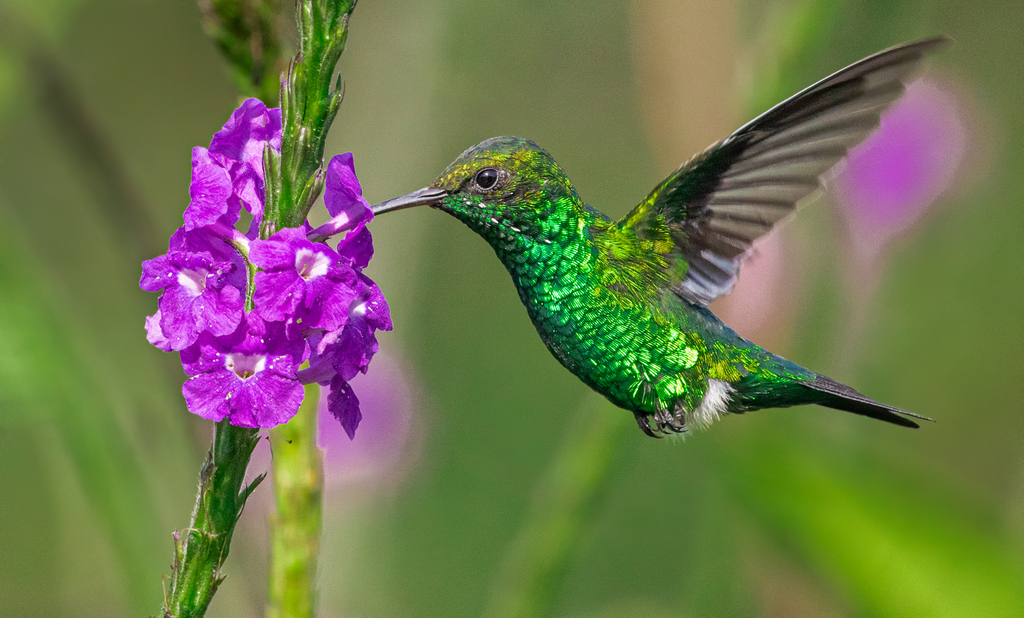
The red-billed emerald (Chlorostilbon gibsoni) is a species of hummingbird in the Trochilidae family. Formerly it was considered as part of the species C. mellisugus, blue-tailed emerald. As considered here, it does not include C. melanorhynchus, (western emerald), of west Colombia and Ecuador, which is sometimes considered conspecific.
From the article Red-billed emerald on Wikipedia (CC BY-SA), quoted section by section
Description
The red-billed emerald is 7.6 to 9 cm (3.0 to 3.5 in) long and weighs about 2.8 g (0.099 oz). The males of all three subspecies have a straight bill with a mostly red mandible. The females' mandibles are red at the base. The bills are about 1.3 cm (0.51 in) long. Males of the nominate subspecies have dark bronze-green upperparts and a deeply forked blue-black tail. Their faces and underparts are glittering green to golden green. Nominate females are shining green above and plain gray below with dusky cheeks and a short white line behind the eye. Their central tail feathers are dark blue-green and the rest dark green with dusky ends and narrow gray-white tips. Subspecies C. g. chrysogaster is larger than the other two subspecies. The male is mostly malachite green; its tail is slightly bluer and more deeply forked than the others'. C. g. nitens is very like the nominate, but with a slight gold sheen and a less deeply forked tail.
Range & habitat
The nominate subspecies of red-billed emerald is found in central Colombia's Magdalena River valley. C. g. chrysogaster is found in northern Colombia between Córdoba and Norte de Santander departments. C. g. nitens is found on Colombia's Guajira Peninsula and adjoining northwestern Venezuela. The species mostly inhabits dry to arid landscapes including desert scrublands, dry woodland, farmed areas, and parks and gardens. In Colombia it is mostly found at elevations below 500 m (1,600 ft) but does occur as high as 2,300 m (7,500 ft) in the upper Magdalena valley. In Venezuela it has been recorded up to 1,300 m (4,300 ft).
Wikipedia: “Distribution and habitat”
What it does
The red-billed emerald forages for nectar by trap-lining, visiting a circuit of flowering trees, shrubs, and other plants. It usually feeds close to the ground, though sometimes higher, and on small flowers that are less attractive to larger hummingbirds. It is assumed to also feed on small insects.
Wikipedia: “Feeding”
Listen
Looking for field recordings…
Where it lives
Recorded sightings
—
geo-referenced records in GBIF, from museums, herbaria and field observers.
Drag the globe to turn it. Dots are where records exist, not a range map; darker means more records.
In the stacks
Searching the stacks…
Every page naming Chlorostilbon gibsoni in the Biodiversity Heritage Library →
This page is assembled live from iNaturalist, GBIF, Wikipedia, the Source Library and the Internet Archive. It is not yet part of the hand-edited codex. iNaturalist taxon 6111.