- Animals
- ›Chordates
- ›Vertebrates
- ›Ray-finned Fishes
- ›Spiny-rayed fishes
- ›Cichlids and Allies
- ›Cichlids
- ›South and Central American Cichlids
- ›Apistogramma
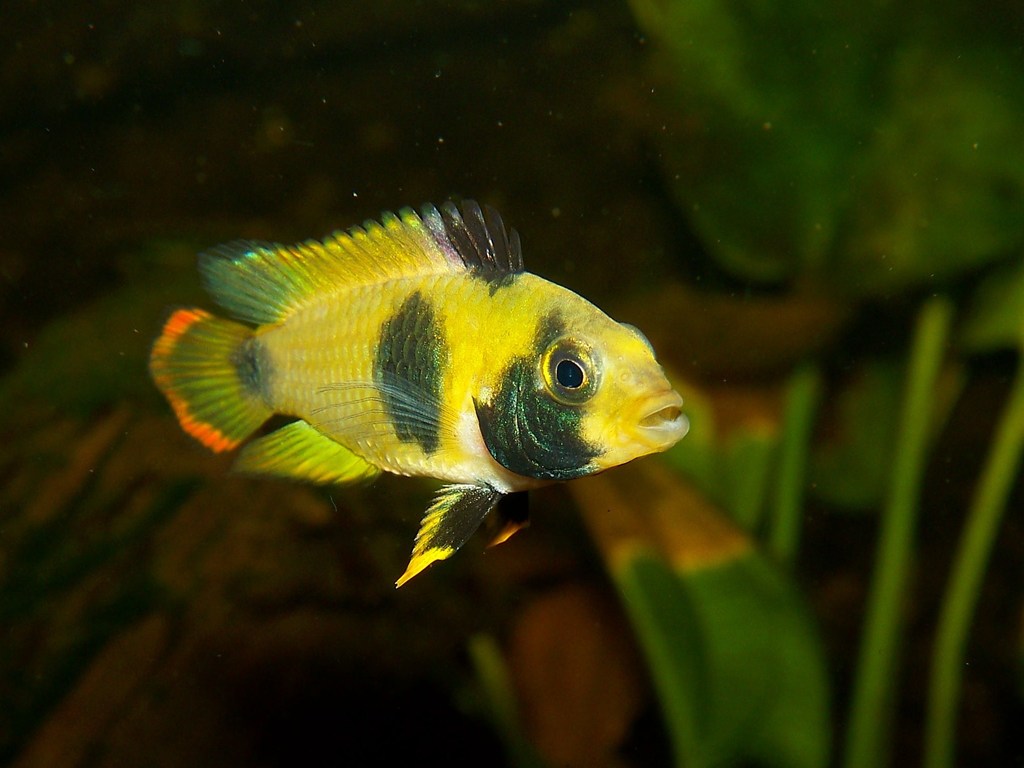
Panda Dwarf Cichlid
Apistogramma nijsseni
Apistogramma nijsseni is a species of cichlid fish, endemic to highly restricted local black water habitats in the Quebrada Carahuayte, a small stream in the Ucayali River drainage, southern Peru. The male reaches a maximum length of 8 cm (3 in), the female remaining somewhat smaller. Apistogramma brooding females assume a bright yellow and black aposematic coloring: in A. nijsseni, unusually, a healthy, unstressed female retains this coloring. The species is popular aquarium fish amongst dwarf cichlid hobbyists,...
From the article Apistogramma nijsseni on Wikipedia (CC BY-SA), quoted section by section
Description
Apistogramma nijsseni is a member of the A. nijsseni species group. This group comprises relatively large species of dwarf cichlid. They have moderately deep, robust and laterally compressed bodies. Their heads are comparatively large, with well-developed jaws and fleshy lips. They have dark brachiostegial membranes which they spread in displays to increase the apparent size of the head. The males have dorsal fins which may be low through to high with deep serrations. The tips of the soft rayed portions of the dorsal and anal fins are soft and blunt. When guarding eggs, the females develop large dark patches on the opercula, sides or abdomen, which may be mirrored in males, although it is often concealed under a blue sheen on the body. The band along the sides is typically not visible except in juveniles. The caudal fin for most species is round, but some are lyre-tailed or have two tips to the caudal fin. Many species develop a red or orange coloured band on the upper and lower margins of the caudal fin. A. nijsseni has a maximum standard length of 3.9 cm (1.5 in).
Range & habitat
Apistogramma nijsseni is endemic to Peru, where the holotype was collected from the Copal River, in Jenaro Herrera, Ucayali river system, Loreto, where it is found in slow flowing Blackwater rivers.
Wikipedia: “Distribution and habitat”
In human culture
Apistogramma nijsseni is classified within the genus Apistogramma. This name combines the Greek apistos, meaning "inconstant", with gramme, which means "line". Charles Tate Regan, who proposed this genus in 1913, did not explain what this alluded to. It is thought that it may refer to the variable development of the lateral line which primarily consists of pored scales. The specific name honours the Dutch ichthyologist Han Nijssen of the Zoölogisch Museum Amsterdam, who wrote many papers about South American fishes, as well as bringing the species to Kullander's attention.
Wikipedia: “Etymology”
Where it lives
Recorded sightings
—
geo-referenced records in GBIF, from museums, herbaria and field observers.
Drag the globe to turn it. Dots are where records exist, not a range map; darker means more records.
In the stacks
Searching the stacks…
Every page naming Apistogramma nijsseni in the Biodiversity Heritage Library →
This page is assembled live from iNaturalist, GBIF, Wikipedia, the Source Library and the Internet Archive. It is not yet part of the hand-edited codex. iNaturalist taxon 611245.