- Animals
- ›Chordates
- ›Vertebrates
- ›Birds
- ›Swifts and Hummingbirds
- ›Hummingbirds
- ›Bee Hummingbirds, Emeralds, Mountain-gems, and Allies
- ›Emerald Hummingbirds and Allies
- ›Chlorostilbon
On eBird ↗
Green-tailed Emerald
Live sightings near you, the range map, bar charts of when it is seen, and Macaulay Library photos and recordings.
Green-tailed Emerald
Chlorostilbon alice
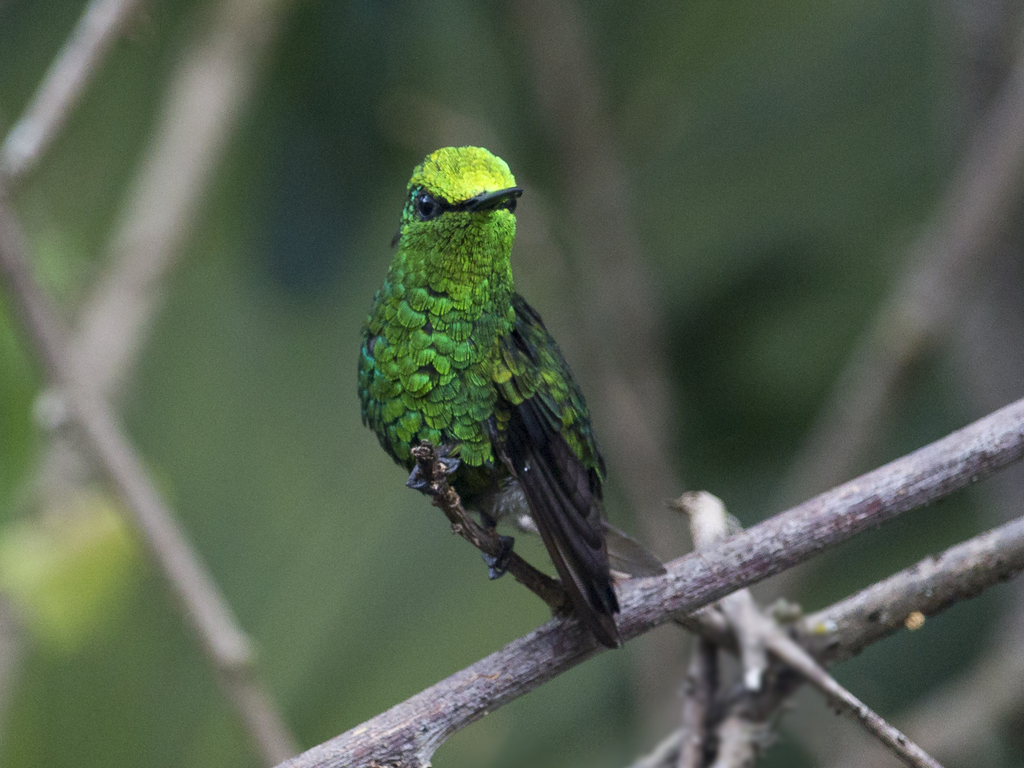
The green-tailed emerald (Chlorostilbon alice) is a species of hummingbird in the family Trochilidae. It is found only in Venezuela. Its natural habitats are subtropical or tropical moist lowland forests, subtropical or tropical moist montane forests, and heavily degraded former forest.
From the article Green-tailed emerald on Wikipedia (CC BY-SA), quoted section by section
Description
The male green-tailed emerald is 7.5 to 8.5 cm (3.0 to 3.3 in) long and females 6.5 to 7.5 cm (2.6 to 3.0 in). The species weighs between 3 and 4 g (0.11 and 0.14 oz). Both sexes have a short, straight, black bill. The male's forehead and crown are shining dark green, its upperparts bronzy green, its tail glittering bronze-green, and its underparts grass green. The female's upperparts are like the male's. It has a white line behind the eye. Its underparts are pale grayish and the undertail coverts are dark gray. Its central tail feathers are green and the rest have green bases with black near the end and grayish tips. Immature birds resemble the female with buffy fringes on the feathers of the head.
Range & habitat
The green-tailed emerald is endemic to northern Venezuela, from Falcón south to Lara and Sucre and east to Monagas. It inhabits the semi-open edges of a variety of forest types including semi-humid rainforest, cloudforest, secondary forest, plantations, and sometimes dry forest. In elevation it ranges between 700 and 1,800 m (2,300 and 5,900 ft).
Wikipedia: “Distribution and habitat”
What it does
The green-tailed emerald uses a variety of foraging strategies to feed on nectar. It uses trap-lining at low-quality sources and "steals" nectar from richer sources in other hummingbird's territories. Males sometimes defend nectar-rich feeding territories. The species forages fairly low in the vegetation, usually between 1 and 6 m (3 and 20 ft) above the ground, and seeks nectar at a variety of flowering plants and shrubs. In addition to nectar, it also feeds on small insects captured by hawking from a perch.
Wikipedia: “Feeding”
Listen
Looking for field recordings…
Where it lives
Recorded sightings
—
geo-referenced records in GBIF, from museums, herbaria and field observers.
Drag the globe to turn it. Dots are where records exist, not a range map; darker means more records.
In the stacks
Searching the stacks…
Every page naming Chlorostilbon alice in the Biodiversity Heritage Library →
This page is assembled live from iNaturalist, GBIF, Wikipedia, the Source Library and the Internet Archive. It is not yet part of the hand-edited codex. iNaturalist taxon 6120.